Part Two: let’s play war
© Melina Magdalena
I understand things at a simple level. I’ve never been good at arguing for argument’s sake. I see no point in talk-fests that prove nothing and achieve even less.
Why not listen to both sides and come up with a set of solutions that overcome the perceived problems and make it possible to work together for the future?
In the world of stage-managed warfare, why not send our youngsters out to be trained up, achieve qualifications and kill civilians?
If they join up, they get money, training and job security which more than fee-paying universities and technical colleges can offer them. Our youngsters are in less danger as soldiers, than the citizens of the nation-states Australia sends them to protect.
Engaging in war is the drama queen’s technique for grabbing attention. Whether she slaps her rival across the face or steals her understudy’s costume, there is no justification for bombing the shit out of a city or country in order to prove one’s political point.
Such behaviour does nothing but create enmity, hatred, bitterness and grief which can lead only to more destruction and terror.
And the world sits back and watches in smug horror. At least it’s them and not us.
And our leaders say nothing, if not to outright condone the terrors perpetrated by nation-states against one another.
“We have a right,” they say, “to defend ourselves in the war on terror. We have a right to pre-empt the terrors that others are intending to perpetrate on us. If we don’t defend ourselves, no one will. Staging an offensive against our terrorist enemies is the responsible thing to do.”
There is no end to the cycle of terror, when we live in a culture that worships fear as a means of control and manipulation.
Ask yourself – what are you afraid of, and why?
- - - - - - - - - - - - - - - - - - - - - - - - - - - - - - - - - - - - - - - - - -
Imagine that someone decided to bomb the highways, runways and railway lines that connect Adelaide to the other cities of Australia. We can hear them talking …
“What about the power stations – we’d better cut off their power and telecommunications, too. And just for good measure, let’s poison their water supply.”
Why would anyone do that? What would it prove? What could it achieve? I put the same question to you.
Taking a cue from Israel; isn’t that what Australia should do to the good old US of A? Aren’t they are holding one of our citizens hostage in Guantanamo Bay?
How dare they? We’re not in a war situation, are we? Oh that’s right – we’re all in this together, this war on terror. But technically, we’re allies. And besides, the USA has nuclear capability. It’s probably not such a wise move to start taking out their power stations and highways, so let’s just ignore the USA’s terror tactics.
I suppose we wouldn’t all die. Some of us have been hoarding food stocks and fresh water supplies for years, in case of tribulation. Some of us don’t live right in the vicinity of mobile phone towers. Backyard rainwater tanks and vegetable patches would probably save a few. But it wouldn’t be long before families were forced to defend their patches against marauding hungry have-nots who were hapless enough to depend on the stock market to preserve their wealth, and bought big, ugly, cold houses in paved low maintenance garden-free zones.
It wouldn’t be easy to learn to murder those in order to defend our own, but we’d get there, or die in the attempt. It’s all about survival of the fittest, after all.
Imagine that we got ourselves back on our feet, buried our dead (mostly women and children) and began to repair the infrastructure that enabled our communities to thrive. Australians are resourceful. We have plenty of resources for export, so why not re-route some of them to Adelaide, to get us back on track?
Then, just as we’re beginning to breathe freely again, when hospital staff can take stock of their situations and begin to plan how to treat the thousands of less-severe casualties who have missed out on treatment in the meantime, it happens again.
The planes and helicopters fly over while we’re busy minding our own businesses. Submarines just rise up one day in the Port River. Who do they belong to? The dolphins are all dead – we didn’t listen to them anyway. Missiles appear out of nowhere. We see our wives and uncles blown to pieces in the street. A bomb falls on the university – did it miss its target? No actually, the university WAS the target. Our enemy has heard that the professors are teaching our children to rise up against them. We’ve reached a critical point in our learning when we’re able to say – that bomb didn’t just ‘drop’ – it was thrown at us deliberately.
We’re a little smarter this time. We made it look as though we were repairing the same highways we had before, but we were also building a tunnel to Olympic Dam. They’ll never bomb that – they need our uranium. The riff raff of Adelaide are fleeing underground. What’s left of us is getting out as fast as our legs can carry us - by trailer, on foot, by bicycle – desperation is the mother of all invention, and we’ve got no petrol left.
We’ve set up a refugee camp at Roxby Downs. It doesn’t matter that food supplies have to be flown in from elsewhere. We’re used now, to going hungry and thirsty. The kids have learned that it’s no use complaining. Someone will look after us and make sure we don’t get massacred in the millions. What would be the point in killing us anyway? We’ve got nothing left, that anybody else would want. Surely someone in the world cares?
God must have saved us for some reason.
- - - - - - - - - - - - - - - - - - - - - - - - - - - - - - - - - - - - - - - - - - - -
So let’s dig up the past. Let’s uncover that shallow grave. Let’s look a little deeper than the topsoil. Let’s get real. Let’s seek the heart of the matter and discover the naked truth.
War achieves power only for the greedy and destroys the lives of the innocent millions. War continues a cycle that humanity ought to have outgrown by now. The trauma of those who survive far outweighs the grief for those who die. In some ways, it’s harder to survive. Humans are not actually dependent for our survival, on warfare to lubricate the machinery of capitalism.
Have you lost your connection to what is real in this world?
Here’s a reminder:
• Every human being comes helpless into this world and depends on the kindness of others to raise it to adulthood.
• Everybody lives and dies.
• No human being is of more worth than another.
• We all need food and water and shelter and education and healthcare and love.
• We all come from families and communities whose aim is to nurture and grow.
• All the food we eat was grown somewhere, by someone in the world.
• If storms and warfare destroy the crops, there will be nothing for us to buy in the shops.
• All the water we drink is part of the Earth’s great reservoir that is cycled again and again and again, enabling life to continue.
• Even wealthy westerners are susceptible to starvation and disease.
• Bombs and landmines kill.
• Like war, nuclear power is dangerous for children, animals, plants and people and all living things.
WE’RE ALL IN THIS TOGETHER.
Saturday, July 15, 2006


Stage Managed Offensive (part one)
Part One: leadership squabble
© Melina Magdalena
Big news this week in Australia: John Howard and Peter Costello’s battle for supremacy. Did anyone else notice how little passion either of these men expressed for his position, his party, his nation; his people?
I had a conversation with a friend yesterday who was describing the kind of blank-faced beige bureaucrats who govern us. They have not a smidgeon of character, and are shape-changing creatures who magically alter their facial expressions, stance and opinions to suit whatever occasion presents itself.
However, let’s not ignore their undeniable skills at the art of distraction and media manipulation.
The polls are not favouring dear John just now, and why should they be?
- - - - - - - - - - - - - - - - - - - - - - - - - - - - - - - - - - - - - - - - -
“Hey Peter – “Let’s play dirty and grab some media attention by acting out in front of the millions of Australians whose lives have been negatively affected by our policies.”
“What a good idea, John! The joke will definitely be on them, if we twist it a little. We’ve got to somehow convince them that politicians don’t lie.”
“The best way to do that is if you accuse me of lying. Then I’ll prove I didn’t.”
Do you believe him?
- - - - - - - - - - - - - - - - - - - - - - - - - - - - - - - - - - - - - - - - -
My teenagers are good at the same thing. I suppose they learned it from me, in the earliest years of their lives. I honed my skills at the art of distraction during the hours spent waiting for and riding on buses around Adelaide.
I’ve seen my kids band together and create a scene over the most petty and trivial of issues (for example which placemat they get to use at the table, when all the placemats came from the same identical set).
The effectiveness of this technique lies in the fact that I am momentarily distracted from whatever was preoccupying me at the time. My kids do it to jolt me out of distress. They pick up on my distress, become distressed in turn, and act out, in order to put me back on track.
Oh – and Australia needs a nuclear power industry like I need a hole in the head.
GET REAL, FOLKS!
© Melina Magdalena
Big news this week in Australia: John Howard and Peter Costello’s battle for supremacy. Did anyone else notice how little passion either of these men expressed for his position, his party, his nation; his people?
I had a conversation with a friend yesterday who was describing the kind of blank-faced beige bureaucrats who govern us. They have not a smidgeon of character, and are shape-changing creatures who magically alter their facial expressions, stance and opinions to suit whatever occasion presents itself.
However, let’s not ignore their undeniable skills at the art of distraction and media manipulation.
The polls are not favouring dear John just now, and why should they be?
- - - - - - - - - - - - - - - - - - - - - - - - - - - - - - - - - - - - - - - - -
“Hey Peter – “Let’s play dirty and grab some media attention by acting out in front of the millions of Australians whose lives have been negatively affected by our policies.”
“What a good idea, John! The joke will definitely be on them, if we twist it a little. We’ve got to somehow convince them that politicians don’t lie.”
“The best way to do that is if you accuse me of lying. Then I’ll prove I didn’t.”
Do you believe him?
- - - - - - - - - - - - - - - - - - - - - - - - - - - - - - - - - - - - - - - - -
My teenagers are good at the same thing. I suppose they learned it from me, in the earliest years of their lives. I honed my skills at the art of distraction during the hours spent waiting for and riding on buses around Adelaide.
I’ve seen my kids band together and create a scene over the most petty and trivial of issues (for example which placemat they get to use at the table, when all the placemats came from the same identical set).
The effectiveness of this technique lies in the fact that I am momentarily distracted from whatever was preoccupying me at the time. My kids do it to jolt me out of distress. They pick up on my distress, become distressed in turn, and act out, in order to put me back on track.
Oh – and Australia needs a nuclear power industry like I need a hole in the head.
GET REAL, FOLKS!
Saturday, July 08, 2006
Another Side of Normal (2)
Living with PTSD - Bleeding
© Melina Magdalena 2006
Once upon a time, it was unthinkable for someone to survive rape. Of course, women survived, but it was kept a shameful, silent secret. A woman who was known to have been raped, was automatically labelled “victim” and treated as a worthless used up slag who would have been better off dead.
Rape is considered to be one of the worst things that can be done to a person. In our legal systems, to be charged with the offence of rape is supposed to be equivalent to being charged with murder. Like murder, the crime of rape has suffered from linguistic filtering and legal permutations so that circumstances can be twisted to diminish the legal seriousness of whatever act is alleged to have taken place between a perpetrator and a victim.
One of the things that really got to me when the man who raped me was being fed through the legal machine, was the way in which my experience was assumed by the Court to be known and understood. In my Victim Impact Statement, I wrote at length about the many ways in which being raped had affected my life and impacted on my ability to function as a woman and a mother.
By this time, I myself had already been fed once through the legal machinery when I applied for Victim’s Compensation a year or two before. The police had no idea who had broken into my home and raped me, and as there seemed to be little possibility the man would ever be brought to any kind of justice, I applied for compensation and was eventually awarded a small sum of money which improved my opportunities and quality of life. It enabled me, for example, to purchase a second-hand computer and printer, to get my driver’s license and a car. These are things I may never have attained as a single mother on a pension. They enabled me to pursue my studies and my writing, and gradually, to become less home-bound.
As part of my application for Victims of Crime compensation, I experienced a baffling interview with a legally-appointed psychologist. Baffling, because she judged that the impact on me of having a strange man break into my home in the middle of the night and threaten to kill me and my children unless I allowed him to rape me was minimal, since this occurred just a few months after I had fled my marriage, while I was still also having to cope with the legal ramifications of custody battles and the Family Court, not to mention the Magistrate’s Court, which I had to attend when my ex-husband opposed the imposition of a Summary Protection Order against him, nor the stresses of bringing up two very small children alone, with no income support save the pension.
I am so glad that this is all behind me now, thirteen years later.
However, I remain bemused by my memories of this interview, years of counselling sessions, and the construction of my Victim Impact Statement. In particular, the physical aftermath of being raped is something I still feel is ignored and is widely misunderstood.
This is not the first time that I’ve tried to write about this, and I think I understand where part of the difficulty lies for me. While following media reports of the inquest into the death of Dianne Brimble aboard a cruise ship in 2002, I’ve talked to a number of survivors abut why the men who filmed each other raping her as she died of a drug overdose of the date rape drug ‘fantasy’ were never charged with rape. Their cabins were cleared of all evidence before the police could board the ship and commence their investigations. The video footage and violated body of Dianne Brimble are all that remain as evidence of what happened to her. This doesn’t seem to have provided sufficient evidence of wrongdoing.
Today when I logged into my email, I saw articles on the web about the reduction in the sentences that some gang-rapists in Sydney had received. I looked at the article and my eye was caught by one particular line “In sentencing the men in 2004, Justice Michael Finnane said the victim had the worst injuries he had seen in his 35-year legal career - requiring surgery to her genitalia after the attack.”
There was a section in the Victim Impact Statement form which asked me to describe the pain and physical injuries that I had suffered as a result of the crime. I distinctly recall feeling inhibited about what “physical injury” meant in my case. I was still in the process then, of getting angry about the many times I had felt coerced during my marriage, into having sexual intercourse when I really didn’t want to. With my limited and traumatic range of sexual experience, my confusion is understandable.
Like many people, I suppose I had felt as though rape perhaps wasn’t as bad if it only involved penile penetration of the vagina, as it has whenever I had been raped. Since that is the same as sexual intercourse, had I any right to claim that I had been physically injured through this act? And what of pain? Had it hurt at the time? I made myself numb, believing I was about to be killed. There are areas on my breasts that are still ice cold, parts of my body that I cannot bear to have touched, where that rapist touched them.
I found out later that some of the women who were also raped by the man who raped me, had suffered greater physical insult to their genitalia and other parts of their bodies. My understanding however, of the effect of sexual assault, is that the emotional effects and trauma that is induced can be of as great severity whether the actual assault consists of physical penetrations, mutilations, verbal harassment and anything in between.
The only kind of thing I felt justified in writing in my Victim Impact Statement was the bruising I had suffered on various parts of my body that was photographed as evidence of the attack on me, and my fear that I had contracted a sexually transmitted disease from the man who raped me.
Thirteen years after being raped, I can tell you with confidence that the physical trauma continues and has not improved. Furthermore, the trauma is not recognized as such by the medical establishment, and there is no treatment for it. Whenever I raise my physical problems with doctors, I am told that my experiences lie within the range of normal. There is nothing for me to be concerned about. Perhaps I am unlucky, but it’s just something I have to live with unless I want to have a hysterectomy. (Not bloody likely.)
I once presented my doctor with a list of physical symptoms which I wanted to address with her. She asked me whether I thought I might be depressed. (She wasn’t the first, and probably won’t be the last to take refuge in the panacea of the antidepressant.) I go to see a different doctor now, but she has not been able to help, either. I allow her to invade my body every two-and-a-half years and give me the required pap smear, and I get her to monitor my iron and thyroxin levels.
I have been tested for fibroids on numerous occasions. I have the levels of various hormones and minerals in my blood checked over and over again. I took myself to the Women’s and Children’s Hospital one evening, a few years ago, fearing that this time I might really die of blood loss. They sent me home again and told me to buy super-sized sanitary pads. In all these years, it has only my iron levels that have shown consistent stress and depletion. I’ve been blessed with good health, and cursed by the ignorance and apathy of doctors.
The idea of a link between body, mind and spirit is something I’m familiar with. Perhaps the system between these aspects of self is too complex to manage in any useful manner? The body is an amazingly complex network of interdependent systems. It’s obvious to me, that as a result of being raped, something in the systems of my body has been knocked permanently off balance. It doesn’t help to tell myself that I am causing my own symptoms, or that if I chose to think in a different way, the symptoms would necessarily resolve themselves. It doesn’t help to think that if I chose not to label my symptoms as dis-ease, I would therefore no longer suffer them as distressing.
Every three or four weeks, my body launches an all-out assault upon me. I feel as though my insides are fighting to become my outsides. Several days before my period actually begins, I fall into a deep and suicidal depression for a day. This black day affects me no matter what else is going on in my life at the time. It’s only dangerous when life is not going reasonably well. From experience, I know to keep my thoughts to myself. I reassure myself that it will pass, as it always has, so far.
On these days, I try not to react to situations that arise with family members, friends or workmates that will later need to be resolved.
My body begins to bloat. The irritation begins, and intensifies over the next forty-eight hours, as I feel I am surrounded by a swarm of angry wasps. I emanate “DON’T TOUCH ME” vibes, and become clumsy, awkward, impatient and reactive. Nothing is simple, nothing works the way it is supposed to and it’s all my fault.
Then like magic, I wake up one morning and I feel fine. I feel like I’ve lost a kilo or two overnight, and my clothes begin to sit right again. During breakfast it dawns on me that this sensation is what heralds the beginning of the bleed. I leave the kitchen and go to the bathroom to check my supplies. If I’m lucky, I will have bought ahead, but all too often, my period (curiously) takes me by surprise. The irregularity is one factor, but perhaps at some subconscious level I still cling to the hope that if I don’t want to have it, it won’t come!
I often experience cramping for a day before the blood appears. It’s the machinery of my body getting into gear. I go to the toilet often, just to see whether the bleeding has begun. Once it has, it is unmistakable. Floods and fury. I can feel my uterus as it contracts and expands like the instinctive muscle it is, sucks blood from outside its walls and pumps it out again. For two or three days this goes on, though mercifully, the cramping usually ends twenty-four hours after the bleeding begins. I go through six to ten super-sized sanitary napkins each day, and two or three pairs of underpants. I wake up twice each night to find the pad, my thighs and my sheets saturated with blood, stagger to the bathroom, change the pad and crawl back into bed for a couple more hours.
By the second day of bleeding, I can barely crawl out of bed, though I do. Despite feeling so wretchedly ill and drained, I mother, I housewife, I go to work and I do whatever needs to be done. The thing I dislike most about this bleeding is the clots. They vary in size, and they fall out of me like I imagine dead fetuses would fall out of me if I were miscarrying. Every month I feel as though my body is telling me I’ve wasted its capacity yet again, to nourish and bear a child. I feel like my body is punishing me.
The scientific link that has been established between certain hormones and fertility is not something that has been helpful in my situation. I spent a year on the birth control pill to see whether this might help. All it did was give me an insight into when the bleeding would begin again, every twenty-eight days without fail. I didn’t require birth control, so I went off the pill after a year. I spent a different year on another medication whose function was to prevent my uterus from sucking up the blood outside itself. This did help a little, but I still clotted and flooded and wept. When the pills ran out, there seemed little point in getting the prescription renewed.
Since being raped, the disruption and malfunction of my menstrual cycle has had a severe impact on my quality of life. This impacts on me far more than any sexual ‘dysfunction’ I might otherwise care to report. The fact that I’m not interested in having sex with men does have some link with being raped, but it’s tied in with many other factors than the purely physical, such as my distinct aversion to spending time in the company of men, let alone inviting a man to have access to my private parts.
I’ve never heard another survivor talk about her menstrual cycle as having been affected or impacted as a result of sexual trauma, but it wouldn’t surprise me to find out that many of us are affected in a similar way. All of us have probably been told that many women suffer from premenstrual syndrome; that it’s unfortunate if we have pain while menstruating, but it’s nothing that anyone can do anything about.
I would like to be able to include this information retrospectively on my Victim Impact Statement. I would like to see the suffering that I continue to endure every few weeks be considered in the sentencing of the man who was convicted of raping me, and who will be released on parole next year. I sometimes joke with people that men suffer from menstrual envy, but deep in my heart I know I’m just projecting my own terror and anguish onto the men I sometimes encounter, who find reasons to give me a hard time. No man in his right mind could envy my menstrual cycle.
REFERENCES:
“Gang rapists have their sentence reduced”, Friday March 24 12:30 AEDT ©AAP 2006, viewed online URL http://news.ninemsn.com.au/article.aspx?id=87738 [24/3/2006].
© Melina Magdalena 2006
Once upon a time, it was unthinkable for someone to survive rape. Of course, women survived, but it was kept a shameful, silent secret. A woman who was known to have been raped, was automatically labelled “victim” and treated as a worthless used up slag who would have been better off dead.
Rape is considered to be one of the worst things that can be done to a person. In our legal systems, to be charged with the offence of rape is supposed to be equivalent to being charged with murder. Like murder, the crime of rape has suffered from linguistic filtering and legal permutations so that circumstances can be twisted to diminish the legal seriousness of whatever act is alleged to have taken place between a perpetrator and a victim.
One of the things that really got to me when the man who raped me was being fed through the legal machine, was the way in which my experience was assumed by the Court to be known and understood. In my Victim Impact Statement, I wrote at length about the many ways in which being raped had affected my life and impacted on my ability to function as a woman and a mother.
By this time, I myself had already been fed once through the legal machinery when I applied for Victim’s Compensation a year or two before. The police had no idea who had broken into my home and raped me, and as there seemed to be little possibility the man would ever be brought to any kind of justice, I applied for compensation and was eventually awarded a small sum of money which improved my opportunities and quality of life. It enabled me, for example, to purchase a second-hand computer and printer, to get my driver’s license and a car. These are things I may never have attained as a single mother on a pension. They enabled me to pursue my studies and my writing, and gradually, to become less home-bound.
As part of my application for Victims of Crime compensation, I experienced a baffling interview with a legally-appointed psychologist. Baffling, because she judged that the impact on me of having a strange man break into my home in the middle of the night and threaten to kill me and my children unless I allowed him to rape me was minimal, since this occurred just a few months after I had fled my marriage, while I was still also having to cope with the legal ramifications of custody battles and the Family Court, not to mention the Magistrate’s Court, which I had to attend when my ex-husband opposed the imposition of a Summary Protection Order against him, nor the stresses of bringing up two very small children alone, with no income support save the pension.
I am so glad that this is all behind me now, thirteen years later.
However, I remain bemused by my memories of this interview, years of counselling sessions, and the construction of my Victim Impact Statement. In particular, the physical aftermath of being raped is something I still feel is ignored and is widely misunderstood.
This is not the first time that I’ve tried to write about this, and I think I understand where part of the difficulty lies for me. While following media reports of the inquest into the death of Dianne Brimble aboard a cruise ship in 2002, I’ve talked to a number of survivors abut why the men who filmed each other raping her as she died of a drug overdose of the date rape drug ‘fantasy’ were never charged with rape. Their cabins were cleared of all evidence before the police could board the ship and commence their investigations. The video footage and violated body of Dianne Brimble are all that remain as evidence of what happened to her. This doesn’t seem to have provided sufficient evidence of wrongdoing.
Today when I logged into my email, I saw articles on the web about the reduction in the sentences that some gang-rapists in Sydney had received. I looked at the article and my eye was caught by one particular line “In sentencing the men in 2004, Justice Michael Finnane said the victim had the worst injuries he had seen in his 35-year legal career - requiring surgery to her genitalia after the attack.”
There was a section in the Victim Impact Statement form which asked me to describe the pain and physical injuries that I had suffered as a result of the crime. I distinctly recall feeling inhibited about what “physical injury” meant in my case. I was still in the process then, of getting angry about the many times I had felt coerced during my marriage, into having sexual intercourse when I really didn’t want to. With my limited and traumatic range of sexual experience, my confusion is understandable.
Like many people, I suppose I had felt as though rape perhaps wasn’t as bad if it only involved penile penetration of the vagina, as it has whenever I had been raped. Since that is the same as sexual intercourse, had I any right to claim that I had been physically injured through this act? And what of pain? Had it hurt at the time? I made myself numb, believing I was about to be killed. There are areas on my breasts that are still ice cold, parts of my body that I cannot bear to have touched, where that rapist touched them.
I found out later that some of the women who were also raped by the man who raped me, had suffered greater physical insult to their genitalia and other parts of their bodies. My understanding however, of the effect of sexual assault, is that the emotional effects and trauma that is induced can be of as great severity whether the actual assault consists of physical penetrations, mutilations, verbal harassment and anything in between.
The only kind of thing I felt justified in writing in my Victim Impact Statement was the bruising I had suffered on various parts of my body that was photographed as evidence of the attack on me, and my fear that I had contracted a sexually transmitted disease from the man who raped me.
Thirteen years after being raped, I can tell you with confidence that the physical trauma continues and has not improved. Furthermore, the trauma is not recognized as such by the medical establishment, and there is no treatment for it. Whenever I raise my physical problems with doctors, I am told that my experiences lie within the range of normal. There is nothing for me to be concerned about. Perhaps I am unlucky, but it’s just something I have to live with unless I want to have a hysterectomy. (Not bloody likely.)
I once presented my doctor with a list of physical symptoms which I wanted to address with her. She asked me whether I thought I might be depressed. (She wasn’t the first, and probably won’t be the last to take refuge in the panacea of the antidepressant.) I go to see a different doctor now, but she has not been able to help, either. I allow her to invade my body every two-and-a-half years and give me the required pap smear, and I get her to monitor my iron and thyroxin levels.
I have been tested for fibroids on numerous occasions. I have the levels of various hormones and minerals in my blood checked over and over again. I took myself to the Women’s and Children’s Hospital one evening, a few years ago, fearing that this time I might really die of blood loss. They sent me home again and told me to buy super-sized sanitary pads. In all these years, it has only my iron levels that have shown consistent stress and depletion. I’ve been blessed with good health, and cursed by the ignorance and apathy of doctors.
The idea of a link between body, mind and spirit is something I’m familiar with. Perhaps the system between these aspects of self is too complex to manage in any useful manner? The body is an amazingly complex network of interdependent systems. It’s obvious to me, that as a result of being raped, something in the systems of my body has been knocked permanently off balance. It doesn’t help to tell myself that I am causing my own symptoms, or that if I chose to think in a different way, the symptoms would necessarily resolve themselves. It doesn’t help to think that if I chose not to label my symptoms as dis-ease, I would therefore no longer suffer them as distressing.
Every three or four weeks, my body launches an all-out assault upon me. I feel as though my insides are fighting to become my outsides. Several days before my period actually begins, I fall into a deep and suicidal depression for a day. This black day affects me no matter what else is going on in my life at the time. It’s only dangerous when life is not going reasonably well. From experience, I know to keep my thoughts to myself. I reassure myself that it will pass, as it always has, so far.
On these days, I try not to react to situations that arise with family members, friends or workmates that will later need to be resolved.
My body begins to bloat. The irritation begins, and intensifies over the next forty-eight hours, as I feel I am surrounded by a swarm of angry wasps. I emanate “DON’T TOUCH ME” vibes, and become clumsy, awkward, impatient and reactive. Nothing is simple, nothing works the way it is supposed to and it’s all my fault.
Then like magic, I wake up one morning and I feel fine. I feel like I’ve lost a kilo or two overnight, and my clothes begin to sit right again. During breakfast it dawns on me that this sensation is what heralds the beginning of the bleed. I leave the kitchen and go to the bathroom to check my supplies. If I’m lucky, I will have bought ahead, but all too often, my period (curiously) takes me by surprise. The irregularity is one factor, but perhaps at some subconscious level I still cling to the hope that if I don’t want to have it, it won’t come!
I often experience cramping for a day before the blood appears. It’s the machinery of my body getting into gear. I go to the toilet often, just to see whether the bleeding has begun. Once it has, it is unmistakable. Floods and fury. I can feel my uterus as it contracts and expands like the instinctive muscle it is, sucks blood from outside its walls and pumps it out again. For two or three days this goes on, though mercifully, the cramping usually ends twenty-four hours after the bleeding begins. I go through six to ten super-sized sanitary napkins each day, and two or three pairs of underpants. I wake up twice each night to find the pad, my thighs and my sheets saturated with blood, stagger to the bathroom, change the pad and crawl back into bed for a couple more hours.
By the second day of bleeding, I can barely crawl out of bed, though I do. Despite feeling so wretchedly ill and drained, I mother, I housewife, I go to work and I do whatever needs to be done. The thing I dislike most about this bleeding is the clots. They vary in size, and they fall out of me like I imagine dead fetuses would fall out of me if I were miscarrying. Every month I feel as though my body is telling me I’ve wasted its capacity yet again, to nourish and bear a child. I feel like my body is punishing me.
The scientific link that has been established between certain hormones and fertility is not something that has been helpful in my situation. I spent a year on the birth control pill to see whether this might help. All it did was give me an insight into when the bleeding would begin again, every twenty-eight days without fail. I didn’t require birth control, so I went off the pill after a year. I spent a different year on another medication whose function was to prevent my uterus from sucking up the blood outside itself. This did help a little, but I still clotted and flooded and wept. When the pills ran out, there seemed little point in getting the prescription renewed.
Since being raped, the disruption and malfunction of my menstrual cycle has had a severe impact on my quality of life. This impacts on me far more than any sexual ‘dysfunction’ I might otherwise care to report. The fact that I’m not interested in having sex with men does have some link with being raped, but it’s tied in with many other factors than the purely physical, such as my distinct aversion to spending time in the company of men, let alone inviting a man to have access to my private parts.
I’ve never heard another survivor talk about her menstrual cycle as having been affected or impacted as a result of sexual trauma, but it wouldn’t surprise me to find out that many of us are affected in a similar way. All of us have probably been told that many women suffer from premenstrual syndrome; that it’s unfortunate if we have pain while menstruating, but it’s nothing that anyone can do anything about.
I would like to be able to include this information retrospectively on my Victim Impact Statement. I would like to see the suffering that I continue to endure every few weeks be considered in the sentencing of the man who was convicted of raping me, and who will be released on parole next year. I sometimes joke with people that men suffer from menstrual envy, but deep in my heart I know I’m just projecting my own terror and anguish onto the men I sometimes encounter, who find reasons to give me a hard time. No man in his right mind could envy my menstrual cycle.
REFERENCES:
“Gang rapists have their sentence reduced”, Friday March 24 12:30 AEDT ©AAP 2006, viewed online URL http://news.ninemsn.com.au/article.aspx?id=87738 [24/3/2006].
Another Side of Normal
Part One - hearing
Living with PTSD
© Melina Magdalena (24/3/06)
The amazing thing about people who live with Post Traumatic Stress Disorder (PTSD) is how well we appear to function in everyday society. Notwithstanding those of us who are so unfortunate as to have been misdiagnosed and so merely exist, drugged to the eyeballs to keep us quiet, most of us remain anonymous, faceless members of the community . We have learned that it’s safer to remain silent about those aspects of our lives that no one seems to be able to do anything about. The traumas that induced our conditions have already happened, after all, and that damage cannot be undone, only lived with. Living with PTSD is a continuous journey towards health.
Having studied Beverley Searle’s analysis of the kind of people upon whom Freud based his theories and diagnoses, I wonder whether a similar analysis could be made of the supposedly wide range of ‘normality’ in terms of the kinds of physical symptoms that survivors of sexual trauma are told are nothing out of the ordinary .
As Searle describes, a large proportion of Freud’s sample of young neurotic women had been sexually abused and traumatized by their fathers, uncles, brothers or family friends. The effect of this on Freud’s scientific output was not to spark outrage and put an end to the damage wreaked by these men on the girls and women they assaulted and violated, rather it was twisted upon the survivors themselves, who were labeled and diagnosed by Freud as being sick, deviant and deficient. These survivors struggled with the selfsame mental, spiritual, emotional and physical symptoms of having been abused, that survivors struggle with today. Today, the scale of normality in terms of mental and physical health which has been imposed upon us through the work of Freud and others, who failed to address the cause of the damage, and only assessed the results, means that we do not really know what normal is or could be, for us.
We have no idea what normal is, for a person who has not suffered trauma. In a way, this is a perfect reflection of the way in which conventional Western medicine functions. It is largely reactive, addressing symptoms as they arise, rather than seeking to prevent their occurrence or heal their underlying cause. The ability of human beings to survive despite all kinds of diseases and disabilities is amazing. It is not just survivors of trauma who exhibit this capacity. In itself, the ability to live and function, to produce, contribute and create within one’s circumstances is proof of the strength and determination of survivors to rise above conditions of ill-health, disability or chronic illness.
Some people might argue that it is precisely the fact that human beings survive and thrive within such a diverse range of possibilities that makes us truly human.
I don’t believe that surviving trauma makes me a better person than someone who has led a charmed and peaceful existence. I do believe it is incumbent upon me to put my life to good use, no matter what has happened to me in my past. That is what makes me truly human.
At the same time as writing this, I am conscious of the empowering belief that I am the expert on my own situation. I know myself better than anyone else possibly could. This is an attitude which I have been encouraged to develop, in order to give me some semblance of control over my life. It is a useful paradigm to work from, but today I choose to focus my attention elsewhere.
This week I went to an audiologist for a hearing assessment. My reasons for having the assessment include a strong family history of hearing loss, the government subsidy that enabled me to have the assessment without incurring a cost, and my auditory experiences which range from the bizarre to the annoying.
Like many people who live with PTSD, my extreme sensitivity to noises is trigger-happy and exhausting. This is something I live with every day and every night, for which I have developed a range of coping strategies which render it almost invisible to anyone else.
Gone are the days when I literally threw myself to the ground and rolled out of danger when a fighter jet roared over the skies of Adelaide as part of a thrilling entertainment spectacle. The spectacle of me having left my body so that I could watch myself shaking with terror on the ground below was enough to convince me that I had to do something to disguise my reactions in future.
I have trained my body not to physically jump in instinctive response to loud and startling noises. Whilst driving, I am able now, to remain outwardly calm, and hold my hands steady on the steering wheel, even when my heart is pounding and my legs have turned to jelly in response to the gunning and screeching of motorcycle engines and tyres behind, in front or beside me.
I work in the city, which means that I am exposed to a great deal of industrial and traffic noise. Walking along streets and waiting for public transport can induce harrowing auditory experiences. So I have learned to attend to a different range of sounds, and to block out those that most distress me.
Of course, this has meant I have to maintain other aspects of hypervigilance, in order to keep myself out of danger. Interestingly, I have developed an exaggerated startle reflex to visual stimuli. When I am dealing with emotional stress, or at times when I am concentrating intently on a single task, I frequently jump and scream when someone comes into my line of vision and startles me. These people are usually around six feet tall, and when their presence registers unexpectedly on my consciousness, I panic.
Unfortunately, along with several of my work colleagues, my sixteen year old son falls in this category. Last weekend I was extremely stressed and preoccupied. Over the course of one day, I jumped and screamed in fright about fifteen times at his sudden appearance, though I knew all along he was with us in the house. His feelings were understandably hurt and he was rightly offended that I was so afraid. My distress had nothing to do with him. This reminds me of the experiences of Shosha and her children, as described in “Soft of Hearing”, broadcast on Radio National in 2002.
There are some noises that I just cannot bear to be around. If I hear loud noises and fighting in our street, I run around the house and turn off every noisy appliance, just so I can hear exactly what might be going on out there. I cannot do anything else until it goes away.
The sounds of sibling rivalry used to be constant triggers, until my children began to explore the world of hip hop. How I hated that music when they first began to listen to it! I had to scream at them to turn it off, or I had to leave the room and leave the house. It was not just the level of profanity and discord, nor just the obscene and degrading lyrics, especially where they pertain to male attitudes to women. It was the various layers of noise that were woven together and somehow came to represent many of the kinds of sounds I find it hard to live with. I still object to the sexism, hatred and violence expressed by much of the hip hop that I have heard over the years, but I have trained myself to be able to listen to the sounds and separate the strands into their layers, thus confining them to limits that are tolerable for me. My children get along better than they used to, but I am now able to tune out their senseless bickering.
I live in an area of a housing boom. When I try to work at home amidst the cacophony of trucks, jackhammers and other building equipment, I know it is going to be more useful to stop what I am trying to write or paint and turn my attention instead, to something repetitive or mundane. The wear and tear on my emotions, from having to keep my reactions at bay whilst attempting to sustain my creative output is deleterious to my energy levels. Amidst such ongoing cacophony, forcing myself to relax and take a nap to recover my strength is also an impossibility.
It is in terms of quality of life, that such sensitivity to noise impacts on how well I am able to function as part of ‘normal’ society. Everyone who has learned to adapt to debilitating or limiting physical conditions, whether short-term, recurring, permanent or chronic, knows the cost of such adaptation can be measured by how much energy one has at one’s disposal, for other things.
Mental and emotional fatigue shows up in my life as a chronic physical symptom of PTSD. It is not my imagination or habit that causes my eyelids to droop around eight-thirty at night, and makes me yawn incessantly from then on. I am simply at the end of my tether. The level of auditory distress with which I have had to cope during the day directly determines my level of exhaustion when it comes to dealing with the noises of the night. Sleep is another matter altogether.
My hearing assessment showed that my hearing in both ears lies comfortably within the normal range. No surprises there. When my home is quiet, I can turn my television down to ‘3’ and still understand every word of dialogue. When I lie awake at night, I can hear the pulse in my wrists. The sound of the sheets as they rustle, when I turn over, trying to get comfortable and cosy enough to fall asleep, overwhelms every other sound around me.
Several years ago, I used to wake at night, believing I had heard gun shots next door. The second time I rang the police about this, the kind woman on the other end of the phone reminded me of the road works that were happening at night as tunnels were being blasted through the foothills of Adelaide, twenty kilometers away. I began to pay attention to the gunshots that I heard. Sure enough, they always occurred on the nights when there was blasting going on up there. I stopped bothering the police with my calls of auditory distress.
It’s funny how well I’ve taught myself to tune out false alarms. The trouble is, that in doing so, I also tend to fade out the noises of social discourse that do not represent potential danger or distress. In order to function socially, I have to consciously switch on my hearing and attend to the sounds that people are making around me. Overstimulation is the most frequent result. In attending to conversation, my hearing goes hyperactive. I overhear so many fascinating and intriguing tidbits, that it’s not easy to tune into the one particular strand of conversation in which I have been invited to be involved. This can be quite fun for a while, but it too, leads to exhaustion.
When I need to concentrate, I’ve learned that multitasking is sometimes the only way to do it. I often have two or three things going on in my head at once. If I am anxious while driving, I will sing a song, as well as counting, or reciting a different set of lyrics in my head. This drives my children up the wall. I’ll also add up the numbers on the numberplates of the cars around me, and make up silly acronyms with the letters.
I can carry on conversation fairly well at the same time as counting and singing in my head, though my retention levels are not high. This is probably what leads me to worry about my memory. It has meant that there are gaps in my sense of time. During the conversations, I appear to be attending and even to be a good listener. It’s later that I obsess about what I did or didn’t hear, and whether I was really there at all.
Creating noise is one of the most effective coping strategies I have developed. When the babble of my extravagant emotion becomes too hard for me to bear, I will take to hammering, throwing things around, and rummaging fruitlessly in my pots and pans cupboard just to drown out my own destructive thoughts. These are the times when I tend to break crockery by mistake, because I bang the plates down on the counter with gleeful rage, and throw them into the sink to be washed. It doesn’t make me crazy. It relieves the pressure without hurting anyone else. I also enjoy slamming doors.
But the best thing of all, I have found, is to put on the kind of music that I like to listen to, and to turn it up loud loud loud!. I love to sing my heart out when I’m feeling bad, because it makes me feel so much better. I don’t care about whether the neighbours can hear me through our paper thin walls. I couldn’t care less about the lameness of the lyrics. All that matters when I’m singing is the glory of the sound itself, and the fact that I am choosing to make it, to the exclusion of all other sound around me.
Living with PTSD is challenging. It’s good to reflect on aspects of what this actually entails. I quite like to admit that I have an extravagant emotional life. I can laugh about my exaggerated startle reflex. These are largely private matters, invisible to the naked eye, so to speak. When asked about my levels of health, I am happy to report that I am relentlessly well. I rarely mention the fatigue that now feels normal to me. This doesn’t mean I am not challenged by living with PTSD, but it reflects my strength and pride in the fact that I step up to that challenge and function very well in spite of it.
REFERENCES:
1. Bambridge, K (2005), “Reclaiming a Life”, pp. 128-131 and Searle, B (2005) “My Experiences of having Dissociative Identity Disorder in South Australia “ pp.178-182, The Reclaiming Anthology: healing our wounds M. Magdalena (Ed.) Seaview Press: Adelaide.
2. Searle, B (2005) ), “The Legacy of Freud“ pp.21-28 , ibid.
3. Aviva Sheb’a (2002) “Soft of Hearing”, adapted for radio by Mike Ladd, broadcast in two parts on Radio National 729 FM, (2002).
Living with PTSD
© Melina Magdalena (24/3/06)
The amazing thing about people who live with Post Traumatic Stress Disorder (PTSD) is how well we appear to function in everyday society. Notwithstanding those of us who are so unfortunate as to have been misdiagnosed and so merely exist, drugged to the eyeballs to keep us quiet, most of us remain anonymous, faceless members of the community . We have learned that it’s safer to remain silent about those aspects of our lives that no one seems to be able to do anything about. The traumas that induced our conditions have already happened, after all, and that damage cannot be undone, only lived with. Living with PTSD is a continuous journey towards health.
Having studied Beverley Searle’s analysis of the kind of people upon whom Freud based his theories and diagnoses, I wonder whether a similar analysis could be made of the supposedly wide range of ‘normality’ in terms of the kinds of physical symptoms that survivors of sexual trauma are told are nothing out of the ordinary .
As Searle describes, a large proportion of Freud’s sample of young neurotic women had been sexually abused and traumatized by their fathers, uncles, brothers or family friends. The effect of this on Freud’s scientific output was not to spark outrage and put an end to the damage wreaked by these men on the girls and women they assaulted and violated, rather it was twisted upon the survivors themselves, who were labeled and diagnosed by Freud as being sick, deviant and deficient. These survivors struggled with the selfsame mental, spiritual, emotional and physical symptoms of having been abused, that survivors struggle with today. Today, the scale of normality in terms of mental and physical health which has been imposed upon us through the work of Freud and others, who failed to address the cause of the damage, and only assessed the results, means that we do not really know what normal is or could be, for us.
We have no idea what normal is, for a person who has not suffered trauma. In a way, this is a perfect reflection of the way in which conventional Western medicine functions. It is largely reactive, addressing symptoms as they arise, rather than seeking to prevent their occurrence or heal their underlying cause. The ability of human beings to survive despite all kinds of diseases and disabilities is amazing. It is not just survivors of trauma who exhibit this capacity. In itself, the ability to live and function, to produce, contribute and create within one’s circumstances is proof of the strength and determination of survivors to rise above conditions of ill-health, disability or chronic illness.
Some people might argue that it is precisely the fact that human beings survive and thrive within such a diverse range of possibilities that makes us truly human.
I don’t believe that surviving trauma makes me a better person than someone who has led a charmed and peaceful existence. I do believe it is incumbent upon me to put my life to good use, no matter what has happened to me in my past. That is what makes me truly human.
At the same time as writing this, I am conscious of the empowering belief that I am the expert on my own situation. I know myself better than anyone else possibly could. This is an attitude which I have been encouraged to develop, in order to give me some semblance of control over my life. It is a useful paradigm to work from, but today I choose to focus my attention elsewhere.
This week I went to an audiologist for a hearing assessment. My reasons for having the assessment include a strong family history of hearing loss, the government subsidy that enabled me to have the assessment without incurring a cost, and my auditory experiences which range from the bizarre to the annoying.
Like many people who live with PTSD, my extreme sensitivity to noises is trigger-happy and exhausting. This is something I live with every day and every night, for which I have developed a range of coping strategies which render it almost invisible to anyone else.
Gone are the days when I literally threw myself to the ground and rolled out of danger when a fighter jet roared over the skies of Adelaide as part of a thrilling entertainment spectacle. The spectacle of me having left my body so that I could watch myself shaking with terror on the ground below was enough to convince me that I had to do something to disguise my reactions in future.
I have trained my body not to physically jump in instinctive response to loud and startling noises. Whilst driving, I am able now, to remain outwardly calm, and hold my hands steady on the steering wheel, even when my heart is pounding and my legs have turned to jelly in response to the gunning and screeching of motorcycle engines and tyres behind, in front or beside me.
I work in the city, which means that I am exposed to a great deal of industrial and traffic noise. Walking along streets and waiting for public transport can induce harrowing auditory experiences. So I have learned to attend to a different range of sounds, and to block out those that most distress me.
Of course, this has meant I have to maintain other aspects of hypervigilance, in order to keep myself out of danger. Interestingly, I have developed an exaggerated startle reflex to visual stimuli. When I am dealing with emotional stress, or at times when I am concentrating intently on a single task, I frequently jump and scream when someone comes into my line of vision and startles me. These people are usually around six feet tall, and when their presence registers unexpectedly on my consciousness, I panic.
Unfortunately, along with several of my work colleagues, my sixteen year old son falls in this category. Last weekend I was extremely stressed and preoccupied. Over the course of one day, I jumped and screamed in fright about fifteen times at his sudden appearance, though I knew all along he was with us in the house. His feelings were understandably hurt and he was rightly offended that I was so afraid. My distress had nothing to do with him. This reminds me of the experiences of Shosha and her children, as described in “Soft of Hearing”, broadcast on Radio National in 2002.
There are some noises that I just cannot bear to be around. If I hear loud noises and fighting in our street, I run around the house and turn off every noisy appliance, just so I can hear exactly what might be going on out there. I cannot do anything else until it goes away.
The sounds of sibling rivalry used to be constant triggers, until my children began to explore the world of hip hop. How I hated that music when they first began to listen to it! I had to scream at them to turn it off, or I had to leave the room and leave the house. It was not just the level of profanity and discord, nor just the obscene and degrading lyrics, especially where they pertain to male attitudes to women. It was the various layers of noise that were woven together and somehow came to represent many of the kinds of sounds I find it hard to live with. I still object to the sexism, hatred and violence expressed by much of the hip hop that I have heard over the years, but I have trained myself to be able to listen to the sounds and separate the strands into their layers, thus confining them to limits that are tolerable for me. My children get along better than they used to, but I am now able to tune out their senseless bickering.
I live in an area of a housing boom. When I try to work at home amidst the cacophony of trucks, jackhammers and other building equipment, I know it is going to be more useful to stop what I am trying to write or paint and turn my attention instead, to something repetitive or mundane. The wear and tear on my emotions, from having to keep my reactions at bay whilst attempting to sustain my creative output is deleterious to my energy levels. Amidst such ongoing cacophony, forcing myself to relax and take a nap to recover my strength is also an impossibility.
It is in terms of quality of life, that such sensitivity to noise impacts on how well I am able to function as part of ‘normal’ society. Everyone who has learned to adapt to debilitating or limiting physical conditions, whether short-term, recurring, permanent or chronic, knows the cost of such adaptation can be measured by how much energy one has at one’s disposal, for other things.
Mental and emotional fatigue shows up in my life as a chronic physical symptom of PTSD. It is not my imagination or habit that causes my eyelids to droop around eight-thirty at night, and makes me yawn incessantly from then on. I am simply at the end of my tether. The level of auditory distress with which I have had to cope during the day directly determines my level of exhaustion when it comes to dealing with the noises of the night. Sleep is another matter altogether.
My hearing assessment showed that my hearing in both ears lies comfortably within the normal range. No surprises there. When my home is quiet, I can turn my television down to ‘3’ and still understand every word of dialogue. When I lie awake at night, I can hear the pulse in my wrists. The sound of the sheets as they rustle, when I turn over, trying to get comfortable and cosy enough to fall asleep, overwhelms every other sound around me.
Several years ago, I used to wake at night, believing I had heard gun shots next door. The second time I rang the police about this, the kind woman on the other end of the phone reminded me of the road works that were happening at night as tunnels were being blasted through the foothills of Adelaide, twenty kilometers away. I began to pay attention to the gunshots that I heard. Sure enough, they always occurred on the nights when there was blasting going on up there. I stopped bothering the police with my calls of auditory distress.
It’s funny how well I’ve taught myself to tune out false alarms. The trouble is, that in doing so, I also tend to fade out the noises of social discourse that do not represent potential danger or distress. In order to function socially, I have to consciously switch on my hearing and attend to the sounds that people are making around me. Overstimulation is the most frequent result. In attending to conversation, my hearing goes hyperactive. I overhear so many fascinating and intriguing tidbits, that it’s not easy to tune into the one particular strand of conversation in which I have been invited to be involved. This can be quite fun for a while, but it too, leads to exhaustion.
When I need to concentrate, I’ve learned that multitasking is sometimes the only way to do it. I often have two or three things going on in my head at once. If I am anxious while driving, I will sing a song, as well as counting, or reciting a different set of lyrics in my head. This drives my children up the wall. I’ll also add up the numbers on the numberplates of the cars around me, and make up silly acronyms with the letters.
I can carry on conversation fairly well at the same time as counting and singing in my head, though my retention levels are not high. This is probably what leads me to worry about my memory. It has meant that there are gaps in my sense of time. During the conversations, I appear to be attending and even to be a good listener. It’s later that I obsess about what I did or didn’t hear, and whether I was really there at all.
Creating noise is one of the most effective coping strategies I have developed. When the babble of my extravagant emotion becomes too hard for me to bear, I will take to hammering, throwing things around, and rummaging fruitlessly in my pots and pans cupboard just to drown out my own destructive thoughts. These are the times when I tend to break crockery by mistake, because I bang the plates down on the counter with gleeful rage, and throw them into the sink to be washed. It doesn’t make me crazy. It relieves the pressure without hurting anyone else. I also enjoy slamming doors.
But the best thing of all, I have found, is to put on the kind of music that I like to listen to, and to turn it up loud loud loud!. I love to sing my heart out when I’m feeling bad, because it makes me feel so much better. I don’t care about whether the neighbours can hear me through our paper thin walls. I couldn’t care less about the lameness of the lyrics. All that matters when I’m singing is the glory of the sound itself, and the fact that I am choosing to make it, to the exclusion of all other sound around me.
Living with PTSD is challenging. It’s good to reflect on aspects of what this actually entails. I quite like to admit that I have an extravagant emotional life. I can laugh about my exaggerated startle reflex. These are largely private matters, invisible to the naked eye, so to speak. When asked about my levels of health, I am happy to report that I am relentlessly well. I rarely mention the fatigue that now feels normal to me. This doesn’t mean I am not challenged by living with PTSD, but it reflects my strength and pride in the fact that I step up to that challenge and function very well in spite of it.
REFERENCES:
1. Bambridge, K (2005), “Reclaiming a Life”, pp. 128-131 and Searle, B (2005) “My Experiences of having Dissociative Identity Disorder in South Australia “ pp.178-182, The Reclaiming Anthology: healing our wounds M. Magdalena (Ed.) Seaview Press: Adelaide.
2. Searle, B (2005) ), “The Legacy of Freud“ pp.21-28 , ibid.
3. Aviva Sheb’a (2002) “Soft of Hearing”, adapted for radio by Mike Ladd, broadcast in two parts on Radio National 729 FM, (2002).
notoriety
Is it notoriety, when I check google for 'Mersigns' and the entry comes up reading: Mersigns Notify Blogger about objectionable content. What does ... ?
Has someone looked at my blog? I wouldn't know - I have received no comments! And that's OK, because it gives me a certain amount of satisfaction to be able to publish online, whoever looks at the thing.
It teases me though - "objectionable content'? What is objectionable on my blog and what kind of person would have called it objectionable?
In looking through what has so far been published, I notice my earliest posts have disappeared. They were the ones that graphically detailed my experience of PTSD. These were the entries I trembled to write, let alone publish. They are possibly too long and in need of editing, but still, I've never read anything like them by anyone else.
Maybe one is not supposed to speak of such things?
Maybe that is what makes them objectionable?
Well, having worked on four different computers during the past six months, I shall go back in my files, find these writings and republish them.
If there are readers out there, please do feel free to comment.
m.m.m.
Has someone looked at my blog? I wouldn't know - I have received no comments! And that's OK, because it gives me a certain amount of satisfaction to be able to publish online, whoever looks at the thing.
It teases me though - "objectionable content'? What is objectionable on my blog and what kind of person would have called it objectionable?
In looking through what has so far been published, I notice my earliest posts have disappeared. They were the ones that graphically detailed my experience of PTSD. These were the entries I trembled to write, let alone publish. They are possibly too long and in need of editing, but still, I've never read anything like them by anyone else.
Maybe one is not supposed to speak of such things?
Maybe that is what makes them objectionable?
Well, having worked on four different computers during the past six months, I shall go back in my files, find these writings and republish them.
If there are readers out there, please do feel free to comment.
m.m.m.
Saturday, July 01, 2006
A Radical Notion
A Radical Notion
© Melina Magdalena (2006)
Sex in the Brave New World
Remember Aldous Huxley’s "Brave New World" (originally published in 1932), where the State controlled and managed human fertility and human sexuality? With the implementation of a strict routine of medication, people were encouraged and incited to have casual sex regularly, albeit in a sterile, factory-like manner without the accompanying neuroses of human relationship. Children were created in bottles and raised by the State, a system which is echoed today in the drive to have babies and toddlers cared for in institutions while their mothers go out to work.
As reviewer James Schellenberg writes in ‘Challenging Destiny: Science Fiction and Fantasy Reviews http://www.challengingdestiny.com/reviews/bravenew.htm (viewed on-line, 1/7/2006) “Huxley is worried about a state of mind … that puts happiness into a materialistic paradigm and then uses it as a method of control, justified as what the people want.”
In his review, Schellenberg reflects on the character of Lenina, who befriends the Savage, a man who was brought up outside of the System, and how “… Lenina and her sexuality often stand for everything that is wrong and corrupt and vacuous about this system …” Could it be that Lenina appears so grotesque in contrast with real live human women, for many of whom the relational aspects of sex are just as, if not more important than the physical?
As far as female sexuality is concerned, it’s important to realize that Huxley wrote the book before The Pill technology emerged and western climates changed from one of sexual restraint and limitation, to promiscuity and permissiveness. After The Pill came on the scene, males were to rejoice that there was now nothing to hold back the tide of female sexual energy. Females were to fully embrace their new freedoms and give their bodies over to sex wherever, whenever and with whomever.
It’s this technology that mirrors Huxley’s vision of fulfilling people’s materialistic desires and calling this happiness. By eliminating the fear that sexual activity will lead to the making of babies, marriages and families; by buying and ingesting The Pill, women can avoid the need to bind their male sexual partners into long-term financial contracts which are designed to ensure that their offspring are adequately provided for.
I first read the book as a sixteen year old, and recall sensing how isolating and lonely an existence would be, in those individual cells, each inhabited by a single person, where one’s interactions with others were segregated, measured and regulated so that no two people could ever know each other. I thought it was cruel.
What’s the point in living at all?
Something that Huxley managed to express very well in his book was the development of a societal aversion towards children, which has also become a strong element in contemporary western society. Just as the relationships between castes and sexes were managed and regulated, in Brave New World, so were the relationships between generations. So much so, that old people delivered themselves to be killed, because nothing but their physical remains were of any further use to society.
The question of ‘what’s the point in living at all?’ is central to Huxley’s vision. It’s a common question, first encountered by most disenchanted adolescents, and revisited from time to time as we are pummelled against life’s challenges. Why do humans continue to reproduce so mindlessly? Who says that the proper way to live is to go to school, get a job, marry and raise a family, play with your grannies and die? Why bother? Where does it get you? What does it get you? You can’t take it with you when you die.
Is it just a matter of grabbing at pleasures where they arise, and damn the consequences? Should we all just make a pact to look after ourselves and let future generations do the same? Should we humans commit mass suicide, and leave the planet to the innocent and more deserving?
Bestowing of Meaning
John Wyndham’s "Consider her Ways" (1959) is another book of speculative fiction in which society is sharply divided into castes, and the role of women is explored. In his vision, children are borne only by particular women, whose elevated role as Mother begins with conception and ends with birth (a vision recently echoed in the cloning film ‘the Island’, although for Wyndham, the cycle repeats and doesn’t end with the killing of the woman immediately after she gives birth).
I find the preoccupation of these two male writers with the role of women and childbirth quite fascinating. Wyndham’s book goes so far as to posit a manless society. Heinlein is another whose writing to me displays a great deal of misogyny, in which women are generally relegated to the undignified role of the sexually objectified.
The feminist speculative utopias I have read, including "Herland" (originally published in 1915), "The Demeter Flower" (Rochelle Singer, 1980), "Woman on the Edge of Time" (1976) and "Door into Ocean" (Joan Slonczewski, 1986) posit societies in which the begetting and raising of children are natural, conscious, valued and central aspects of the communities they describe.
In these feminist novels, the problem of men and the nature of man is a central theme. Is this simply a foil for the preoccupation of male novelists, for the nature and role of women? Why is motherhood so central to the women novelists and for the men, a medical problem at best, and a neurosis at worst?
Is it significant, that in researching this article, I came across a web-page by the fundamentalist Christian Right, which denounced all feminist speculative fiction? (Clear Goal for Utopia, by John and Clara Godwin, see ‘Feminist Utopias’ http://www.tparents.org/Library/Unification/Publications/Utopia/utopia1wa1.htm viewed on-line, 2/7/2006).
Funnily enough, it is the spiritual haves who tend to reproduce with far more fervour than the spiritual have-nots. Leaving aside the obvious religious reasons for this (the meek shall inherit the earth; raise up your armies to conquer the infidel; bear sons so that you shall be rewarded in heaven) I wonder whether the confidence to reproduce also stems from a conviction that it is in relating, that human endeavour acquires a significance that elevates it from the mundane, physical and mechanical, to something more magical and sacred? Humans who relate to something bigger than themselves – whether that be Gaia, God, a Higher Self, Christ, Wilderness or a set of Deities – are automatically in a relationship with the rest of the world that non-believers lack.
It is true that we ourselves are the bestowers of meaning on every aspect of our lives, and that without bestowing such meaning, there is little point in anything, except to do our little but in maintaining the status quo and holding up the power structure.
The Baby Bonus
Indeed in Howard’s Australia, the cost of children is high on the government’s agenda. Women are now being paid thousands of dollars to bear children. Only future generations can justify the actions of past generations. Unless we have children to be born in hospitals and then go to child care and then school and then university and eat and play and consume and do their bit to maintain the economic cycle of production and consumption, we might as well all lie down and die. There’s no point at all.
Howard’s disdain for cultural and artistic expression as a basis for meaningful human endeavour is easy to explain away because in these domains, the causal relationships between production, consumption and profit are not so easily characterized. Contrast this with his so-called passion for sport, where sport is not just a game of winning and losing, but entails much value-adding in terms of media interests, advertising, and a myriad of sport-related product-lines and it is obvious that his enthusiasm is purely capitalist. I’ve seen no evidence of any vision beyond the level of spiritual manager and bureaucrat. Howard’s policies inspire nothing, but the oft-thwarted pursuit of material happiness.
Would Australian women keep having babies if they weren’t being paid to do so? It’s clear to me that Huxley’s ‘soma’ is money. Money is where the power lies; not in human relationship, not in cultural expression, not in community and certainly not in family. Apparently, people will do anything they are told to do, as long as they are paid for it. Money is a scarce commodity. More money is in the hands of a few powerful people, than the rest of the money that is sprinkled like poppy seeds amongst the general population.
How racist is Howard’s agenda? Is it just to balance the rampant reproduction of the newly arrived to our shores, that he wants the more well-established women of Australia to have babies? His welfare policies further enlighten those who look for the hidden agenda. Surely it’s not a general call to reproduce, (though the Baby Bonus beckons at the quick-fix needy poor).
Wouldn’t Howard prefer to populate the country just with the offspring of certain individuals – well-educated, heterosexual professionals with property? Wouldn’t this be fair enough? These are surely the parts of society most able to raise healthy, clever, contributing children for the next generation. But think a little deeper – what will these children do when they are grown up? Our society is not egalitarian, even though the Baby Bonus goes to all sectors of society. What about the children of the poor, the working-class, the refugees and migrants? The children of the middle class will grow up to be the managers and teachers of the milling millions whose parents were less able.
Ultimately, what is wrong with this? Isn’t this the way the world has always worked? It’s hardly radical; hardly a departure from the norm. We all know society is divided into the haves and the have-nots. We all know how desperate the have-nots become, how they struggle and strive to change their status. Perhaps they will be seduced into thinking the Baby Bonus will enable them to achieve that step up the ladder to financial security?
I see Howard’s vision as manipulative, grandiose, narrow and disappointingly shallow. It attracts the support of the many precisely because of its conservatism. How often do we stop to ask the question ‘what’s the point in living at all?’ In our secular world, we do everything we can to avoid such questions. It is when we are brought face to face with them, if we lose our partner, lose a child, lose our job, that we finally admit that these questions have been in hot pursuit like the Greek Harpies, and have hounded us for years to pay attention to them.
Motherhood minus the father
In my world, I have come to question the role of fathers as anything but sperm donors. That is an extreme and radical statement, and I don’t wish to detract from the families in which mothers and fathers both play important and contributing roles in the raising of children. However, I know of so many families with absent fathers.
In these families, The Pill has not saved anyone from reproduction. It has not liberated the women from their pre-ordained role as mother. It has not rescued the children from lives of unstinting poverty. And the people in these families are obliged to fulfil Howard’s expectations for how single mothers ought to live.
These women, these mothers have not borne their children in order to get the Baby Bonus or the Pension (a.k.a. Parenting Payment Single). In the majority of cases, their children were conceived within heterosexual relationships that went wrong. These mothers, girlfriends and wives never anticipated the depths to which their sexual relations with men would take them.
Their children have been deserted by the men who fathered them. The wrongdoings of these men have resulted in long-term disadvantage for their children, which could be redressed either by enforcing some kind of contractual arrangement between the parents which made the father liable to support the children until they were financially independent, or by the government recognizing the value of motherhood and supporting the mother to raise the children in dignity until they were financially independent.
Though it purports to, Australia does neither of these very well. Instead, mothers and children are left in the lurch, perched upon a fragile twig of welfare offerings, struggling to maintain work and family balance, fighting to fulfil their side of the mutual obligation equation, when single-parent families are never recognized within the government schemata of how Australians ought to live, and the Government makes them beg for every cent they get. The double standards are never acknowledged, which is why it is so frustrating to take these issues into a community which meets them with the blank face of hostility and misunderstanding.
So I say to those women who want to have children and do not have male partners who will support them in raising those children – you won’t gain anything by not having them, so you may as well find some sperm and inseminate yourselves without agonizing over the lack of a father in your future child’s life. Eliminate him from the equation. Do not expect anything from him, whether financial, emotional or sexual. Give him no claim on the child. He’ll only want that if he feels it is to his economic advantage to use his biological bond in order to evade fiscal responsibility.
That is my radical notion. In my feminist utopia, children are conceived and brought into a world of love. Their mothers are valued and the work they do in raising them is recognized and rewarded so that families live comfortably and productively.
Children are cherished and educated by the community. No man or woman abducts, rapes and murders an eight-year-old in a public toilet. No priest molests choirgirls and altar boys. No brothers, uncles, cousins, step- or grandfathers or foster parents abuse the children under their protection and care.
In my feminist utopia, women are not ‘just’ mothers. They are expected and encouraged to contribute to their community in every way they can. Everything they do demonstrates what important, valued contributors they are, to the society of which they are part.
© Melina Magdalena (2006)
Sex in the Brave New World
Remember Aldous Huxley’s "Brave New World" (originally published in 1932), where the State controlled and managed human fertility and human sexuality? With the implementation of a strict routine of medication, people were encouraged and incited to have casual sex regularly, albeit in a sterile, factory-like manner without the accompanying neuroses of human relationship. Children were created in bottles and raised by the State, a system which is echoed today in the drive to have babies and toddlers cared for in institutions while their mothers go out to work.
As reviewer James Schellenberg writes in ‘Challenging Destiny: Science Fiction and Fantasy Reviews http://www.challengingdestiny.com/reviews/bravenew.htm (viewed on-line, 1/7/2006) “Huxley is worried about a state of mind … that puts happiness into a materialistic paradigm and then uses it as a method of control, justified as what the people want.”
In his review, Schellenberg reflects on the character of Lenina, who befriends the Savage, a man who was brought up outside of the System, and how “… Lenina and her sexuality often stand for everything that is wrong and corrupt and vacuous about this system …” Could it be that Lenina appears so grotesque in contrast with real live human women, for many of whom the relational aspects of sex are just as, if not more important than the physical?
As far as female sexuality is concerned, it’s important to realize that Huxley wrote the book before The Pill technology emerged and western climates changed from one of sexual restraint and limitation, to promiscuity and permissiveness. After The Pill came on the scene, males were to rejoice that there was now nothing to hold back the tide of female sexual energy. Females were to fully embrace their new freedoms and give their bodies over to sex wherever, whenever and with whomever.
It’s this technology that mirrors Huxley’s vision of fulfilling people’s materialistic desires and calling this happiness. By eliminating the fear that sexual activity will lead to the making of babies, marriages and families; by buying and ingesting The Pill, women can avoid the need to bind their male sexual partners into long-term financial contracts which are designed to ensure that their offspring are adequately provided for.
I first read the book as a sixteen year old, and recall sensing how isolating and lonely an existence would be, in those individual cells, each inhabited by a single person, where one’s interactions with others were segregated, measured and regulated so that no two people could ever know each other. I thought it was cruel.
What’s the point in living at all?
Something that Huxley managed to express very well in his book was the development of a societal aversion towards children, which has also become a strong element in contemporary western society. Just as the relationships between castes and sexes were managed and regulated, in Brave New World, so were the relationships between generations. So much so, that old people delivered themselves to be killed, because nothing but their physical remains were of any further use to society.
The question of ‘what’s the point in living at all?’ is central to Huxley’s vision. It’s a common question, first encountered by most disenchanted adolescents, and revisited from time to time as we are pummelled against life’s challenges. Why do humans continue to reproduce so mindlessly? Who says that the proper way to live is to go to school, get a job, marry and raise a family, play with your grannies and die? Why bother? Where does it get you? What does it get you? You can’t take it with you when you die.
Is it just a matter of grabbing at pleasures where they arise, and damn the consequences? Should we all just make a pact to look after ourselves and let future generations do the same? Should we humans commit mass suicide, and leave the planet to the innocent and more deserving?
Bestowing of Meaning
John Wyndham’s "Consider her Ways" (1959) is another book of speculative fiction in which society is sharply divided into castes, and the role of women is explored. In his vision, children are borne only by particular women, whose elevated role as Mother begins with conception and ends with birth (a vision recently echoed in the cloning film ‘the Island’, although for Wyndham, the cycle repeats and doesn’t end with the killing of the woman immediately after she gives birth).
I find the preoccupation of these two male writers with the role of women and childbirth quite fascinating. Wyndham’s book goes so far as to posit a manless society. Heinlein is another whose writing to me displays a great deal of misogyny, in which women are generally relegated to the undignified role of the sexually objectified.
The feminist speculative utopias I have read, including "Herland" (originally published in 1915), "The Demeter Flower" (Rochelle Singer, 1980), "Woman on the Edge of Time" (1976) and "Door into Ocean" (Joan Slonczewski, 1986) posit societies in which the begetting and raising of children are natural, conscious, valued and central aspects of the communities they describe.
In these feminist novels, the problem of men and the nature of man is a central theme. Is this simply a foil for the preoccupation of male novelists, for the nature and role of women? Why is motherhood so central to the women novelists and for the men, a medical problem at best, and a neurosis at worst?
Is it significant, that in researching this article, I came across a web-page by the fundamentalist Christian Right, which denounced all feminist speculative fiction? (Clear Goal for Utopia, by John and Clara Godwin, see ‘Feminist Utopias’ http://www.tparents.org/Library/Unification/Publications/Utopia/utopia1wa1.htm viewed on-line, 2/7/2006).
Funnily enough, it is the spiritual haves who tend to reproduce with far more fervour than the spiritual have-nots. Leaving aside the obvious religious reasons for this (the meek shall inherit the earth; raise up your armies to conquer the infidel; bear sons so that you shall be rewarded in heaven) I wonder whether the confidence to reproduce also stems from a conviction that it is in relating, that human endeavour acquires a significance that elevates it from the mundane, physical and mechanical, to something more magical and sacred? Humans who relate to something bigger than themselves – whether that be Gaia, God, a Higher Self, Christ, Wilderness or a set of Deities – are automatically in a relationship with the rest of the world that non-believers lack.
It is true that we ourselves are the bestowers of meaning on every aspect of our lives, and that without bestowing such meaning, there is little point in anything, except to do our little but in maintaining the status quo and holding up the power structure.
The Baby Bonus
Indeed in Howard’s Australia, the cost of children is high on the government’s agenda. Women are now being paid thousands of dollars to bear children. Only future generations can justify the actions of past generations. Unless we have children to be born in hospitals and then go to child care and then school and then university and eat and play and consume and do their bit to maintain the economic cycle of production and consumption, we might as well all lie down and die. There’s no point at all.
Howard’s disdain for cultural and artistic expression as a basis for meaningful human endeavour is easy to explain away because in these domains, the causal relationships between production, consumption and profit are not so easily characterized. Contrast this with his so-called passion for sport, where sport is not just a game of winning and losing, but entails much value-adding in terms of media interests, advertising, and a myriad of sport-related product-lines and it is obvious that his enthusiasm is purely capitalist. I’ve seen no evidence of any vision beyond the level of spiritual manager and bureaucrat. Howard’s policies inspire nothing, but the oft-thwarted pursuit of material happiness.
Would Australian women keep having babies if they weren’t being paid to do so? It’s clear to me that Huxley’s ‘soma’ is money. Money is where the power lies; not in human relationship, not in cultural expression, not in community and certainly not in family. Apparently, people will do anything they are told to do, as long as they are paid for it. Money is a scarce commodity. More money is in the hands of a few powerful people, than the rest of the money that is sprinkled like poppy seeds amongst the general population.
How racist is Howard’s agenda? Is it just to balance the rampant reproduction of the newly arrived to our shores, that he wants the more well-established women of Australia to have babies? His welfare policies further enlighten those who look for the hidden agenda. Surely it’s not a general call to reproduce, (though the Baby Bonus beckons at the quick-fix needy poor).
Wouldn’t Howard prefer to populate the country just with the offspring of certain individuals – well-educated, heterosexual professionals with property? Wouldn’t this be fair enough? These are surely the parts of society most able to raise healthy, clever, contributing children for the next generation. But think a little deeper – what will these children do when they are grown up? Our society is not egalitarian, even though the Baby Bonus goes to all sectors of society. What about the children of the poor, the working-class, the refugees and migrants? The children of the middle class will grow up to be the managers and teachers of the milling millions whose parents were less able.
Ultimately, what is wrong with this? Isn’t this the way the world has always worked? It’s hardly radical; hardly a departure from the norm. We all know society is divided into the haves and the have-nots. We all know how desperate the have-nots become, how they struggle and strive to change their status. Perhaps they will be seduced into thinking the Baby Bonus will enable them to achieve that step up the ladder to financial security?
I see Howard’s vision as manipulative, grandiose, narrow and disappointingly shallow. It attracts the support of the many precisely because of its conservatism. How often do we stop to ask the question ‘what’s the point in living at all?’ In our secular world, we do everything we can to avoid such questions. It is when we are brought face to face with them, if we lose our partner, lose a child, lose our job, that we finally admit that these questions have been in hot pursuit like the Greek Harpies, and have hounded us for years to pay attention to them.
Motherhood minus the father
In my world, I have come to question the role of fathers as anything but sperm donors. That is an extreme and radical statement, and I don’t wish to detract from the families in which mothers and fathers both play important and contributing roles in the raising of children. However, I know of so many families with absent fathers.
In these families, The Pill has not saved anyone from reproduction. It has not liberated the women from their pre-ordained role as mother. It has not rescued the children from lives of unstinting poverty. And the people in these families are obliged to fulfil Howard’s expectations for how single mothers ought to live.
These women, these mothers have not borne their children in order to get the Baby Bonus or the Pension (a.k.a. Parenting Payment Single). In the majority of cases, their children were conceived within heterosexual relationships that went wrong. These mothers, girlfriends and wives never anticipated the depths to which their sexual relations with men would take them.
Their children have been deserted by the men who fathered them. The wrongdoings of these men have resulted in long-term disadvantage for their children, which could be redressed either by enforcing some kind of contractual arrangement between the parents which made the father liable to support the children until they were financially independent, or by the government recognizing the value of motherhood and supporting the mother to raise the children in dignity until they were financially independent.
Though it purports to, Australia does neither of these very well. Instead, mothers and children are left in the lurch, perched upon a fragile twig of welfare offerings, struggling to maintain work and family balance, fighting to fulfil their side of the mutual obligation equation, when single-parent families are never recognized within the government schemata of how Australians ought to live, and the Government makes them beg for every cent they get. The double standards are never acknowledged, which is why it is so frustrating to take these issues into a community which meets them with the blank face of hostility and misunderstanding.
So I say to those women who want to have children and do not have male partners who will support them in raising those children – you won’t gain anything by not having them, so you may as well find some sperm and inseminate yourselves without agonizing over the lack of a father in your future child’s life. Eliminate him from the equation. Do not expect anything from him, whether financial, emotional or sexual. Give him no claim on the child. He’ll only want that if he feels it is to his economic advantage to use his biological bond in order to evade fiscal responsibility.
That is my radical notion. In my feminist utopia, children are conceived and brought into a world of love. Their mothers are valued and the work they do in raising them is recognized and rewarded so that families live comfortably and productively.
Children are cherished and educated by the community. No man or woman abducts, rapes and murders an eight-year-old in a public toilet. No priest molests choirgirls and altar boys. No brothers, uncles, cousins, step- or grandfathers or foster parents abuse the children under their protection and care.
In my feminist utopia, women are not ‘just’ mothers. They are expected and encouraged to contribute to their community in every way they can. Everything they do demonstrates what important, valued contributors they are, to the society of which they are part.
Friday, June 23, 2006
New Australian Fascism
© Melina Magdalena
(14/6/2006)
I’ve been listening to Minister Joe Hockey speaking on Radio National’s “Religion Report” (14/6/2006). To see the transcript of this program, go to this link: "Churches say no to federal plans for the unemployed" (and ignore the typos) http://www.abc.net.au/rn/religionreport/stories/2006/1665033.htm
Minister Hockey's words confirm my suspicion that the Federal Government is moving closer and closer to fascism. Prime Minister Howard's cosy mania for the wholesome christian nuclear family is the obvious driving force behind the many moves by the Federal Government to impose someone else's world view upon our reality. Sitting here, with the twentieth century behind me, this is scary stuff.
Minister Hockey says that now that the Federal Government’s Welfare to Work legislation is becoming a reality for all Australians, non-government organisations including church agencies are obliged to comply with government directives and cooperate in administering the breaching system. Minister Hockey refuses to acknowledge the distinction between government and non-government agencies. He resorts to petty emotional blackmail, when he asserts that church agencies and non-government organisations which do not take up the government’s offer to take on the work of administering the government’s system, are letting down the most vulnerable people in Australian society – those very people the Government is aiming to breach, punish and abuse through its Welfare to Work legislation.
The only people I know who refuse to work are those non-custodial fathers who do not want to pay child support. Welfare to Work is designed to make the custodial mothers forsake their parental responsibilities and try and find paid work in addition to their parenting responsibilities. This policy sets up their children to be neglected. It leaves the next generations vulnerable to higher levels of parental abuse, because those who do not receive the good parenting that is only possible by parents who are present and actively engaged in positive parenting, do not learn how to parent their own children well.
The people targeted by the Federal Government’s Welfare to Work legislation are not people who refuse to work. People who do not have a paid job are people who have other concerns in their lives. They are people with disabilities, mental heath issues and family-life circumstances that make it difficult for them to take on regular work. Economic rationalism makes it difficult for businesses to adjust their practices in a way that would enable such vulnerable people to be employed.
NGOs and church agencies will continue to assist the most vulnerable people in Australian society, without cooperating with the Federal Government’s fascist schemes. Those most vulnerable people will be obliged in ever greater numbers to seek the assistance of these groups, because the Federal Government’s fascist legislation, with its eight-week breaching system is designed to starve them into submission.
(14/6/2006)
I’ve been listening to Minister Joe Hockey speaking on Radio National’s “Religion Report” (14/6/2006). To see the transcript of this program, go to this link: "Churches say no to federal plans for the unemployed" (and ignore the typos) http://www.abc.net.au/rn/religionreport/stories/2006/1665033.htm
Minister Hockey's words confirm my suspicion that the Federal Government is moving closer and closer to fascism. Prime Minister Howard's cosy mania for the wholesome christian nuclear family is the obvious driving force behind the many moves by the Federal Government to impose someone else's world view upon our reality. Sitting here, with the twentieth century behind me, this is scary stuff.
Minister Hockey says that now that the Federal Government’s Welfare to Work legislation is becoming a reality for all Australians, non-government organisations including church agencies are obliged to comply with government directives and cooperate in administering the breaching system. Minister Hockey refuses to acknowledge the distinction between government and non-government agencies. He resorts to petty emotional blackmail, when he asserts that church agencies and non-government organisations which do not take up the government’s offer to take on the work of administering the government’s system, are letting down the most vulnerable people in Australian society – those very people the Government is aiming to breach, punish and abuse through its Welfare to Work legislation.
The only people I know who refuse to work are those non-custodial fathers who do not want to pay child support. Welfare to Work is designed to make the custodial mothers forsake their parental responsibilities and try and find paid work in addition to their parenting responsibilities. This policy sets up their children to be neglected. It leaves the next generations vulnerable to higher levels of parental abuse, because those who do not receive the good parenting that is only possible by parents who are present and actively engaged in positive parenting, do not learn how to parent their own children well.
The people targeted by the Federal Government’s Welfare to Work legislation are not people who refuse to work. People who do not have a paid job are people who have other concerns in their lives. They are people with disabilities, mental heath issues and family-life circumstances that make it difficult for them to take on regular work. Economic rationalism makes it difficult for businesses to adjust their practices in a way that would enable such vulnerable people to be employed.
NGOs and church agencies will continue to assist the most vulnerable people in Australian society, without cooperating with the Federal Government’s fascist schemes. Those most vulnerable people will be obliged in ever greater numbers to seek the assistance of these groups, because the Federal Government’s fascist legislation, with its eight-week breaching system is designed to starve them into submission.
Monday, June 12, 2006
retrospective use of rapist's DNA
STATEMENT – retrospective use of rapist’s DNA
© Melina Magdalena (12/6/2006)
(written in preparation for tv interview with Channel 10 (Adelaide) news reporter Gerda Jezuchowski)
First of all, this person who was raped is not a victim of rape. She’s a survivor. Moreover, I would like to acknowledge her courage, in reporting the crime to the police. That is not an easy thing to do, and I wish her strength in the journey ahead.
Secondly, it’s bad enough to be raped by someone who is known to you. If it’s not someone you live with, you’re always going to be on tenterhooks, afraid to run into him somewhere unexpectedly, and you wonder who in your social circle knows about him and hasn’t said anything. That’s pretty creepy.
But when you’re raped by a stranger, one of the first questions you ask is – why me? To have such a personal violation, this atrocity committed against you, and then you say – it can’t have been a random attack. It’s so pointless. And after that, you realise that every man is suspect. It could have been the policeman who is interviewing you. It could be the man in front of you at the supermarket checkout. It could be your nephew, your uncle’s best friend, your neighbour, your grandson’s teacher, your mechanic.
So you walk around with this burden of knowing that you are a damaged, violated, broken person. And you know it can happen again, at any moment. Who was it? No one knows. But that rapist knows you now. And he might come back. You might encounter him anywhere and he’ll be laughing about it, because you’re so terrified. There’s no way to prevent it from happening again. There is no such thing as personal safety. You are vulnerable to attack at every minute of every day. You wind yourself up as tight as a spring and you’re ready to be raped again.
After a long time, you get used to being on edge all the time. You live with the fatigue of spending all your energy keeping guard and you modify the way you do things, to try and feel a little bit safer. You worry about the people you love, and hope they never go through what you’ve gone through and you live with the constant regret that those who are closest have seen you at your worst, and you wonder how it’s affected them. And you get on with your life, because what else can you do? It’s either that, or give up and die. But you never forget that you are under siege.
I was raped thirteen years ago when a stranger broke into my home while I was asleep. Even now, after all this time, I do not go to sleep ever, without running through scenarios in my mind. If it happens again tonight, what will I do? Is the phone beside my bed? Do I have a clear escape route? Is there anything nearby that he could hit me or cut me or strangle me with? Have I checked the doors and windows? What will happen to the children if I am murdered tonight? Have I done absolutely everything I can to make sure they will be all right even if I am not?
Thirdly, this business of DNA testing is being twisted to a criminal’s advantage, by conveniently forgetting the purpose for which his DNA was taken and tested in the first place. Police DNA records should be no more sacrosanct than fingerprints. The whole point of a DNA Bank is to assist police to solve crimes, prosecute offenders, and stop further offences from being committed.
If your fingerprints are on file, it is a good deterrent not to commit a crime that might be linked back to the reason your fingerprints were taken in the first place. The same follows for DNA testing. No one is advocating that every person in Australia have their DNA arbitrarily put into the DNA Bank just in case they commit a crime down the track.
If the police have this rapist’s DNA on file, we may presume they took it for some other offence-related purpose. When a person is not convicted for a crime because of lack of evidence, it doesn’t mean that person didn’t commit the crime. But saying that his DNA cannot subsequently be used to identify a crime that he did commit because he didn’t commit the other one, is a bit like saying “OK, you got off, that time so feel free to go out and re-offend.” Wouldn’t it be more sensible to say “You were lucky that time, you bastard, and we’ll be watching you, so keep your nose clean! If you hurt anyone else, we will be on to you in a flash, because that kind of behaviour is unacceptable and we will not tolerate it.”
© Melina Magdalena (12/6/2006)
(written in preparation for tv interview with Channel 10 (Adelaide) news reporter Gerda Jezuchowski)
First of all, this person who was raped is not a victim of rape. She’s a survivor. Moreover, I would like to acknowledge her courage, in reporting the crime to the police. That is not an easy thing to do, and I wish her strength in the journey ahead.
Secondly, it’s bad enough to be raped by someone who is known to you. If it’s not someone you live with, you’re always going to be on tenterhooks, afraid to run into him somewhere unexpectedly, and you wonder who in your social circle knows about him and hasn’t said anything. That’s pretty creepy.
But when you’re raped by a stranger, one of the first questions you ask is – why me? To have such a personal violation, this atrocity committed against you, and then you say – it can’t have been a random attack. It’s so pointless. And after that, you realise that every man is suspect. It could have been the policeman who is interviewing you. It could be the man in front of you at the supermarket checkout. It could be your nephew, your uncle’s best friend, your neighbour, your grandson’s teacher, your mechanic.
So you walk around with this burden of knowing that you are a damaged, violated, broken person. And you know it can happen again, at any moment. Who was it? No one knows. But that rapist knows you now. And he might come back. You might encounter him anywhere and he’ll be laughing about it, because you’re so terrified. There’s no way to prevent it from happening again. There is no such thing as personal safety. You are vulnerable to attack at every minute of every day. You wind yourself up as tight as a spring and you’re ready to be raped again.
After a long time, you get used to being on edge all the time. You live with the fatigue of spending all your energy keeping guard and you modify the way you do things, to try and feel a little bit safer. You worry about the people you love, and hope they never go through what you’ve gone through and you live with the constant regret that those who are closest have seen you at your worst, and you wonder how it’s affected them. And you get on with your life, because what else can you do? It’s either that, or give up and die. But you never forget that you are under siege.
I was raped thirteen years ago when a stranger broke into my home while I was asleep. Even now, after all this time, I do not go to sleep ever, without running through scenarios in my mind. If it happens again tonight, what will I do? Is the phone beside my bed? Do I have a clear escape route? Is there anything nearby that he could hit me or cut me or strangle me with? Have I checked the doors and windows? What will happen to the children if I am murdered tonight? Have I done absolutely everything I can to make sure they will be all right even if I am not?
Thirdly, this business of DNA testing is being twisted to a criminal’s advantage, by conveniently forgetting the purpose for which his DNA was taken and tested in the first place. Police DNA records should be no more sacrosanct than fingerprints. The whole point of a DNA Bank is to assist police to solve crimes, prosecute offenders, and stop further offences from being committed.
If your fingerprints are on file, it is a good deterrent not to commit a crime that might be linked back to the reason your fingerprints were taken in the first place. The same follows for DNA testing. No one is advocating that every person in Australia have their DNA arbitrarily put into the DNA Bank just in case they commit a crime down the track.
If the police have this rapist’s DNA on file, we may presume they took it for some other offence-related purpose. When a person is not convicted for a crime because of lack of evidence, it doesn’t mean that person didn’t commit the crime. But saying that his DNA cannot subsequently be used to identify a crime that he did commit because he didn’t commit the other one, is a bit like saying “OK, you got off, that time so feel free to go out and re-offend.” Wouldn’t it be more sensible to say “You were lucky that time, you bastard, and we’ll be watching you, so keep your nose clean! If you hurt anyone else, we will be on to you in a flash, because that kind of behaviour is unacceptable and we will not tolerate it.”
Saturday, June 10, 2006
Numbers Game
1 March, 2006
Dear Friends,
I need to explain this to someone. It seems as though no one really understands this number game. Everyone says it’s so good that I’m working, that I’m a good Mum, that I’m not just a welfare mother, how clever I am, what potential I have blah blah blah – bullshit.
If I’d stayed married, things might not be any better. X’s vision was for me to go and clean nursing homes while he stayed home and played his guitar while the babies screamed in the background. I can’t castigate myself now for leaving that marriage.
The second piece of irony – and this one stings – I’ve finally found a job I like and can do, with people I can respect, who respect me. I actually like my job and enjoy it.
What’s so soul-destroying is the numbers game which holds me hostage. And yes – I did blow my entire income tax return last year by going overseas. Again, I get all kinds of messages about how that was a great thing to have done: “It’s the first thing you’ve done for yourself in all these years, and it’s about time you had a holiday.” Bullshit. People like me don’t deserve to go on holidays. We should stay in our little holes and not bother anybody.
Am I profligate with my money? Could I – should I – manage it better? I honestly don’t see how. Food and bills are all I spend it on – the absolute bare minimum basics. I work 18.38 hours each week. If I didn’t go out to work, I might not have more money to spend, but I also would have fewer commitments that demand that I spend money on them. If I have to pay for all-day parking once each week, I earn almost nothing over and above what I’d be getting on welfare alone.
Here is how it works.
I go out to work in a 0.5 fractional position at HEO3 level rates. (It’s an entry-level position. What do I expect – I’m a single mother, unprofessional, at least it’s not a casual job!)
Each fortnight, my pay slip tells me I’ve earned around $600, for which I am taxed $200. About $400 is deposited into my bank account. However, I have to report my gross earnings to Centrelink, who reduce my welfare payment. For the $400 net I earn each fortnight after tax, Centrelink takes another third, leaving me with about $200 in net earnings.
Now, I am extraordinarily lucky to live in government housing. (Imagine if I had to pay private rent?) In addition, because I was clever enough to flee my marriage in 1993, even though it took 14 years to be housed, legislation states that I cannot now be kicked out of my home (which, I have to acknowledge, has got to be a good thing). And I thank my lucky stars each and every day that I live in meek old Adelaide, where “the cost of living” is so very low. Here’s the thing: because I am in government housing, I am not eligible for rent relief from Centrelink.
Rent relief may be a non-issue, but the scaled rental payment for which I am liable each week is significant. If I had nothing but Centrelink payments, I would pay about $80 each week to live in this house. However, because I earn the exorbitant amount of $600+ each fortnight (yes – Housing Trust works out my rental payment according to the gross amount, as does Centrelink), my rent has almost doubled. I pay $151.50 each week.
The difference (I’ll work that out for you) is $71.50 per week. That $71.50 is money that I have earned by going out to work. It is the money I owe the government for living in government housing and earning outside of the government welfare system. It is money over and above the (reduced) Centrelink payment I am handed each fortnight for being a single parent, and it is money over and above the money that is deducted in tax from my pay each fortnight.
Now actually, I receive two Centrelink payments. On the week in between, I receive about $400 for the parenting payment. So my total fortnightly income consists of:

Looks pretty good, doesn’t it. $1,400 per fortnight – that’s $700 per week, for goodness sake. If I can’t raise two teenagers on that amount, there must be something wrong with me. What do I expect – larger government handouts?
Remember, that’s not the real picture. It is, however, the picture that Centrelink, the Housing Trust, the Smith Family and the Salvation look at Army (believe me – I’ve been pushed to beg more than once before, for my groceries).
But I have to explain this to someone. So here’s the real picture:

So that is actually only $500 per week to raise two teenagers. From this amount comes rent, food, petrol, school fees and everything else.
If we take a look at the rental situation in a similar light, it only gets worse.
Here’s how it would be if I didn’t go out and earn.
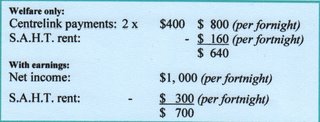
OK, so I’m $60 in front! Whoopeedoo! What’s the story? Why am I complaining? Why am I depressed? Why am I feeling trapped and in despair? Why don’t I go out and spend that extra $30 each week – live it up, treat myself to something nice?
Let’s look at it another way. If, after all that, I am only $30 per week in front of my welfare entitlements, and I am working 18+ hours each week, that means I am working for the grand sum of $1.66 per hour.
And for that extra $30, I get to be productively occupied with something other than parenting!
So what would I be doing with my time if I didn’t go out to work? I might still be depressed and in despair. I might long to have my days filled with some kind of meaningful productivity other than keeping house. I might have written my novels by now. I might have time to op shopping for the essentials I am forced to buy new, because I don’t have time to op shop, and because my children and I live with the pretence that as a working single mother we can do better. Who knows? It might not be any better. But does that make what we have, all right?
The solution? It’s not my employers’ fault. I knew when I applied for the job, that it was only an HEO3 half-time position. And yes, I probably will get a chunk of this money back at the end of the financial year. (I can see by my payslip that I have already paid $3,238.00 in tax.) But that doesn’t help me pay the bills I have right now. My creditors are not going to be willing to wait for August or September on my promise that I will pay them if and when I get the money back from the government.
I’m bitter and I’m sad. I’m in despair. I see no way out. It’s not a pretty picture.
We aren’t starving. We never will. We have a roof over our heads. We have a car to drive around in. We have furniture to sit on, beds to sleep in. We have so much, yet we have so little.
The solution? Again, it’s a tough one. Obviously, I need to work longer hours, and/or I need a higher-paid position. I cannot begin to calculate what will happen when my son goes onto Youth Allowance in May. That just frightens me even more. I intend to finish my graduate diploma in Education, by taking leave without pay from my job for 5 weeks in May/June, after which I will be qualified to teach. When I did that last year, we managed quite well without any extra income (this should come as no surprise, if you’ve managed to follow what I’ve written here). In the meantime, it is unlikely I’d find a higher-paid job for the next three months that would let me go on leave for five weeks, so I guess I keep on treading water for that $30 per week and believing everything will be all right. Do I want to teach? Not really – I like my part-time office job – but I don’t think I can afford the luxury of choice.
Forgive me if my attitude at work seems deficient. I know it’s not your fault I’m working for $1.66 per hour, but somehow, that doesn’t make me feel any better. I promise to go on doing my best. This is the best I can do.
Yours truly,
Melina Magdalena
P.S. Please note that I have rounded figures both up and down in the above diatribe, which balances itself out, in the end. After all, numbers are just numbers. We’re just one small family trying to make ends meet. And we’re the enemy – the greedy, unscrupulous, welfare dependent ne’er do wells that Australia loves to vilify, and who do not deserve to be heard. However, I am audacious enough to expect, await, and look forward to your response.
© 2006
Dear Friends,
I need to explain this to someone. It seems as though no one really understands this number game. Everyone says it’s so good that I’m working, that I’m a good Mum, that I’m not just a welfare mother, how clever I am, what potential I have blah blah blah – bullshit.
If I’d stayed married, things might not be any better. X’s vision was for me to go and clean nursing homes while he stayed home and played his guitar while the babies screamed in the background. I can’t castigate myself now for leaving that marriage.
The second piece of irony – and this one stings – I’ve finally found a job I like and can do, with people I can respect, who respect me. I actually like my job and enjoy it.
What’s so soul-destroying is the numbers game which holds me hostage. And yes – I did blow my entire income tax return last year by going overseas. Again, I get all kinds of messages about how that was a great thing to have done: “It’s the first thing you’ve done for yourself in all these years, and it’s about time you had a holiday.” Bullshit. People like me don’t deserve to go on holidays. We should stay in our little holes and not bother anybody.
Am I profligate with my money? Could I – should I – manage it better? I honestly don’t see how. Food and bills are all I spend it on – the absolute bare minimum basics. I work 18.38 hours each week. If I didn’t go out to work, I might not have more money to spend, but I also would have fewer commitments that demand that I spend money on them. If I have to pay for all-day parking once each week, I earn almost nothing over and above what I’d be getting on welfare alone.
Here is how it works.
I go out to work in a 0.5 fractional position at HEO3 level rates. (It’s an entry-level position. What do I expect – I’m a single mother, unprofessional, at least it’s not a casual job!)
Each fortnight, my pay slip tells me I’ve earned around $600, for which I am taxed $200. About $400 is deposited into my bank account. However, I have to report my gross earnings to Centrelink, who reduce my welfare payment. For the $400 net I earn each fortnight after tax, Centrelink takes another third, leaving me with about $200 in net earnings.
Now, I am extraordinarily lucky to live in government housing. (Imagine if I had to pay private rent?) In addition, because I was clever enough to flee my marriage in 1993, even though it took 14 years to be housed, legislation states that I cannot now be kicked out of my home (which, I have to acknowledge, has got to be a good thing). And I thank my lucky stars each and every day that I live in meek old Adelaide, where “the cost of living” is so very low. Here’s the thing: because I am in government housing, I am not eligible for rent relief from Centrelink.
Rent relief may be a non-issue, but the scaled rental payment for which I am liable each week is significant. If I had nothing but Centrelink payments, I would pay about $80 each week to live in this house. However, because I earn the exorbitant amount of $600+ each fortnight (yes – Housing Trust works out my rental payment according to the gross amount, as does Centrelink), my rent has almost doubled. I pay $151.50 each week.
The difference (I’ll work that out for you) is $71.50 per week. That $71.50 is money that I have earned by going out to work. It is the money I owe the government for living in government housing and earning outside of the government welfare system. It is money over and above the (reduced) Centrelink payment I am handed each fortnight for being a single parent, and it is money over and above the money that is deducted in tax from my pay each fortnight.
Now actually, I receive two Centrelink payments. On the week in between, I receive about $400 for the parenting payment. So my total fortnightly income consists of:
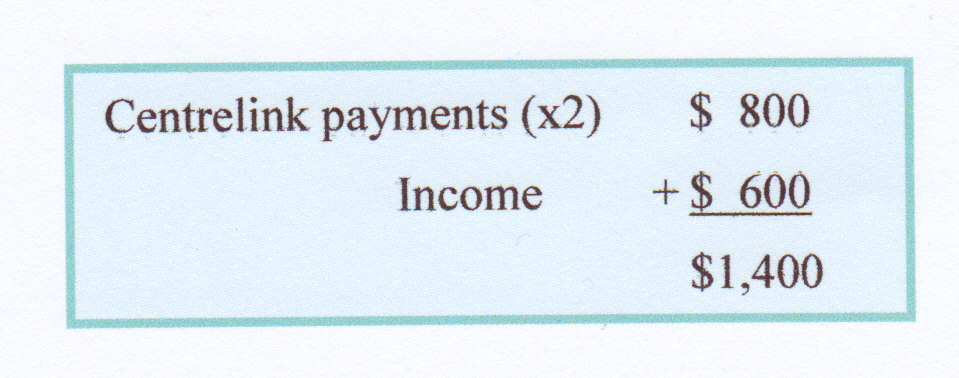
Looks pretty good, doesn’t it. $1,400 per fortnight – that’s $700 per week, for goodness sake. If I can’t raise two teenagers on that amount, there must be something wrong with me. What do I expect – larger government handouts?
Remember, that’s not the real picture. It is, however, the picture that Centrelink, the Housing Trust, the Smith Family and the Salvation look at Army (believe me – I’ve been pushed to beg more than once before, for my groceries).
But I have to explain this to someone. So here’s the real picture:

So that is actually only $500 per week to raise two teenagers. From this amount comes rent, food, petrol, school fees and everything else.
If we take a look at the rental situation in a similar light, it only gets worse.
Here’s how it would be if I didn’t go out and earn.
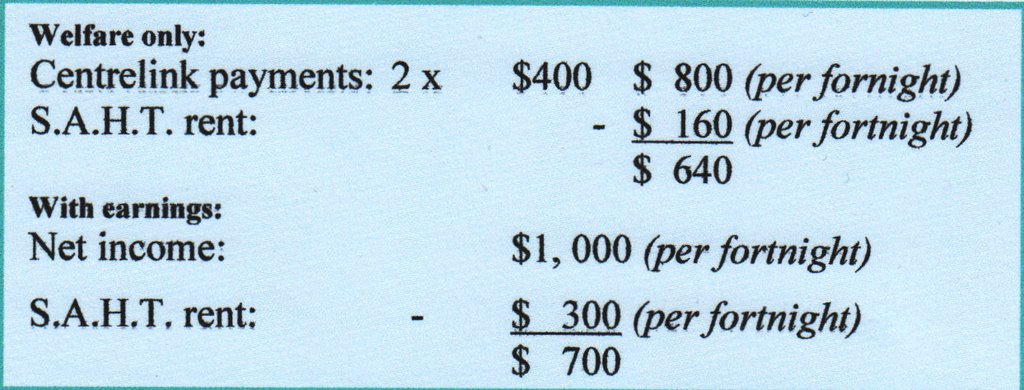
OK, so I’m $60 in front! Whoopeedoo! What’s the story? Why am I complaining? Why am I depressed? Why am I feeling trapped and in despair? Why don’t I go out and spend that extra $30 each week – live it up, treat myself to something nice?
Let’s look at it another way. If, after all that, I am only $30 per week in front of my welfare entitlements, and I am working 18+ hours each week, that means I am working for the grand sum of $1.66 per hour.
And for that extra $30, I get to be productively occupied with something other than parenting!
So what would I be doing with my time if I didn’t go out to work? I might still be depressed and in despair. I might long to have my days filled with some kind of meaningful productivity other than keeping house. I might have written my novels by now. I might have time to op shopping for the essentials I am forced to buy new, because I don’t have time to op shop, and because my children and I live with the pretence that as a working single mother we can do better. Who knows? It might not be any better. But does that make what we have, all right?
The solution? It’s not my employers’ fault. I knew when I applied for the job, that it was only an HEO3 half-time position. And yes, I probably will get a chunk of this money back at the end of the financial year. (I can see by my payslip that I have already paid $3,238.00 in tax.) But that doesn’t help me pay the bills I have right now. My creditors are not going to be willing to wait for August or September on my promise that I will pay them if and when I get the money back from the government.
I’m bitter and I’m sad. I’m in despair. I see no way out. It’s not a pretty picture.
We aren’t starving. We never will. We have a roof over our heads. We have a car to drive around in. We have furniture to sit on, beds to sleep in. We have so much, yet we have so little.
The solution? Again, it’s a tough one. Obviously, I need to work longer hours, and/or I need a higher-paid position. I cannot begin to calculate what will happen when my son goes onto Youth Allowance in May. That just frightens me even more. I intend to finish my graduate diploma in Education, by taking leave without pay from my job for 5 weeks in May/June, after which I will be qualified to teach. When I did that last year, we managed quite well without any extra income (this should come as no surprise, if you’ve managed to follow what I’ve written here). In the meantime, it is unlikely I’d find a higher-paid job for the next three months that would let me go on leave for five weeks, so I guess I keep on treading water for that $30 per week and believing everything will be all right. Do I want to teach? Not really – I like my part-time office job – but I don’t think I can afford the luxury of choice.
Forgive me if my attitude at work seems deficient. I know it’s not your fault I’m working for $1.66 per hour, but somehow, that doesn’t make me feel any better. I promise to go on doing my best. This is the best I can do.
Yours truly,
Melina Magdalena
P.S. Please note that I have rounded figures both up and down in the above diatribe, which balances itself out, in the end. After all, numbers are just numbers. We’re just one small family trying to make ends meet. And we’re the enemy – the greedy, unscrupulous, welfare dependent ne’er do wells that Australia loves to vilify, and who do not deserve to be heard. However, I am audacious enough to expect, await, and look forward to your response.
© 2006
Report: Meeting with my local MP
Report: Meeting with my local Member of Parliament (MP)
Issue: Workforce Participation for Sole Parents
Attached Below: Original letter sent to politicians and agencies
PLEASE FORWARD THIS IMPORTANT INFORMATION TO ALL THE SOLE PARENTS YOU KNOW
18 March, 2006
Dear Friends,
Yesterday I had an appointment with my local Federal Member of Parliament, Christopher Pyne (Torrens, South Australia). The meeting had not been easy to set up. First I sent a letter (via email), to which I received no reply. A week later, I rang his office, and his diary secretary said she would speak with Christopher and get back to me. A week after that, I rang his office again. This time, his diary secretary told me that the materials I had sent were on his desk, and she hoped he would have a chance to look at them that afternoon. She promised to get back to me after speaking with him to set up an appointment. A week later, I went to his office and told the young man at the front desk that I had been trying for three weeks to get an appointment to speak with Christopher Pyne. He disappeared for several long minutes, and then reappeared, with the diary secretary, who told me “Christopher is happy to meet with you, and he is available next Friday. What time would suit you?”
Advice: It is your right to speak with your MP. Perseverance pays off. Fronting up to the office elicits the most rapid response.
Christopher met me in the meeting room, of his office, a lovely old bungalow on Magill Road in Adelaide. He has the whole building set up as working space. There is no backyard left, it having been converted to a car park, but his indulgence, an old gold bomb-like car, sits in the driveway. The meeting room has two doors, and a window that looks out onto the street. It contains a large, wooden table, with many chairs. I made sure I took a chair that didn’t leave my back to either of the doors.
He asked me why I was there. I said “Did you read my letter?” He said “Well, it would be somewhere out there,” and gestured vaguely toward the other part of his building.
Advice: Bring a copy of your letter and/or documentation with you, when you meet your local politician.
Disappointed that my letter clearly had remained unread, or had made no impact on him, I took him through the ludicrous situation in which I find myself. Briefly, that as a sole parent, I work 18 hours a week on top of parenting, for about $1.66/hour, due to the combination of being taxed, plus having my welfare payment deducted. I explained to him that I had made an error in my letter, believing that Centrelink deducted my pension at the rate of 30¢ in the dollar, when in fact it deducts my pension at 40¢ in the dollar.
I explained to Christopher the impact that this has on me and my children, that I find it and demoralizing and struggle with depression. That it interferes with my creative life. That I prefer to work as well as parent, but this regime interferes with my well-being and ability to create, let alone function. That as a sole parent, I have been unusual in prioritizing my children’s extra-curricular activities, and ensuring they live a life as close to ‘normal’ as possible, but that as they have gotten older, this has become untenable. I empty my bank account each week just with paying out for the basic things of life: food, rent, car and school expenses.
I told Christopher that since sending my letter, I had received a response from Centrelink, who had been contacted by Joe Hockey (NSW), one of the politicians to whom I had sent the letter. Centrelink investigated my file and discovered an anomaly which meant I was owed arrears in the order of $565. I told Christopher that receiving this money had been a wonderful surprise, but it didn’t solve my problem.
I told him that the $565 enabled me to pay off my outstanding debt to my mechanic, to pay a chunk off the school fees I owe for my children (both at a state high school), and that I would now be able to buy some new underwear for myself, and my daughter. He laughed at this, but I was serious. I hadn’t been able to afford to replace my underwear, which has been getting progressively shabbier by the week.
Christopher wanted to know the age of my children, and what school they go to. He said that his children go to Burnside Primary School, and agreed with me that yes, even state schools charge fees. He asked me how long I had been a sole parent. I said I had left my marriage in 1993. He said “Thirteen years? Your daughter must have been very small then.” I said “Yes, she was still breastfeeding at the time.”
He agreed with me that the situation is ludicrous, and went to pains to let me know I was not telling him anything he didn’t already know. He said I am obviously a good mum, to which I responded “Well there’s no doubt that I’m a good mother, but that’s not really the point.”
Christopher Pyne then went into politician-mode and confided to me that conditions for sole parents and the Welfare to Work platform of his Liberal Party, is a political issue, with which Labor disagrees. He said it’s something the Liberal Party wants to deal with, in order to take away any ammunition from the Labor Party. I said to Christopher Pyne that as far as I am concerned, it’s more about the people whose lives are being affected by these punitive regimes.
Christopher Pyne said to me that the issue of Welfare to Work is very important to Peter Costello, and that it is being looked at right now. He said that there may be something good for me coming out in this year’s budget, and that Peter Costello would prefer to make tax cuts for those people on the low end of the tax bracket, than for those who earn over $100,000 per annum.
He mentioned the idea of increasing the Tax Free Threshold to $20,000. I said that I have heard welfare groups talk about this as a possible solution to the problem. I said however, that I am happy to pay tax. I am tired of sole parents being referred to as a drain on the tax payer, because we pay a lot of tax. What I don’t think is fair, is the way the government dips into my income twice and deducts 70% of my earnings every fortnight, leaving me barely able to maintain my household at a decent living standard.
Christopher changed the subject. He wanted to know whether I had any connection with the Women’s Centre at St Peters, which he used to “help”, after it had had its budget slashed by the State Government. He told me that everyone there voted Labor, but that didn’t stop him from helping them. Now that he has children of his own, however, Christopher has no loose money, and so he no longer helps out the women’s centre.
When Christopher so callously complained of having “no loose money” due to the fact that he now has three children and a wife to maintain, I realised he had not heard me at all when I spoke of my life, in which I am unable to afford to buy new underwear, or my fear of having two bright teenagers for whose higher education I have been unable to save a single cent. Though a quick browse on the internet does not bring the exact figures to light, I am certain that Christopher Pyne earns at least six times what I do each week.
I feel ashamed that I did not manage to come out with the words that I had rehearsed, in preparation for my meeting with Christopher Pyne. I had planned to ask him how he thought his lovely wife would cope, raising their lovely children on the kind of income on which my children and I subsist. Alas, he was already out of his chair, ushering me toward the second door in his meeting room which turned out to lead directly to the street. “You’ve done what you could,” he said to me, “in coming to see your local politician.”
If the Tax Free Threshold is raised to $20,000 per annum, I think life for me may become a little easier. However, I still fear for my future, and the future of my children, who are about to be faced with becoming numbers themselves, in the system, as they go from being my children to being Youth Allowance recipients and themselves having to report their every move to Centrelink. This will determine many aspects of their future, such as what kind of job they choose, whether they are able to go to university and where, as well as what kind of housing they can afford when they eventually leave home.
As for me, with my meager superannuation savings, despite voluntary contributions, I can really only hope to die young, and be grateful that my HECS debt will not be taken out of whatever estate I have to leave my children, because it would surely bankrupt them before they have even begun. As it is, I cannot even afford my own funeral yet, so I’d better not begin to plan it just yet.
Yours truly,
Melina Magdalena
© 2006
Issue: Workforce Participation for Sole Parents
Attached Below: Original letter sent to politicians and agencies
PLEASE FORWARD THIS IMPORTANT INFORMATION TO ALL THE SOLE PARENTS YOU KNOW
18 March, 2006
Dear Friends,
Yesterday I had an appointment with my local Federal Member of Parliament, Christopher Pyne (Torrens, South Australia). The meeting had not been easy to set up. First I sent a letter (via email), to which I received no reply. A week later, I rang his office, and his diary secretary said she would speak with Christopher and get back to me. A week after that, I rang his office again. This time, his diary secretary told me that the materials I had sent were on his desk, and she hoped he would have a chance to look at them that afternoon. She promised to get back to me after speaking with him to set up an appointment. A week later, I went to his office and told the young man at the front desk that I had been trying for three weeks to get an appointment to speak with Christopher Pyne. He disappeared for several long minutes, and then reappeared, with the diary secretary, who told me “Christopher is happy to meet with you, and he is available next Friday. What time would suit you?”
Advice: It is your right to speak with your MP. Perseverance pays off. Fronting up to the office elicits the most rapid response.
Christopher met me in the meeting room, of his office, a lovely old bungalow on Magill Road in Adelaide. He has the whole building set up as working space. There is no backyard left, it having been converted to a car park, but his indulgence, an old gold bomb-like car, sits in the driveway. The meeting room has two doors, and a window that looks out onto the street. It contains a large, wooden table, with many chairs. I made sure I took a chair that didn’t leave my back to either of the doors.
He asked me why I was there. I said “Did you read my letter?” He said “Well, it would be somewhere out there,” and gestured vaguely toward the other part of his building.
Advice: Bring a copy of your letter and/or documentation with you, when you meet your local politician.
Disappointed that my letter clearly had remained unread, or had made no impact on him, I took him through the ludicrous situation in which I find myself. Briefly, that as a sole parent, I work 18 hours a week on top of parenting, for about $1.66/hour, due to the combination of being taxed, plus having my welfare payment deducted. I explained to him that I had made an error in my letter, believing that Centrelink deducted my pension at the rate of 30¢ in the dollar, when in fact it deducts my pension at 40¢ in the dollar.
I explained to Christopher the impact that this has on me and my children, that I find it and demoralizing and struggle with depression. That it interferes with my creative life. That I prefer to work as well as parent, but this regime interferes with my well-being and ability to create, let alone function. That as a sole parent, I have been unusual in prioritizing my children’s extra-curricular activities, and ensuring they live a life as close to ‘normal’ as possible, but that as they have gotten older, this has become untenable. I empty my bank account each week just with paying out for the basic things of life: food, rent, car and school expenses.
I told Christopher that since sending my letter, I had received a response from Centrelink, who had been contacted by Joe Hockey (NSW), one of the politicians to whom I had sent the letter. Centrelink investigated my file and discovered an anomaly which meant I was owed arrears in the order of $565. I told Christopher that receiving this money had been a wonderful surprise, but it didn’t solve my problem.
I told him that the $565 enabled me to pay off my outstanding debt to my mechanic, to pay a chunk off the school fees I owe for my children (both at a state high school), and that I would now be able to buy some new underwear for myself, and my daughter. He laughed at this, but I was serious. I hadn’t been able to afford to replace my underwear, which has been getting progressively shabbier by the week.
Christopher wanted to know the age of my children, and what school they go to. He said that his children go to Burnside Primary School, and agreed with me that yes, even state schools charge fees. He asked me how long I had been a sole parent. I said I had left my marriage in 1993. He said “Thirteen years? Your daughter must have been very small then.” I said “Yes, she was still breastfeeding at the time.”
He agreed with me that the situation is ludicrous, and went to pains to let me know I was not telling him anything he didn’t already know. He said I am obviously a good mum, to which I responded “Well there’s no doubt that I’m a good mother, but that’s not really the point.”
Christopher Pyne then went into politician-mode and confided to me that conditions for sole parents and the Welfare to Work platform of his Liberal Party, is a political issue, with which Labor disagrees. He said it’s something the Liberal Party wants to deal with, in order to take away any ammunition from the Labor Party. I said to Christopher Pyne that as far as I am concerned, it’s more about the people whose lives are being affected by these punitive regimes.
Christopher Pyne said to me that the issue of Welfare to Work is very important to Peter Costello, and that it is being looked at right now. He said that there may be something good for me coming out in this year’s budget, and that Peter Costello would prefer to make tax cuts for those people on the low end of the tax bracket, than for those who earn over $100,000 per annum.
He mentioned the idea of increasing the Tax Free Threshold to $20,000. I said that I have heard welfare groups talk about this as a possible solution to the problem. I said however, that I am happy to pay tax. I am tired of sole parents being referred to as a drain on the tax payer, because we pay a lot of tax. What I don’t think is fair, is the way the government dips into my income twice and deducts 70% of my earnings every fortnight, leaving me barely able to maintain my household at a decent living standard.
Christopher changed the subject. He wanted to know whether I had any connection with the Women’s Centre at St Peters, which he used to “help”, after it had had its budget slashed by the State Government. He told me that everyone there voted Labor, but that didn’t stop him from helping them. Now that he has children of his own, however, Christopher has no loose money, and so he no longer helps out the women’s centre.
When Christopher so callously complained of having “no loose money” due to the fact that he now has three children and a wife to maintain, I realised he had not heard me at all when I spoke of my life, in which I am unable to afford to buy new underwear, or my fear of having two bright teenagers for whose higher education I have been unable to save a single cent. Though a quick browse on the internet does not bring the exact figures to light, I am certain that Christopher Pyne earns at least six times what I do each week.
I feel ashamed that I did not manage to come out with the words that I had rehearsed, in preparation for my meeting with Christopher Pyne. I had planned to ask him how he thought his lovely wife would cope, raising their lovely children on the kind of income on which my children and I subsist. Alas, he was already out of his chair, ushering me toward the second door in his meeting room which turned out to lead directly to the street. “You’ve done what you could,” he said to me, “in coming to see your local politician.”
If the Tax Free Threshold is raised to $20,000 per annum, I think life for me may become a little easier. However, I still fear for my future, and the future of my children, who are about to be faced with becoming numbers themselves, in the system, as they go from being my children to being Youth Allowance recipients and themselves having to report their every move to Centrelink. This will determine many aspects of their future, such as what kind of job they choose, whether they are able to go to university and where, as well as what kind of housing they can afford when they eventually leave home.
As for me, with my meager superannuation savings, despite voluntary contributions, I can really only hope to die young, and be grateful that my HECS debt will not be taken out of whatever estate I have to leave my children, because it would surely bankrupt them before they have even begun. As it is, I cannot even afford my own funeral yet, so I’d better not begin to plan it just yet.
Yours truly,
Melina Magdalena
© 2006
Saturday, June 03, 2006
Free Lunches
 It worries me, how in this first decade of the twenty-first century we have all become wheeler dealers. Everything we do must be paid for. Schemes for obtaining customer loyalty through customer rewards have skyrocketed in availability and popularity.
 I am not immune. And while I enjoy getting $5 off my sixth purchase of chicken products after spending $12 or more during the previous five purchases, AND modify my spending habits to enable this ‘reward’, I sense a frenetic quality, an almost desperation in myself for taking advantage in this way. It’s a symptom of a deeper societal malaise. We’ve all been tainted.
Last week, I was treated to a scrumptious lunch of rice, chickpeas and vegetables, made to a modified recipe by the class I’ve been teaching for the last five weeks. They served it to me lovingly, on an oval plate, with a large spoonful of each version of the dish as prepared by each of the three groups who were working together in the Home Economics kitchen. On one side of the plate was a generous serving of yoghurt.
When my mentor teacher and I were invited to eat lunch with our students in the Home Economics room, teachers of other classes joked with us that “there’s no such thing as a free lunch”. This reminded me of my favourite Heinlein book, The Moon is a Harsh Mistress (1966).
 I like the radical quality of some of Heinlein’s works despite the sexual decadence of some of them, which sits uncomfortably and feels so dated in this post-70s era. Heinlein never managed to circumvent his exploitation of women within his writing, despite his exploration of various scientific, social and political ideas. In The Moon is a Harsh Mistress, Heinlein posits radical new family structures, a sentient computer and a revolutionary politics which I find refreshing and inspiring. A recurring theme in this book is ‘There Ain’t No Such Thing As A Free Lunch’ (Chapter 11, p. 122 in my 1979 New English library edition).
 I wonder ...
This has been a week in which social and political activism has been uppermost in my mind. I’ve been working with a group of teenage refugees to Australia from Afghanistan, Ethiopia, Sierra Leone, Kurdistan, Liberia, Sudan and Somalia. They have been studying Australian Government, and haven’t enjoyed this much at all. I challenged myself to find a way to engage them in this topic.
 Along with Aboriginal people, refugees are some of the most disenfranchised residents of Australia. These young people all have aspirations towards the citizenship that will grant them a permanent and safe place to live out their lives. Like most teenagers, they are also bursting with energy, ideas, experiences and opinions. They want to do their own thing, without bending to the arbitrary demands of adults. During their short time in Australia, (less than two years) they have all, without exception, experienced the sting of racism. This has disillusioned them and distanced them from the joyful hopes and dreams they brought with them to this country.
  Having come from places where government actively seeks to make life chaotic, cruel and dangerous for its people, abstract classroom discussions of democracy and the history of Australia’s political system were hardly likely to engage them. Yet in a short time, having attained both adult status and the prize of Australian citizenship, they will all be expected to vote.
 I thought about my political activism over the years, and wondered about this idea of democracy. Certainly, I have not taken for granted, my right to protest and to lobby government for what I believe in. Since AIDEX 1991*, I don’t attend any protests without the fear of police brutality and media misrepresentation. My Jewish heritage lingers in the worry I feel at large public gatherings, that our united presence offers ideal opportunities to eliminate voices of dissent. As a novice teacher I know that my police record, if not my ASIO file, will be open to scrutiny.
 A few things reminded me of AIDEX this week. It chills me, the way South Australia’s Labor government has been crowing about our position as Australia’s “defence state”. Since the Federal Government decided to move AIDEX offshore, after the protests in 1991, I have not kept in touch with its activities and aspirations to gain more and more contracts to produce weapons and all the other paraphernalia to do with the machinery of war. Contracts to build military equipment are said to be flowing hard and fast.
 Secondly, the so-called debate about nuclear energy has gripped Australia’s media this week. To say that nuclear power is environmentally-friendly is an oxymoron that stunned me almost speechless. Yet the Federal Government has such tight control over Australia’s media, that the other side of the debate has remained almost silenced in the mainstream media. This is terrifying, particularly given the headline on yesterday’s newspaper in Adelaide, where Alexander Downer claims a strong case for the first nuclear reactor to be built in Adelaide (front page, The Advertiser, 2 June 2006).
 Thirdly, the recurrent rise of violent unrest in East Timor and the sending of Australian peacekeepers reminded me of the paradox of maintaining and promoting a defence force for our nation that spends most of its energy in assisting other countries to attain peace.
 Sad as it may seem, Matt Groening and The Simpsons have done a brilliant job of desensitising Australia’s young people to the issue of nuclear energy. If the Simpsons can dwell in tranquil unconcern about the nuclear reactor in their back yard, and even laugh about their father’s ineptitude in his job to maintain the safety of the reactor, then what are all these old fogey hippies yelling about, when they say that nuclear energy is dangerous and unnecessary? There’s no issue, is there?
 Sadly, the twists and cynicism of the Simpsons go straight over the heads of Australia’s apolitical youth. They may be taught in school to critically analyse texts until they are blue in the face, but the fact of the matter is that applying this critical analysis to situations in their own lives is never encouraged. For teacher in schools, just like workers in women’s health centres and those behind the desks of the public service, the exploration of issues is tightly controlled. We impose silence over our opinions to protect ourselves. No one wants to risk losing their job or jeopardising the existence of public services by saying things that the government doesn’t want us to say.
 (Doesn’t sound much like democracy to me, but there you go!)
 Homer and Bart, like Howard and Costello, Rann and Foley, are still our larrikin heroes. Lisa and Marge, like Bob, Sandra and Natasha, are everybody’s mothers who exist only to spoil the boys’ fun. Needless to say, we all want to be one of the boys!
 For my class, I wrote a short description of the arrestable protest action I undertook, with six other young people, at AIDEX 1989. We read this as a class, and began to discuss whether our action had achieved anything. The point of the exercise was to instil in these young people, the idea that dissent is a natural and inevitable part of every democracy.
Complacency is the result of disenfranchisement.
 The second step was to analyse authentic letters to the editor. I put them in groups of three, each with a different letter. The topics ranged from nuclear energy, Sydney’s riots last year, working women to Australia’s anti-terrorism legislation. These were tough issues for the refugee students to comprehend, let alone work with.
 By the end of the week, students wrote ‘letters to the editor’ about issues they feel strongly about. To set the scene, I had first of all to explain the role of an editor in newspapers, and the right of residents to write letters to media and politicians on the assumption that these letters receive attention and even be published. My aim was to given the students the idea that as new Australians, they can and should contribute to our society.
 Not surprisingly, a couple of them chose to write about the racist attacks they have experienced on Adelaide’s public transport. Others wrote about issues to do with driving – petrol prices, drink driving, and using a mobile phone whilst driving. These are all issues with which these young people are engaged. I felt encouraged by their willingness to accept the idea that they have a voice in determining aspects of the society in which they live.
 As far as the free lunch goes, I could be cynical and say it was offered to me in thanks for caring enough about them to give them access to voicing their concerns and their ideas in this world. I’ll leave it to my readers to determine my motivation – was it altruism, or purely self-interest?
*AIDEX (Australian International Defence Equipment Exhibition) was first held in Canberra in 1989. Planned to occur every two years, protest action against the arms exhibition grew exponentially between 1989 and 1991 to such an extent that the exhibition was subsequently moved offshore. Protests which had aimed to be peaceful and creative, were marked by police brutality towards protesters who were mostly white and middle class, and had never been exposed to the reality of such violence. For more archived information about AIDEX and its legal aftermath, see: http://www.greenleft.org.au/back/1992/42/42p2b.htm “Aidex aftermath”, published in Green Left Weekly, http://www.cat.org.au/catv/catv95/Aidex.html “AIDEX ’91 Inside the Arms Trade”, http://www.jcs.act.gov.au/eLibrary/lrc/r15/r15a.html Attachment A, Attorney General’s Office, http://www.jcs.act.gov.au/eLibrary/lrc/r12/r12_fn.html , http://nla.gov.au/nla.cs-pa-http%253A%252F%252Fbuffy.lib.unimelb.edu.au%252Fcgi-bin%252Fmua-search%253Ftdetails%253D936%253Bimgdetails%253D936 “Picture Australia – Police and protestors clash at the Australian International Defence Equipment Exhibition (AIDEX) protest, Canberra, 26 November 1991”, http://users.senet.com.au/~gregogle/Free%20Speech%20Speech.htm “Protest and the Law. An Anarchist Speech at South Australia’s Law Week Speaker’s Corner”, (16 May 2002), http://www.spunk.org/texts/tech/sp001035.txt “Surveillance”, (Dimity)
Saturday, May 27, 2006
Being Present
Being Present
© Melina Magdalena (2006)
“I wanted you to be present”
(Majid, just before his death; Caché (Hidden) Michael Haneke, 2005)
To be present at any given time is to give the gift of human connection to the world. Moment by moment, we make choices about what we attend to. At the moment, I am typing on my computer ... listening to music ... singing along ... knowing the washing machine cycle will finish soon and wondering how cold it will be when I go outside to hang it out ... savouring my fried rice breakfast, still warm in my stomach ... thinking about my sister and her newborn baby girl ... conscious that I have planning to do for my teaching this week ... and the need to get out my paints to make thank you cards for the students in my class, who have taught me such a lot over the last four weeks ...
But all of this is now also in the past. And some of it is in the future. The flow of time is a matter of ever-present perplexity for me. How often am I really present? How can I be present and still maintain links to the past and the future? What is present?
Caché (Hidden) Michael Haneke, (2005)
(http://www.imdb.com/title/tt0387898/)
I went to watch “Hidden” last weekend. At the films’ conclusion, like several other members of the audience, I sat in stunned and horrified numbness, wondering what the film was all about, and what it said about me, in my life.
I was horrified and stunned by Majid’s act of defiance, but something else disturbed me more. While Majid’s end is swift and startling (albeit not without ongoing ramifications), the behaviour and attitude of George, his erstwhile peer and brother, is what leaves me sleepless. Majid’s act of self-destruction contributes nothing, because George refuses to engage with it on any level at all.
It reminded me of Marilyn French’s “The Women’s Room”, (1977) where Val self-destructs in what seems to be a pointless act of aggression against patriarchy. Not only does her participation in the robbery fail to solve any problems, but it does not even attract the attention of the world to what those problems are.
I am also reminded of the sorry tale of Sorry Day in Australia, (http://home.alphalink.com.au/~rez/Journey/) and John Howard’s refusal to say ‘sorry’. His refusal leaves me almost speechless, because it is such an inhuman response, revealing him as cold, passionless, manipulative and cruel. The ability to show empathy and compassion for what others have experienced is not a weakness, but a gift and a strength that connects one person to another. When our nation’s leader claims that showing empathy will make him liable and accountable for the past, he is missing the point.
What we have and what we are is connected to what we did in the past. Australians ride high on what was stolen from the Aboriginal peoples of this land. However, Australia’s Indigenous peoples are not holding the rest of us to ransom. No one is demanding that we relinquish everything we have and give it back. It is not possible to turn back the clock and restore things as they used to be.
Like disenfrachised people everywhere, whether they were colonised or hounded from their homelands, Aboriginal people simply want to be recognised as human beings, and be given what every Australian has – equal opportunities to live, work, play, create and thrive as valued and contributing members of the Australian community.
George’s rejection of Majid and what he represents goes deeper than any personal guilt he may be covering up, for the fact that Majid, an Algerian Frenchman, grw up penniless and orphaned, in contrast to George’s well-padded, connected and affluent lifestyle. In the whole film, Majid is represented as hospitable and welcoming. He is not accusatory of George, but opens his home, offers George a drink, somewhere to sit and asks him about his life. But George rejects any level of connection with Majid. This is an absolute image of racism. George refuses to recognise that Majid is a human being. At the end of the film, we see George sleeping off the events of the previous weeks. Sleep is his solution to encountering the trauma in which he was complicit. It’s an easy metaphor to interpret – equivalent to hiding one’s head in the sand. (At the end of the day, we’re all too busy to do anything anyway. But is inaction equivalent to passive non-violent resistance?)
In the closing scene, we watch tensely, as George’s son Pierrot, leaves his school at the end of the day. From our viewpoint, we might be watching from behind a video camera, or looking down the barrel of a gun. While watching the film, I was convinced that we were about to witness a bloodbath; especially given the situation could be constructed as a war between two religious groups, the Christian-haves and the Muslim-have-nots. Instead, we are treated to an alternative that challenges the prejudices uncovered by my initial thoughts as to what will happen next. Majid’s son is indeed at the school, where he meets George’s soon. They walk off together in conversation, as their fathers never did, and never will.
© Melina Magdalena (2006)
“I wanted you to be present”
(Majid, just before his death; Caché (Hidden) Michael Haneke, 2005)
To be present at any given time is to give the gift of human connection to the world. Moment by moment, we make choices about what we attend to. At the moment, I am typing on my computer ... listening to music ... singing along ... knowing the washing machine cycle will finish soon and wondering how cold it will be when I go outside to hang it out ... savouring my fried rice breakfast, still warm in my stomach ... thinking about my sister and her newborn baby girl ... conscious that I have planning to do for my teaching this week ... and the need to get out my paints to make thank you cards for the students in my class, who have taught me such a lot over the last four weeks ...
But all of this is now also in the past. And some of it is in the future. The flow of time is a matter of ever-present perplexity for me. How often am I really present? How can I be present and still maintain links to the past and the future? What is present?
Caché (Hidden) Michael Haneke, (2005)
(http://www.imdb.com/title/tt0387898/)
I went to watch “Hidden” last weekend. At the films’ conclusion, like several other members of the audience, I sat in stunned and horrified numbness, wondering what the film was all about, and what it said about me, in my life.
I was horrified and stunned by Majid’s act of defiance, but something else disturbed me more. While Majid’s end is swift and startling (albeit not without ongoing ramifications), the behaviour and attitude of George, his erstwhile peer and brother, is what leaves me sleepless. Majid’s act of self-destruction contributes nothing, because George refuses to engage with it on any level at all.
It reminded me of Marilyn French’s “The Women’s Room”, (1977) where Val self-destructs in what seems to be a pointless act of aggression against patriarchy. Not only does her participation in the robbery fail to solve any problems, but it does not even attract the attention of the world to what those problems are.
I am also reminded of the sorry tale of Sorry Day in Australia, (http://home.alphalink.com.au/~rez/Journey/) and John Howard’s refusal to say ‘sorry’. His refusal leaves me almost speechless, because it is such an inhuman response, revealing him as cold, passionless, manipulative and cruel. The ability to show empathy and compassion for what others have experienced is not a weakness, but a gift and a strength that connects one person to another. When our nation’s leader claims that showing empathy will make him liable and accountable for the past, he is missing the point.
What we have and what we are is connected to what we did in the past. Australians ride high on what was stolen from the Aboriginal peoples of this land. However, Australia’s Indigenous peoples are not holding the rest of us to ransom. No one is demanding that we relinquish everything we have and give it back. It is not possible to turn back the clock and restore things as they used to be.
Like disenfrachised people everywhere, whether they were colonised or hounded from their homelands, Aboriginal people simply want to be recognised as human beings, and be given what every Australian has – equal opportunities to live, work, play, create and thrive as valued and contributing members of the Australian community.
George’s rejection of Majid and what he represents goes deeper than any personal guilt he may be covering up, for the fact that Majid, an Algerian Frenchman, grw up penniless and orphaned, in contrast to George’s well-padded, connected and affluent lifestyle. In the whole film, Majid is represented as hospitable and welcoming. He is not accusatory of George, but opens his home, offers George a drink, somewhere to sit and asks him about his life. But George rejects any level of connection with Majid. This is an absolute image of racism. George refuses to recognise that Majid is a human being. At the end of the film, we see George sleeping off the events of the previous weeks. Sleep is his solution to encountering the trauma in which he was complicit. It’s an easy metaphor to interpret – equivalent to hiding one’s head in the sand. (At the end of the day, we’re all too busy to do anything anyway. But is inaction equivalent to passive non-violent resistance?)
In the closing scene, we watch tensely, as George’s son Pierrot, leaves his school at the end of the day. From our viewpoint, we might be watching from behind a video camera, or looking down the barrel of a gun. While watching the film, I was convinced that we were about to witness a bloodbath; especially given the situation could be constructed as a war between two religious groups, the Christian-haves and the Muslim-have-nots. Instead, we are treated to an alternative that challenges the prejudices uncovered by my initial thoughts as to what will happen next. Majid’s son is indeed at the school, where he meets George’s soon. They walk off together in conversation, as their fathers never did, and never will.
Tuesday, May 23, 2006
Not our culture
Not our culture
©Melina Magdalena (2006)
a plea for compassion, empathy, understanding, hope and action
In the mid-1990s I began to study linguistics at university. The format of the course involved one lecture and one tutorial each week. One of the things our tutor worked hard to impress upon us was the concept that language reflects the world which created it, in which that language continues to evolve. The tutor chose to instruct us in this concept by using “rape” as an idea that only exists in a certain cultural framework.
His thesis was that we who look at what happens to the women and children in other cultures get outraged by “rape” because we mistakenly attribute the same connotations and understandings and attitudes to what we observe taking place there, when in fact for the people in those cultures, there is no wrongdoing and no need for outrage, because there is no such thing as “rape”.
I was reminded this week of the deep rage and sadness this triggered in me, with the media frenzy over child sexual abuse and domestic violence in Aboriginal communities of the Northern Territory. The woman who impressed me most was Betty Pearce, who is quoted saying “Anger is so great because this is not an Aboriginal culture. Even 20 years ago, 22 years ago, had an Aboriginal person done that he’d have been killed, had he raped a child.”
Child sexual abuse and domestic violence are present in all sectors of Australian society, and it is significant that media excitement about these issues on Aboriginal communities is hyped to such an extent, when the people involved say that action is needed now (and twenty years ago), not just more talking. Otherwise, domestic violence and child sexual abuse hardly rate a mention in Australian media except when they involve gruesome murder suicides.
We know that rape is not about claiming one’s traditional rights to a child bride. Nor is rape about sex. Rape is about power.
We know that domestic violence, which is when one’s spouse, child, or lover enforces a reign of terror in one’s daily life, is about control. We know that the perpetrator of domestic violence does everything he can to maintain control over those under his power. When verbal abuse is not sufficient, he resorts to physical, sexual, social, financial and spiritual abuse.
As a mother, the impulse to appeal to a child’s father’s better judgment can lead to the child getting in the way of its father’s rage, and bearing its brunt. (I know I’m not the only woman who put my child between myself and the one who wanted to strangle me, in the vain hope that he would cease his tyranny, for the love of his child.) And my hopes were dashed in the instant it took for me to recognise my mistake. A child will be used to fuel the rage, in an attempt to control its mother.
We know that people who have no power and no control over their lives, people who have been deprived of choice, opportunity, self expression, growth, education, purpose and health will enact and act out their life situations anyway they can. This is not an excuse, but it is a matter of survival.
Those who have suffered react to that suffering in a range of ways, depending on the avenues of expression that are open to them. To move out of the status quo and into an unknown way of being requires luck, perseverance, assistance and courage. It doesn’t work to say that women should take their children, leave, and set up homes elsewhere. In any case, they have tried that, and the men simply follow. Where else are they supposed to go? Will it heal communities to further fragment families?
I wrote two poems to express my fury at what I thought my tutor was suggesting, in claiming that it is only our world view and the culture we grew up in, that determines whether “rape” is an act of evil.
I’d also like to point out the prevalence of rape and child abuse as it appears in the western Bible, often with no commentary or condemnation. I question my tutor’s stand even more, in light of these examples. Who decided that “rape” for those who live in the western world, is a reprehensible act? And when did this occur? Is it only to do with dowries, transactions and ownership of the female by the male? Why do we continue to victimise the victims, as though they are to blame for their own victimisation? That was the message I took away from these linguistics tutorials.
To my Tutor #1
©Melina Magdalena (1996)
I’m studying linguistics, you see.
Here’s a demonstration of the power of language.
Two men sitting, one a tutor, one a student
feebly batting back and forth
words like rape and good and bad and evil and loaded
ideas about language taboos and cultural realities
I heard the tutor ask him
“so is rape always evil; what about rape in war?”
“I don’t believe in evil” says the student
“yes, but surely you accept that one’s society puts
constraints on what is construed
as all right and what is unacceptable?”
(Ah, I say to myself,
the despair is descending upon me.)
So rape is sometimes good?
So rape in war is justified?
And the perpetual war against women is all that makes
this discussion acceptable.
(And when was either of you two raped?)
(Melodrama. Trigger back into the nightmare.)
“I have overcome great obstacles to be here today.”
(Loopy tragic thoughts frantic spiral doodles)
resolutely break those chains that train of thought ...
NOW!
“I don’t want to waste this hour on remembering.
I am not here to indulge in self pity.
I came here today to further my learning.
It took me years to accept the existence of evil.
To my Tutor #2
©Melina Magdalena (1997)
The fact that you revealed
your prejudice to all assembled
the fact that you revealed
your stupidity and lack of compassion
the fact that you revealed
without discretion or reflection
Is proof unto itself of where you-man speak from
The fact that you spoke
of the rape of woman
the fact that you spoke
where all of us could hear
the fact that you spoke
as though we did not exist
Is proof unto itself that you-man think you rule
The fact that you made claims
with complete disregard
The fact you made claims
on your own beliefs only
The fact you made claims
as though only your claims counted
Is proof unto itself that you think rape is man’s right
The fact that you did not
inquire as to woman’s view
The fact that you did not
invite us into discussion
The fact that you did not
view our experience as relevant
Is proof until itself that you think women deserve to be raped
Now I could go further and claim
that you are a rapist in thought
Now I could go further and claim
that thought is incriminating enough
Now I could go further and claim
that you hate and fear women like me
Your dry intellectualism gave you permission
To state your beliefs far beyond the boundaries
of what is acceptable, tolerable and professional
The fact that I said nothing at the time speaks clearly for itself.
“Indigenous groups warn violence worsening”, (ABC ONLINE) URL: http://www.abc.net.au/news/newsitems/200605/s1640083.htm (viewed online, 18/5/2006)
©Melina Magdalena (2006)
a plea for compassion, empathy, understanding, hope and action
In the mid-1990s I began to study linguistics at university. The format of the course involved one lecture and one tutorial each week. One of the things our tutor worked hard to impress upon us was the concept that language reflects the world which created it, in which that language continues to evolve. The tutor chose to instruct us in this concept by using “rape” as an idea that only exists in a certain cultural framework.
His thesis was that we who look at what happens to the women and children in other cultures get outraged by “rape” because we mistakenly attribute the same connotations and understandings and attitudes to what we observe taking place there, when in fact for the people in those cultures, there is no wrongdoing and no need for outrage, because there is no such thing as “rape”.
I was reminded this week of the deep rage and sadness this triggered in me, with the media frenzy over child sexual abuse and domestic violence in Aboriginal communities of the Northern Territory. The woman who impressed me most was Betty Pearce, who is quoted saying “Anger is so great because this is not an Aboriginal culture. Even 20 years ago, 22 years ago, had an Aboriginal person done that he’d have been killed, had he raped a child.”
Child sexual abuse and domestic violence are present in all sectors of Australian society, and it is significant that media excitement about these issues on Aboriginal communities is hyped to such an extent, when the people involved say that action is needed now (and twenty years ago), not just more talking. Otherwise, domestic violence and child sexual abuse hardly rate a mention in Australian media except when they involve gruesome murder suicides.
We know that rape is not about claiming one’s traditional rights to a child bride. Nor is rape about sex. Rape is about power.
We know that domestic violence, which is when one’s spouse, child, or lover enforces a reign of terror in one’s daily life, is about control. We know that the perpetrator of domestic violence does everything he can to maintain control over those under his power. When verbal abuse is not sufficient, he resorts to physical, sexual, social, financial and spiritual abuse.
As a mother, the impulse to appeal to a child’s father’s better judgment can lead to the child getting in the way of its father’s rage, and bearing its brunt. (I know I’m not the only woman who put my child between myself and the one who wanted to strangle me, in the vain hope that he would cease his tyranny, for the love of his child.) And my hopes were dashed in the instant it took for me to recognise my mistake. A child will be used to fuel the rage, in an attempt to control its mother.
We know that people who have no power and no control over their lives, people who have been deprived of choice, opportunity, self expression, growth, education, purpose and health will enact and act out their life situations anyway they can. This is not an excuse, but it is a matter of survival.
Those who have suffered react to that suffering in a range of ways, depending on the avenues of expression that are open to them. To move out of the status quo and into an unknown way of being requires luck, perseverance, assistance and courage. It doesn’t work to say that women should take their children, leave, and set up homes elsewhere. In any case, they have tried that, and the men simply follow. Where else are they supposed to go? Will it heal communities to further fragment families?
I wrote two poems to express my fury at what I thought my tutor was suggesting, in claiming that it is only our world view and the culture we grew up in, that determines whether “rape” is an act of evil.
I’d also like to point out the prevalence of rape and child abuse as it appears in the western Bible, often with no commentary or condemnation. I question my tutor’s stand even more, in light of these examples. Who decided that “rape” for those who live in the western world, is a reprehensible act? And when did this occur? Is it only to do with dowries, transactions and ownership of the female by the male? Why do we continue to victimise the victims, as though they are to blame for their own victimisation? That was the message I took away from these linguistics tutorials.
To my Tutor #1
©Melina Magdalena (1996)
I’m studying linguistics, you see.
Here’s a demonstration of the power of language.
Two men sitting, one a tutor, one a student
feebly batting back and forth
words like rape and good and bad and evil and loaded
ideas about language taboos and cultural realities
I heard the tutor ask him
“so is rape always evil; what about rape in war?”
“I don’t believe in evil” says the student
“yes, but surely you accept that one’s society puts
constraints on what is construed
as all right and what is unacceptable?”
(Ah, I say to myself,
the despair is descending upon me.)
So rape is sometimes good?
So rape in war is justified?
And the perpetual war against women is all that makes
this discussion acceptable.
(And when was either of you two raped?)
(Melodrama. Trigger back into the nightmare.)
“I have overcome great obstacles to be here today.”
(Loopy tragic thoughts frantic spiral doodles)
resolutely break those chains that train of thought ...
NOW!
“I don’t want to waste this hour on remembering.
I am not here to indulge in self pity.
I came here today to further my learning.
It took me years to accept the existence of evil.
To my Tutor #2
©Melina Magdalena (1997)
The fact that you revealed
your prejudice to all assembled
the fact that you revealed
your stupidity and lack of compassion
the fact that you revealed
without discretion or reflection
Is proof unto itself of where you-man speak from
The fact that you spoke
of the rape of woman
the fact that you spoke
where all of us could hear
the fact that you spoke
as though we did not exist
Is proof unto itself that you-man think you rule
The fact that you made claims
with complete disregard
The fact you made claims
on your own beliefs only
The fact you made claims
as though only your claims counted
Is proof unto itself that you think rape is man’s right
The fact that you did not
inquire as to woman’s view
The fact that you did not
invite us into discussion
The fact that you did not
view our experience as relevant
Is proof until itself that you think women deserve to be raped
Now I could go further and claim
that you are a rapist in thought
Now I could go further and claim
that thought is incriminating enough
Now I could go further and claim
that you hate and fear women like me
Your dry intellectualism gave you permission
To state your beliefs far beyond the boundaries
of what is acceptable, tolerable and professional
The fact that I said nothing at the time speaks clearly for itself.
“Indigenous groups warn violence worsening”, (ABC ONLINE) URL: http://www.abc.net.au/news/newsitems/200605/s1640083.htm (viewed online, 18/5/2006)
Subscribe to:
Posts (Atom)