Sperm Donor Adventures: the second installment
(c) Melina Magdalena (2007)
By consulting my dictionary for accepted usage of words, I am not trying to deny anyone's realities. There is no doubt that the odd exception not only exists, but functions very well. This blog is my private indulgence. What I write here reflects my reality, my experience, my creation and my world.
In accepting the dictionary's offerings, I don't mean that the dictionary reflects anyone's reality. (Don't take the dictionary's word for it!) Language is alive and dynamic – we language users twist and transform the words we use, in order to suit our purposes and express our worlds. We are creators of language.
Furthermore, placing limits around what is acceptable to me does not mean I am placing the same restrictions on anyone else's life or reality. I further reserve the right to expand my boundaries or rein them in, as necessary.
* * * * * * * * * * * * * * * * * * * * * * * * * * * *
There’s a terrible irony in my quest to have another baby by finding a man who is willing to donate sperm for this purpose. Women who have sex with men fall pregnant accidentally more often than they fall pregnant having planned to do so! Having fallen pregnant, they deal with the consequences after the fact, rather than with intention. This is nothing new, and I don’t point this out in order to disparage women in this situation. After all, that’s how I got my first two children.
I heard this weekend a terrible tale of a heterosexual couple in contemporary compassionate Australia, who bore a second child in order to get the government's baby bonus. They then refused to feed the child, which almost perished from neglect and starvation. Alerted to the baby's plight, a social worker removed it along with its older sibling. The two have now been placed in the care of their grandparents. I know other members of this family, and have no reason to doubt the story’s validity.
This tale was told to me hot on the heels of my interest in a newspaper photograph, which depicted a welfare (single) mother and her five offspring sitting outside their home, having been evicted for accruing a (public housing) rental debt in the order of $10,000. Clearly, there’s more to this story than the fact that when the mother was in hospital to be treated for pregnancy complications with her fifth child, her children’s father moved into the home and failed to pay his portion of the rent that he owed, as an additional adult tenant.
This story was presented to me as another example of welfare cheats, and isn’t good that they get caught sometimes? The kinds of questions that were asked included
- Was that the father of all her children?
- Did he not live with them just so that she could get the pension?
- Why didn’t she get a job instead of depending on government support?
- Why did she have five children if she couldn’t afford to pay the rent?
Believe me – the pension is not all it’s cracked up to be! It’s a struggle to survive; a life of constant scraping the bottom of the barrel. Chronic financial stress is not a lazy or easygoing lifestyle choice.
I don’t know this woman’s story. I don’t know why she has five children, or who their father is. I think it was probably a good thing that the man moved in to look after the four that were motherless whilst she was in hospital.
I do know that men and women and children suffer under welfare and public housing regulations. I know of a father who is about to be homeless because he cannot afford the cost of renting a home for himself and his son anywhere in Adelaide these days. He’s sent the boy back to his mother, who already supports their daughter by working full-time. This mother won’t get any extra support for the son who is now also living with her, because he is over the age of eight.
Once upon a time, welfare families were those that depended on handouts in order to survive. When government welfare was extended to all mothers in the form of child endowment, it was partly in recognition of the struggles many women encountered when their spouses refused to contribute sufficiently towards housekeeping for her to clothe and feed their collective children.
This is not a new state of affairs. Some women have always chosen the route of leaving their husbands and going it alone, rather than despairing and bickering over the budget. This doesn’t make it fair on such mothers, that they have incurred sexually transmitted debt by dint of sleeping with men.
After long battles for justice, single mothers were granted additional welfare payments, when they did not get anything from the fathers of their children.
When this occurred, more women chose to turn their backs on the bitter battlegrounds of their marriages. The other side of the coin is what happened to the fathers of their children. There were several kinds of responses. Most common – those who turned their backs on their ex-wives and had little to do with their children; and those who became bitter in their own right because they perceived that women were now getting a better deal.
This generation of men has been succeeded by the fathers’ rights groups, who wage a vicious campaign against the rights of women and mothers. Why should they give money to the women who have stolen their children? Why do the Family Court judges rule in favour of the mothers, and neglect the rights of fathers? Why should they pay lawyers to represent them in the Family Court when they are just trying to defend their human rights?
Notably, the men’s movement never aimed to support fathers in acting upon their collective responsibilities as heads of households. There was no moral campaign to force fathers to change their spending habits, to do more housework, or even to help their children with their homework.
No, the men’s movement complains incessantly about women’s rights, and the disparity of attention awarded to the plight and rights of women, when compared with the attention given to men. Where children are concerned, the men’s movement seeks only to control, regulate and quantify the amount of time that a father should be spending with his offspring.
* * * * * * * * * * * * * * * * * * * * * * * * * * * * * * * * *
These days, Johnny Howard has turned every Australian family into a welfare family. New names, new regulations and new obligations have been imposed upon people who receive child endowment and sole parent pensions. The sole aim of this is to systematically control and regulate Australian families. Provision of the baby bonus is another tool in the package. Behind the scenes are quite sinister objectives
– to punish women who do not bear their children in the correct heterosexual, coupled arrangement and
– to provide less and less income support for families in need
We are told that Australian women are not bearing enough children. Australians are living longer and there are not enough younger Australians to take care of the older Australians. What that means of course, is that Anglo-Celtic or other European Australian women are not having enough children, while other groups (particularly the newest waves of migrants and refugees) are having too many children. So Australian women (if they are of European origins) should have at least three children – one for the mother, one for the father, and one for the country.
* * * * * * * * * * * * * * * * * * * * * * * * * * * * * * * * *
… back to the drawing board ...
It's a curious habit of this era perhaps, to transform nouns into verbs. Maybe it's something that has happened and will continue to happen for time immemorial? But I've definitely noticed a prevalence of this practice in Australia's bureaucratic jargon.
Maybe it's done in the "right" spirit, in order to open up new possibilities for living in the world, and to reflect our changing realities, but it often feels like something being foisted upon us, by grim, determined bureaucrats who believe they know what's best for us, and are intent on delivering that medicine whether we need it or not.
Maybe having initiated such grammatical transformations, the people who make up our society will limp along and eventually catch up with the game?
… for example …
Father
and
Mother
and
Baby
are all people/ nouns/ things/ subjects/ objects
‘to baby’ means to deal with something in the same way that one would treat a baby
‘to mother’ means to behave like a mother
‘to father’ means to contribute the sperm that fertilises an egg which grows into a baby
It may be that these bald meanings have been expanded and transformed. Certainly, in this day and age we consider that there is a little more to fathering than contributing the sperm. However, the remnant of the patriarchal property laws that tell us a wife and children are but chattel to be distributed as per the man’s wishes, mean that when a woman is pregnant, the child she is carrying is invariably referred to as the child of the man whose sperm fertilised her egg.
Even celebrity mothers with their own fortunes and means to raise their children present a problem when it’s not clear which man was responsible for fathering her child. It’s the convention to state that “so and so is pregnant by X”, and that “the baby she is carrying is X’s”.
Imagine if ‘to mother’ meant mainly ‘to contribute the egg which is fertilised by the sperm which grows into a baby? It just doesn’t sound quite right, does it!
But no – fathers are problems in contemporary Australia. No one quite knows their purpose, or what they’re supposed to be doing.
* * * * * * * * * * * * * * * * * * * * * * * * * * * * * * * * *
People jump up and down about those fathers who evade their fiscal responsibilities and fail to pay child support to the mothers of their children.
Women complain that they have to mother their male partners just as much as their children.
Most of us are nowhere near sufficiently liberated to view housekeeping separately from child rearing. The lioness’ share of both falls firmly on the women’s shoulders.
We hear a lot about the plight of fathers who want to spend more time with their children, and about fathers whose rights to be fathers are curtailed because of the selfishness of the mothers who refuse them access to their children.
We hear a lot about the mothers who juggle multiple jobs and a myriad of roles in order to raise their children as well as having lives of their own.
There’s little doubt that mothers are keeping their end of the bargain. We are right to complain of the disparity between the fulfilment of our rights and responsibilities when compared with the fulfilment of the responsibilities and rights of the fathers of our children.
And so the bureaucrats have given us a new word to play with while we try to figure out what we should be doing about fathers: “to parent”.
Personally, I don’t find “parenting” particularly appealing or engaging, although I have become accustomed to using the word. It’s a whitewashed, bland piece of terminology that seeks to remove the blood sweat and tears that are part of the journey of raising a child.
“Parenting” is more of a mechanical process, than a human vocation. It has little to do with family, and dovetails perfectly with the discourse that seeks to control our fertility, and to cause us to procreate only within the strictures of what is declared to be normal in Australian society.
In the past 17 years I have availed myself of training in how to be a parent. In this sense, I use the discourse comfortably. However, when I think about my identity, I still see myself primarily as a mother, raher than as a parent.
Monday, February 19, 2007


Saturday, February 10, 2007
Sperm Donor Adventures: the first installment
Sperm Donor Adventures: the first installment
(c) Melina Magdalena (2007)
They ask, because they cannot imagine themselves in my position. They want to better understand who I am. They do not ask because they are malicious; because they want to control me; or because they believe I do not have the right to make such choices. People ask, because they are curious.
So what is it about their questions, and about being the person who is questioned, that makes me feel I need to justify my choices?
Imagine me, a married woman of 36, suddenly discovering I have fallen accidentally pregnant. I thought my symptoms were an ovarian cyst … early menopause … some weird virus … New life has taken root in my womb, and I never saw it coming.
What questions would I be asked in this situation?
“Will you need to build an extension on your house!”
“How will it feel to be an older mother?”
“Will you have an amniocentesis?”
“What will your other children think?”
“I would have thought by now, you’d know where babies come from!”
Not
“Why would you want another child?”
“Will you have the baby?”
“Think of what you’ll be giving up.”
“Why do this to yourself?”
“How will your husband cope?”
It reminds me of those questions that are asked of rape victims, which seem so ludicrous when asked of victims of theft. The situation is not different enough to warrant such a different style of interrogation, but in real life, that’s what happens.
I do not need to justify my choice.
When justification is demanded because I already have two children, it makes me feel as though the questioner believes I do not deserve to have more children. Perhaps he believes there are already too many children being born on this planet? Perhaps he believes I would not love another child as much as I love the ones I already have? And perhaps he believes that if he helped me have another child, I could easily hand that child over for him because – after all, I’ve already raised two.
When justification is demanded because of the changes it would make in my lifestyle, since I’m on the brink of so-called freedom, it makes me wonder about the quality of freedom and its impact on my life. Does my life seem so empty and meaningless as it is right now? Have I achieved nothing of value while I’ve been mothering? And should I blame the fact that I have been a mother for the past 17 years on the way I live? What is wrong with living in a family? These kinds of questions make me feel devalued and pitied.
When justification is demanded because of my sexuality, I feel angry. Such questions can make me feel as though I am under fire because I have a boy child and I have a girl child. I wonder whether the questioner really believes I have betrayed my lesbian self as someone who would contribute to the patriarchy by bearing and raising boy children? I wonder why such questioners doubt my ability and right to mother boy children and girl children in this, the world we live in? I wonder why I am not welcome as a lesbian, as a woman, in the rarified circles they inhabit? I don’t wonder why I don’t wish to separate myself and refuse to participate in the real world.
There are also those who question my right to mother at all, because I am a lesbian. I wonder what I would have to change about myself in order to fit into the box these questioners have ready for me? Why I would have to cage and chain myself in order to attain the natural rights I have by virtue of being a woman? I wonder what they think I should have done with the children I’ve already borne, since the anomaly of lesbian mother is too much for them to cope with?
Most often, justification is demanded because I am single. What if I offered the following scenario?
Imagine me, a single woman of 36, suddenly discovering I have fallen accidentally pregnant. I had thought my symptoms were an ovarian cyst … early menopause … some weird virus … New life has taken root in my womb, and I never saw it coming. Can’t remember who the father was, so I guess he’s out of the picture anyway.
OR
Oh no! My boyfriend is really going to hit the roof now. He’ll hate my body because I’ll get fat, and he’ll resent the fact that he has to support me and the baby. He never wanted children. He’ll say I tricked him into this.
And what about this one?
Imagine me, a single woman of 36, hearing my biological clock tick every minute of every day. Watching the menstrual flow and feeling with every contraction of my empty womb that hope of new life is being pulled irrevocably down the drain. I didn’t want children when I was in my 20s. Now I can think of nothing else.
But wait – we’re talking about me, and my situation. When I am asked to justify my choice on the basis that I am single, I wonder why being a mother must be defined by being part of a couple? A woman who becomes a wife does not necessarily become a mother, any more than a man who becomes a husband necessarily becomes a father.
I wonder about those Centrelink ads “Support the System that Supports You”. When will such questioners emerge from the Dark Ages of the 1950s and realize that just because a mother embarks on a live-in sexual relationship, her sexual partner has not agreed to take on the responsibility for paying board, rent and living expenses for himself, let alone for his girlfriend and her children? She likely has to pay for him as well as her family, so why remove the supports that enable her to survive? Why deprive her of the right to a sexual partnership because she is a single mother?
This line of questioning is outrageous. There is no anomaly in the collocation of ‘single’ and ‘mother’. There is no natural obligation on the part of a man who has sex with a woman to support her, and her child. Social convention; legal obligation – yes, these exist, but I wonder why such questioners doubt a woman’s capability of mothering a child just because the child’s natural father may not be present to support her?
Almost every mother I know, even in these days of metrosexual sensitive new age co-parenting couples, spends at least 80% of her time as a single mother. These mothers may be materially more secure; they may have more access to resources; and perhaps that 20% of the time when they receive hands-on parenting support from their partner makes a difference in the quality of their lives? The fact remains that even within their role as one-half of the socially sanctioned heterosexual couple, these mothers operate almost the same as single mothers.
Such questioners invariably move on to their next line of attack. They ask a very simple question: But what about the children?
When justification is demanded on behalf of the rights of children to grow up happy and healthy, I wonder where the questioners have been burying their heads? There have always been single mothers, and there will always be children of single mothers. I wonder how these questioners can live with themselves, when they deny the evidence of the link between poverty and success? I wonder why these questioners can believe my children are less better off and less deserving than the children of couples who abuse them? I wonder why these questioners continue to insult and punish single mothers by depriving their children of the supports and resources that would assist them in raising fine, strong, healthy, happy young people?
I do not need to justify my choice.
I choose to have more children, because I choose to have more children. This choice becomes me.
(c) Melina Magdalena (2007)
They ask, because they cannot imagine themselves in my position. They want to better understand who I am. They do not ask because they are malicious; because they want to control me; or because they believe I do not have the right to make such choices. People ask, because they are curious.
So what is it about their questions, and about being the person who is questioned, that makes me feel I need to justify my choices?
Imagine me, a married woman of 36, suddenly discovering I have fallen accidentally pregnant. I thought my symptoms were an ovarian cyst … early menopause … some weird virus … New life has taken root in my womb, and I never saw it coming.
What questions would I be asked in this situation?
“Will you need to build an extension on your house!”
“How will it feel to be an older mother?”
“Will you have an amniocentesis?”
“What will your other children think?”
“I would have thought by now, you’d know where babies come from!”
Not
“Why would you want another child?”
“Will you have the baby?”
“Think of what you’ll be giving up.”
“Why do this to yourself?”
“How will your husband cope?”
It reminds me of those questions that are asked of rape victims, which seem so ludicrous when asked of victims of theft. The situation is not different enough to warrant such a different style of interrogation, but in real life, that’s what happens.
I do not need to justify my choice.
When justification is demanded because I already have two children, it makes me feel as though the questioner believes I do not deserve to have more children. Perhaps he believes there are already too many children being born on this planet? Perhaps he believes I would not love another child as much as I love the ones I already have? And perhaps he believes that if he helped me have another child, I could easily hand that child over for him because – after all, I’ve already raised two.
When justification is demanded because of the changes it would make in my lifestyle, since I’m on the brink of so-called freedom, it makes me wonder about the quality of freedom and its impact on my life. Does my life seem so empty and meaningless as it is right now? Have I achieved nothing of value while I’ve been mothering? And should I blame the fact that I have been a mother for the past 17 years on the way I live? What is wrong with living in a family? These kinds of questions make me feel devalued and pitied.
When justification is demanded because of my sexuality, I feel angry. Such questions can make me feel as though I am under fire because I have a boy child and I have a girl child. I wonder whether the questioner really believes I have betrayed my lesbian self as someone who would contribute to the patriarchy by bearing and raising boy children? I wonder why such questioners doubt my ability and right to mother boy children and girl children in this, the world we live in? I wonder why I am not welcome as a lesbian, as a woman, in the rarified circles they inhabit? I don’t wonder why I don’t wish to separate myself and refuse to participate in the real world.
There are also those who question my right to mother at all, because I am a lesbian. I wonder what I would have to change about myself in order to fit into the box these questioners have ready for me? Why I would have to cage and chain myself in order to attain the natural rights I have by virtue of being a woman? I wonder what they think I should have done with the children I’ve already borne, since the anomaly of lesbian mother is too much for them to cope with?
Most often, justification is demanded because I am single. What if I offered the following scenario?
Imagine me, a single woman of 36, suddenly discovering I have fallen accidentally pregnant. I had thought my symptoms were an ovarian cyst … early menopause … some weird virus … New life has taken root in my womb, and I never saw it coming. Can’t remember who the father was, so I guess he’s out of the picture anyway.
OR
Oh no! My boyfriend is really going to hit the roof now. He’ll hate my body because I’ll get fat, and he’ll resent the fact that he has to support me and the baby. He never wanted children. He’ll say I tricked him into this.
And what about this one?
Imagine me, a single woman of 36, hearing my biological clock tick every minute of every day. Watching the menstrual flow and feeling with every contraction of my empty womb that hope of new life is being pulled irrevocably down the drain. I didn’t want children when I was in my 20s. Now I can think of nothing else.
But wait – we’re talking about me, and my situation. When I am asked to justify my choice on the basis that I am single, I wonder why being a mother must be defined by being part of a couple? A woman who becomes a wife does not necessarily become a mother, any more than a man who becomes a husband necessarily becomes a father.
I wonder about those Centrelink ads “Support the System that Supports You”. When will such questioners emerge from the Dark Ages of the 1950s and realize that just because a mother embarks on a live-in sexual relationship, her sexual partner has not agreed to take on the responsibility for paying board, rent and living expenses for himself, let alone for his girlfriend and her children? She likely has to pay for him as well as her family, so why remove the supports that enable her to survive? Why deprive her of the right to a sexual partnership because she is a single mother?
This line of questioning is outrageous. There is no anomaly in the collocation of ‘single’ and ‘mother’. There is no natural obligation on the part of a man who has sex with a woman to support her, and her child. Social convention; legal obligation – yes, these exist, but I wonder why such questioners doubt a woman’s capability of mothering a child just because the child’s natural father may not be present to support her?
Almost every mother I know, even in these days of metrosexual sensitive new age co-parenting couples, spends at least 80% of her time as a single mother. These mothers may be materially more secure; they may have more access to resources; and perhaps that 20% of the time when they receive hands-on parenting support from their partner makes a difference in the quality of their lives? The fact remains that even within their role as one-half of the socially sanctioned heterosexual couple, these mothers operate almost the same as single mothers.
Such questioners invariably move on to their next line of attack. They ask a very simple question: But what about the children?
When justification is demanded on behalf of the rights of children to grow up happy and healthy, I wonder where the questioners have been burying their heads? There have always been single mothers, and there will always be children of single mothers. I wonder how these questioners can live with themselves, when they deny the evidence of the link between poverty and success? I wonder why these questioners can believe my children are less better off and less deserving than the children of couples who abuse them? I wonder why these questioners continue to insult and punish single mothers by depriving their children of the supports and resources that would assist them in raising fine, strong, healthy, happy young people?
I do not need to justify my choice.
I choose to have more children, because I choose to have more children. This choice becomes me.
Tuesday, February 06, 2007
world weary
world weary
(c) Melina Magdalena (2007)
- first draft -
last night
twilight
indigo sky
luminous
glowing
almost black
silhouettes
gum trees
branches spread
welcome the night
timeless
wind blowing
reminding me of
someplace
sometime
something
not cold
not hot
leaves danced
and
how I wanted
at that moment
to go home
but home
is
was
never will be
anywhere
on this earth
(c) Melina Magdalena (2007)
- first draft -
last night
twilight
indigo sky
luminous
glowing
almost black
silhouettes
gum trees
branches spread
welcome the night
timeless
wind blowing
reminding me of
someplace
sometime
something
not cold
not hot
leaves danced
and
how I wanted
at that moment
to go home
but home
is
was
never will be
anywhere
on this earth
Monday, January 29, 2007
Robbers and Rapists
Robbers and Rapists
© Melina Magdalena, 2007
My son was robbed yesterday on his way to work.
I think about how Hebrew words are formed from a discrete number of root-words which are made up of three consonants. Words that relate to one another can be traced back to their roots, despite the grammatical transformations they have undergone in order to form new ways of expressing new things.
It was broad daylight, on a suburban street near the shopping centre, and there were other people around. Cars were probably driving past. My son appealed to one passer by for assistance, but was ignored or not noticed.
I think of the root word R-B-D, in which the middle consonant ‘B’ could be further softened to ‘M’, or hardened to ‘P’. In this context, ‘robbed’ could so easily be related to ‘raped’. I think about other words in English with the same group of consonants – ‘rapped’, ‘rammed’, ‘ribbed’, ‘ripped’, ‘rubbed’… do they not share a similar context of something being removed, or restored?
I’m not going to research the etymology of these English words, to find their source. It’s just a distraction technique. I’m clearly very distressed by what has happened.
The sequence of events is clear in my son’s mind. He was walking to work when his way was barred by two men walking towards him. He had politely stepped to the gravel part of the footpath, but they moved across and deliberately blocked his way. The men were carrying shopping bags and drinking beer, having just purchased this at the local bottleshop. The main culprit, bigger and tougher than my son, demanded that he give them his wallet. He told them he didn’t have a wallet on him, so the man demanded his phone. He said he doesn’t have a phone, which is true. The man asked what was in his pocket? My son pulled out his tie, which he wears for work. The man pointed to his other pocket and asked my son whether he wanted to be punched in the face, or whether he would show him what was in his pocket. My son said he didn’t have anything in his other pocket. The man threatened violence again. My son pulled out his i-pod; the man snatched it and with his sidekick, proceeded up the street, with my son close on their heels.
Robbed or raped – for the person who experiences these violations, the degree to which these differ is irrelevant. I know that saying this causes a controversy. How can I compare what it is like to be raped, with what it is like to be robbed? For many victims, a significant yet intangible loss is experienced, while the injury and violation, which are unapparent to outsiders, are often minimised and disregarded. It’s why the journeys of recovery from such violations are so similar.
I can see the effects in my son already – the self-castigation, the obsessive replaying of events, the assumption that had he done the slightest thing differently, the result would have been drastically; fantastically other than it was. My son seems to think this was all his fault.
I brought him up to believe that violence is not the answer to problems. (Wasn’t that a stupid thing to do?) My son follows the pair of them up the street, talking, cajoling, pleading, reasoning.
“Why’d you take it, man? What did I ever do to you? I’ve got nothing. Give it back! It’s mine! You had no right to take it!”
The man throws clumsy words back at him. He is looking for a fight. He can sense my son won’t attack him, not when there are two people to contend with; not when my son is dressed for work, in his white shirt and black trousers; not when my son is obviously not a fighter. He says something about whiteys having taken his land, so now he’s taking something back.
“I don’t want to fight you, just give it back!”
The man’s companion is embarrassed, tries to convince his friend to give it back to my son. It’s clear to me that my son’s strategy has almost worked.
My son doesn’t see this. All he sees is his failure to respond in kind; his failure to fight; his weakness; the loss of his i-pod – his treasure that was his ticket to engaging with his peers on his own terms; he never wanted a mobile phone anyway.
Didn’t I try to reason with my rapist? Didn’t I tell him I would call the police? Didn’t I tell him that my babies needed me? Didn’t I struggle against his touch? It got me nowhere. He threatened to hurt my babies next, if the noise I was making woke them up. He threatened to pull the phone out of the wall. He told me that if I rang the police, he would come back and kill me.
The humiliation is what sticks in his throat. My son will not accept comfort. He will not accept a hug. He is angry with himself. He comes home and throws things around, puts dents in the walls and the door. He verbally abuses me for asking questions, for showing concern. He is beyond human. He deserves no compassion. He is angry with the world. He doesn’t want to be here anymore. He believes he is a weakling. He thinks these men should be punished for what they have done to him. He thinks the police are not doing their job. He thinks he will never get his i-pod back. He thinks this is the worst thing that has ever happened to him.
Robbed and raped. After he raped me, he wanted me to pay his taxi fare so he could leave the area and avoid being caught. I had very little money, but I was angry, outraged, terrified and I wanted him gone, as well. Out of my life. I told him where to find my purse. He took the money and left. Little did I know how long his foul presence would linger, staining our lives forever.
The police come. They searched, but failed to find the men in the vicinity. They take a statement, are gentle and sympathetic towards my son, in their gruff, interrogative policemannish way. I appreciate this. They deem the crime a robbery, and not just a theft. I ask about this distinction. A robbery contains the element of violence or threatened violence, whereas a theft involves only the appropriation of property. I think this is important. My son maintains he was not threatened. He tells the police that the men were not armed. He says they didn’t frighten him. The police have heard his story. They see how he is; they watch his body language. They know better than to take his word for what it is.
To appear to have done whatever one could do to defend oneself is necessary in a culture where victims are generally blamed. No one is blaming my son for being robbed, but he feels acutely that he is to blame, because he is the only person in the situation who could have changed the outcome. This is interesting to me, because of my perception that I was blamed for being raped. The police asked me what I had worn to bed; people asked me whether I had checked to see that the windows were locked; my grandmother questioned my state of mind on the night in question… as though any of these factors or these factors combined, had somehow brought about the events as they occurred.
My son wanted so badly to not have to tell the police that the man who had stolen his i-pod was Aboriginal. I also brought him up to believe that racism is wrong. But that side of the evidence emerged as he told the story.
Eventually, the man was tired of being followed. He asked my son why he was still following him, when he’d thrown the i-pod in the bushes way back there. He opened the shopping bags for my son to inspect. He showed my son that he had no pockets, and my son gave up. He was already late for work. He went back, looked in the bushes, found nothing, and ran home to call the police to report that he had been robbed.
Mitigating circumstances – this bully expressed the belief that because he is Aboriginal and because my son is white, he had the right to steal from him and to threaten him. Such thinking is common amongst criminals, who will find the flimsiest of excuses to explain why they choose to behave the way they behave. Robbers and rapists always have reasons for robbing and raping. But don’t the rest of us have reasons just as valid, for not robbing and not raping? It’s not just that we’re not so inclined – if you listen to their excuses, you might be forgiven for believing that every dispossessed, abused person in the world has the perfect right to act out by violating the rights of others.
My son has lost far more than just his i-pod. He’s lost his day’s pay, and he’s lost his self-respect. He has become vulnerable in a way he had never considered himself to be. The police say to my son – at least it’s just an i-pod, and you’re not lying broken and bleeding by the side of the road. Neither of which is of any comfort to my son. He would rather be seen to have put up a fight and won, than to have suffered and lost because he was too scared to assault the men who had assaulted him.
The ramifications of a robbery, whether it culminates in theft or rape, are far greater than just the appropriation of property or just the physical assault. The insult lingers and festers. Wounds that lie beneath the surface, barely acknowledged, fail to heal.
My son rants and raves and threatens vengeance. Not upon the Aboriginal man who took his i-pod, tricked him into thinking he had thrown it in a bush, and threatened more than once to punch him in the face if he did not reveal what was in his pocket, but against the man’s sidekick. I gently remind my son that according to his story, the sidekick had tried in his own way, to defend him, and to convince his friend to return the i-pod he had stolen. But my son is adamant that next time he crosses the sidekick’s path, he will throw him against the wall and force him to reveal the whereabouts of the man who robbed him. He says he could take him any day.
I didn’t know the perpetrator of the crime against me. I never knew who raped, and robbed me. All I knew was his voice, his face, his smell and his foul breath. Such generalities could be awarded to almost any man whom I had the misfortune to encounter. I held every man responsible for raping me, and I was not safe anywhere.
My son wants justice. He doesn’t just want his i-pod back – he wants that man to be punished for his crime! But for survivors or robbery and rape, there is no such thing as justice. These things should never have been done to them in the first place. And what is done cannot be undone. Only the consequences can be borne, and lived with.
My rapist went to jail for 12 crimes against women. He had confessed to several more, but the victims in these crimes had not reported to the police, so the police had no way of prosecuting him for them. The judge sentenced him to 10 years jail. The Department of Public Prosecution appealed successfully against her leniency. The rapist appealed against their appeal and won. His victims were not informed of this.
At least I now knew the perpetrator of the crime against me. I didn’t have to hold his crimes against all mankind. Life became easier for me once he was behind bars. I could breathe.
I tell my son the kinds of things that I was told. “You never know how you’re going to react when something like this happens to you” and “what you did made perfect sense in the context in which you did it.” I tell him this was a crime of opportunity, but that doesn’t make him feel any better. After all, this was a crime that happened to him! He is the one who has to bear the consequences (as do those around him, who will continue to be affected by the behaviour he exhibits in his shock and his distress).
My rapist was released last week, on the day before Australia Day, 2007. I got the letter from the Parole Board after the fact. I suppose they did not want me camped outside the gates of the jail to protest or make a scene and draw attention to the injustice that was being perpetrated there. He had been in jail for considerably less than 10 years – a model prisoner, to all intents and purposes.
My son has every right be to be afraid. He should be outraged at the way that he was treated. The tragedy is that my son cannot see that his strategies for getting his property back and saving his skin were valid. They were clever. Just because they did not work, doesn’t mean he is more of a victim than he would have been, had he defended himself physically. His struggle to address his experience of being robbed is what makes him a survivor of this crime, and not just the victim. I hope one day soon, he comes to realize this.
Now that he is out on parole, there is a strong possibility that our paths will cross. The irony is that he will probably not recognize me anyway, having raped me when he was drunk and stoned. I wonder how jail has changed him. I wonder whether he has gained weight, whether he still wears a moustache, whether he still smokes so heavily.
The day he was released, I sat on a bus and noticed a bearded man sitting further down the bus, in a seat that faced the back. It seemed to me that he was watching me through his dark glasses. The passenger who sat behind me was a smoker. I could smell the stench from where I sat. Those creepy feelings started crawling their way over me. I began to feel jumpy, naked, scrutinized, mocked, threatened.
My imagination took over. My rapist was on that bus, enjoying his first taste of freedom. The years of penance behind bars have not worked any magic on his psyche. He hates himself worse than ever. He knows he is hated by those women he attacked. He knows his wife and daughters will never trust him again. What was the point of going through the legal process? It was a waste of 9 years of his life. It did not alleviate the guilt and the pain. His wife was wrong. She should not have convinced him that everything would turn out all right in the end, if he just faced up to his behaviour and took the consequences. And that one – she was such a loudmouthed uppity slut. Complaining at every opportunity about her menstrual cycle, her pain, her suffering since he raped her. She was a single mother, wasn’t she? It was probably the best root she’d had in a long time.
He could seek me out. Parole conditions are worthless, if he chooses to take me with him. His life will never be normal again, so why shouldn’t he go out with a bang?
I wonder how my son will feel the next time he has to walk down the street in our neighbourhood?
I’m not safe. We are none of us safe. Never were, and never will be.
© Melina Magdalena, 2007
My son was robbed yesterday on his way to work.
I think about how Hebrew words are formed from a discrete number of root-words which are made up of three consonants. Words that relate to one another can be traced back to their roots, despite the grammatical transformations they have undergone in order to form new ways of expressing new things.
It was broad daylight, on a suburban street near the shopping centre, and there were other people around. Cars were probably driving past. My son appealed to one passer by for assistance, but was ignored or not noticed.
I think of the root word R-B-D, in which the middle consonant ‘B’ could be further softened to ‘M’, or hardened to ‘P’. In this context, ‘robbed’ could so easily be related to ‘raped’. I think about other words in English with the same group of consonants – ‘rapped’, ‘rammed’, ‘ribbed’, ‘ripped’, ‘rubbed’… do they not share a similar context of something being removed, or restored?
I’m not going to research the etymology of these English words, to find their source. It’s just a distraction technique. I’m clearly very distressed by what has happened.
The sequence of events is clear in my son’s mind. He was walking to work when his way was barred by two men walking towards him. He had politely stepped to the gravel part of the footpath, but they moved across and deliberately blocked his way. The men were carrying shopping bags and drinking beer, having just purchased this at the local bottleshop. The main culprit, bigger and tougher than my son, demanded that he give them his wallet. He told them he didn’t have a wallet on him, so the man demanded his phone. He said he doesn’t have a phone, which is true. The man asked what was in his pocket? My son pulled out his tie, which he wears for work. The man pointed to his other pocket and asked my son whether he wanted to be punched in the face, or whether he would show him what was in his pocket. My son said he didn’t have anything in his other pocket. The man threatened violence again. My son pulled out his i-pod; the man snatched it and with his sidekick, proceeded up the street, with my son close on their heels.
Robbed or raped – for the person who experiences these violations, the degree to which these differ is irrelevant. I know that saying this causes a controversy. How can I compare what it is like to be raped, with what it is like to be robbed? For many victims, a significant yet intangible loss is experienced, while the injury and violation, which are unapparent to outsiders, are often minimised and disregarded. It’s why the journeys of recovery from such violations are so similar.
I can see the effects in my son already – the self-castigation, the obsessive replaying of events, the assumption that had he done the slightest thing differently, the result would have been drastically; fantastically other than it was. My son seems to think this was all his fault.
I brought him up to believe that violence is not the answer to problems. (Wasn’t that a stupid thing to do?) My son follows the pair of them up the street, talking, cajoling, pleading, reasoning.
“Why’d you take it, man? What did I ever do to you? I’ve got nothing. Give it back! It’s mine! You had no right to take it!”
The man throws clumsy words back at him. He is looking for a fight. He can sense my son won’t attack him, not when there are two people to contend with; not when my son is dressed for work, in his white shirt and black trousers; not when my son is obviously not a fighter. He says something about whiteys having taken his land, so now he’s taking something back.
“I don’t want to fight you, just give it back!”
The man’s companion is embarrassed, tries to convince his friend to give it back to my son. It’s clear to me that my son’s strategy has almost worked.
My son doesn’t see this. All he sees is his failure to respond in kind; his failure to fight; his weakness; the loss of his i-pod – his treasure that was his ticket to engaging with his peers on his own terms; he never wanted a mobile phone anyway.
Didn’t I try to reason with my rapist? Didn’t I tell him I would call the police? Didn’t I tell him that my babies needed me? Didn’t I struggle against his touch? It got me nowhere. He threatened to hurt my babies next, if the noise I was making woke them up. He threatened to pull the phone out of the wall. He told me that if I rang the police, he would come back and kill me.
The humiliation is what sticks in his throat. My son will not accept comfort. He will not accept a hug. He is angry with himself. He comes home and throws things around, puts dents in the walls and the door. He verbally abuses me for asking questions, for showing concern. He is beyond human. He deserves no compassion. He is angry with the world. He doesn’t want to be here anymore. He believes he is a weakling. He thinks these men should be punished for what they have done to him. He thinks the police are not doing their job. He thinks he will never get his i-pod back. He thinks this is the worst thing that has ever happened to him.
Robbed and raped. After he raped me, he wanted me to pay his taxi fare so he could leave the area and avoid being caught. I had very little money, but I was angry, outraged, terrified and I wanted him gone, as well. Out of my life. I told him where to find my purse. He took the money and left. Little did I know how long his foul presence would linger, staining our lives forever.
The police come. They searched, but failed to find the men in the vicinity. They take a statement, are gentle and sympathetic towards my son, in their gruff, interrogative policemannish way. I appreciate this. They deem the crime a robbery, and not just a theft. I ask about this distinction. A robbery contains the element of violence or threatened violence, whereas a theft involves only the appropriation of property. I think this is important. My son maintains he was not threatened. He tells the police that the men were not armed. He says they didn’t frighten him. The police have heard his story. They see how he is; they watch his body language. They know better than to take his word for what it is.
To appear to have done whatever one could do to defend oneself is necessary in a culture where victims are generally blamed. No one is blaming my son for being robbed, but he feels acutely that he is to blame, because he is the only person in the situation who could have changed the outcome. This is interesting to me, because of my perception that I was blamed for being raped. The police asked me what I had worn to bed; people asked me whether I had checked to see that the windows were locked; my grandmother questioned my state of mind on the night in question… as though any of these factors or these factors combined, had somehow brought about the events as they occurred.
My son wanted so badly to not have to tell the police that the man who had stolen his i-pod was Aboriginal. I also brought him up to believe that racism is wrong. But that side of the evidence emerged as he told the story.
Eventually, the man was tired of being followed. He asked my son why he was still following him, when he’d thrown the i-pod in the bushes way back there. He opened the shopping bags for my son to inspect. He showed my son that he had no pockets, and my son gave up. He was already late for work. He went back, looked in the bushes, found nothing, and ran home to call the police to report that he had been robbed.
Mitigating circumstances – this bully expressed the belief that because he is Aboriginal and because my son is white, he had the right to steal from him and to threaten him. Such thinking is common amongst criminals, who will find the flimsiest of excuses to explain why they choose to behave the way they behave. Robbers and rapists always have reasons for robbing and raping. But don’t the rest of us have reasons just as valid, for not robbing and not raping? It’s not just that we’re not so inclined – if you listen to their excuses, you might be forgiven for believing that every dispossessed, abused person in the world has the perfect right to act out by violating the rights of others.
My son has lost far more than just his i-pod. He’s lost his day’s pay, and he’s lost his self-respect. He has become vulnerable in a way he had never considered himself to be. The police say to my son – at least it’s just an i-pod, and you’re not lying broken and bleeding by the side of the road. Neither of which is of any comfort to my son. He would rather be seen to have put up a fight and won, than to have suffered and lost because he was too scared to assault the men who had assaulted him.
The ramifications of a robbery, whether it culminates in theft or rape, are far greater than just the appropriation of property or just the physical assault. The insult lingers and festers. Wounds that lie beneath the surface, barely acknowledged, fail to heal.
My son rants and raves and threatens vengeance. Not upon the Aboriginal man who took his i-pod, tricked him into thinking he had thrown it in a bush, and threatened more than once to punch him in the face if he did not reveal what was in his pocket, but against the man’s sidekick. I gently remind my son that according to his story, the sidekick had tried in his own way, to defend him, and to convince his friend to return the i-pod he had stolen. But my son is adamant that next time he crosses the sidekick’s path, he will throw him against the wall and force him to reveal the whereabouts of the man who robbed him. He says he could take him any day.
I didn’t know the perpetrator of the crime against me. I never knew who raped, and robbed me. All I knew was his voice, his face, his smell and his foul breath. Such generalities could be awarded to almost any man whom I had the misfortune to encounter. I held every man responsible for raping me, and I was not safe anywhere.
My son wants justice. He doesn’t just want his i-pod back – he wants that man to be punished for his crime! But for survivors or robbery and rape, there is no such thing as justice. These things should never have been done to them in the first place. And what is done cannot be undone. Only the consequences can be borne, and lived with.
My rapist went to jail for 12 crimes against women. He had confessed to several more, but the victims in these crimes had not reported to the police, so the police had no way of prosecuting him for them. The judge sentenced him to 10 years jail. The Department of Public Prosecution appealed successfully against her leniency. The rapist appealed against their appeal and won. His victims were not informed of this.
At least I now knew the perpetrator of the crime against me. I didn’t have to hold his crimes against all mankind. Life became easier for me once he was behind bars. I could breathe.
I tell my son the kinds of things that I was told. “You never know how you’re going to react when something like this happens to you” and “what you did made perfect sense in the context in which you did it.” I tell him this was a crime of opportunity, but that doesn’t make him feel any better. After all, this was a crime that happened to him! He is the one who has to bear the consequences (as do those around him, who will continue to be affected by the behaviour he exhibits in his shock and his distress).
My rapist was released last week, on the day before Australia Day, 2007. I got the letter from the Parole Board after the fact. I suppose they did not want me camped outside the gates of the jail to protest or make a scene and draw attention to the injustice that was being perpetrated there. He had been in jail for considerably less than 10 years – a model prisoner, to all intents and purposes.
My son has every right be to be afraid. He should be outraged at the way that he was treated. The tragedy is that my son cannot see that his strategies for getting his property back and saving his skin were valid. They were clever. Just because they did not work, doesn’t mean he is more of a victim than he would have been, had he defended himself physically. His struggle to address his experience of being robbed is what makes him a survivor of this crime, and not just the victim. I hope one day soon, he comes to realize this.
Now that he is out on parole, there is a strong possibility that our paths will cross. The irony is that he will probably not recognize me anyway, having raped me when he was drunk and stoned. I wonder how jail has changed him. I wonder whether he has gained weight, whether he still wears a moustache, whether he still smokes so heavily.
The day he was released, I sat on a bus and noticed a bearded man sitting further down the bus, in a seat that faced the back. It seemed to me that he was watching me through his dark glasses. The passenger who sat behind me was a smoker. I could smell the stench from where I sat. Those creepy feelings started crawling their way over me. I began to feel jumpy, naked, scrutinized, mocked, threatened.
My imagination took over. My rapist was on that bus, enjoying his first taste of freedom. The years of penance behind bars have not worked any magic on his psyche. He hates himself worse than ever. He knows he is hated by those women he attacked. He knows his wife and daughters will never trust him again. What was the point of going through the legal process? It was a waste of 9 years of his life. It did not alleviate the guilt and the pain. His wife was wrong. She should not have convinced him that everything would turn out all right in the end, if he just faced up to his behaviour and took the consequences. And that one – she was such a loudmouthed uppity slut. Complaining at every opportunity about her menstrual cycle, her pain, her suffering since he raped her. She was a single mother, wasn’t she? It was probably the best root she’d had in a long time.
He could seek me out. Parole conditions are worthless, if he chooses to take me with him. His life will never be normal again, so why shouldn’t he go out with a bang?
I wonder how my son will feel the next time he has to walk down the street in our neighbourhood?
I’m not safe. We are none of us safe. Never were, and never will be.
Tuesday, January 16, 2007
A Dog's Life (part two)
A Dog's Life (part two)
(c) Melina Magdalena (2006)
**I saw Meryl Streep on the Golden Globes last night and thought it was high time I published the second part of this piece. Stay tuned for Part Three "Dog Bosses".**
The Dog's Breakfast
The idea for this piece came after I watched The Devil Wears Prada, a movie surely made by a woman, with its concentration on relationships and the odd tidbit of womanly concern such as the Take Back the Night article Andy wrote while still at college. I watched the movie and thought – I’ve had bosses like Miranda Priestly. Men and women for whom others go to extraordinary lengths to please; and bosses who never seem to be pleased by what their minions do in an effort to please them. “I’m always so disappointed by my assistants…” Meryl Streep breathes in this movie, in an icy, understated manner that speaks volumes for how little she esteems those assistants who disappoint her.
I began to think about the bosses I have had; ringleaders in circuses of their own creation; small empires with an astounding rate of production and a distressingly high rate of burnout and turnover of circus hands. I’ve played the oblivious, too-earnest clown in such circuses for years before realizing I was being abused and taken for granted simply because I was doing the job I’d been employed to do. Somehow, my seriousness was misplaced. I showed too little resistance, simply believing that by refusing to engage in the power games, I would be left alone to do my work.
I try to work from the premise that the small parts that I am doing are necessary and important to the whole, and that I will eventually be properly acknowledged for my part in it. Eventually, like Andy in the movie, I begin to see the flaws in the universe of my bosses’ grand schemes. I begin to look at the grimaces behind the socially acceptable greasepaint they wear on their implacable faces, and to see the pretty backdrops for what they really are – wallpaper that covers the cracks of their exploitative practices. Their worlds are stratified, and I am forever the sidekick, the funny, earnest pleb who works until she drops, and then struggles back to her feet after being kicked in the teeth for her inadequate efforts. Eventually I explode and leave, disappointed yet again by lack of recognition and intolerable work conditions.
It’s a pattern I’m not particularly proud of.
(c) Melina Magdalena (2006)
**I saw Meryl Streep on the Golden Globes last night and thought it was high time I published the second part of this piece. Stay tuned for Part Three "Dog Bosses".**
The Dog's Breakfast
The idea for this piece came after I watched The Devil Wears Prada, a movie surely made by a woman, with its concentration on relationships and the odd tidbit of womanly concern such as the Take Back the Night article Andy wrote while still at college. I watched the movie and thought – I’ve had bosses like Miranda Priestly. Men and women for whom others go to extraordinary lengths to please; and bosses who never seem to be pleased by what their minions do in an effort to please them. “I’m always so disappointed by my assistants…” Meryl Streep breathes in this movie, in an icy, understated manner that speaks volumes for how little she esteems those assistants who disappoint her.
I began to think about the bosses I have had; ringleaders in circuses of their own creation; small empires with an astounding rate of production and a distressingly high rate of burnout and turnover of circus hands. I’ve played the oblivious, too-earnest clown in such circuses for years before realizing I was being abused and taken for granted simply because I was doing the job I’d been employed to do. Somehow, my seriousness was misplaced. I showed too little resistance, simply believing that by refusing to engage in the power games, I would be left alone to do my work.
I try to work from the premise that the small parts that I am doing are necessary and important to the whole, and that I will eventually be properly acknowledged for my part in it. Eventually, like Andy in the movie, I begin to see the flaws in the universe of my bosses’ grand schemes. I begin to look at the grimaces behind the socially acceptable greasepaint they wear on their implacable faces, and to see the pretty backdrops for what they really are – wallpaper that covers the cracks of their exploitative practices. Their worlds are stratified, and I am forever the sidekick, the funny, earnest pleb who works until she drops, and then struggles back to her feet after being kicked in the teeth for her inadequate efforts. Eventually I explode and leave, disappointed yet again by lack of recognition and intolerable work conditions.
It’s a pattern I’m not particularly proud of.
Saturday, January 13, 2007

Saturday, December 30, 2006
Happy New Year!
Reflections on 2006
(c) Melina Magdalena (2006)

I began this year with a sense of joyous anticipation. Good things were in store for me and mine. I flew home from Japan on a high, knowing that travel was again a possibility for me in this lifetime.
The year was characterized by unexpected obstacles. These made many things far more difficult to complete than anyone who was involved had anticipated. This sometimes produced a climate of conflict, when everyone got stressed and had to work hard towards good outcomes. Working hard meant conflict resolution and mediation that was made even harder when our individual needs to assert ourselves meant that we kept hurting one another’s feelings.
I felt surprised again and again, to encounter situations that I had not predicted and for which I was unprepared. Sometimes I triumphed, and other times I failed miserably. The highs and lows made the year interesting, but taxed my hard-won equilibrium.
It has felt as though I have been tested in every area of my life where I had attained a certain level of stability or security; not only on the welfare front, but also within my family life. Parenting rapidly maturing teenagers is something I had feared, and I am happy to say that we are all learning how to be a family together.
As the year progressed, there were losses and sorrows. My grandmother’s death in May was a huge blow and an unforgettable experience. I was sad when her ex-partner died later this year, and also sorry to learn of the sudden death of Bill Phippard, founding partner of Seaview Press.
The loss of my job, friendships and my lover were losses I didn’t anticipate for 2006. I’m trying to be positive and have faith that these losses will lead to new adventures and opportunities, but it’s hard to avoid self-pity!
I was buffered and uplifted during the year by new opportunities to be an active change-maker in the community. Horrified by media coverage of Dianne Brimble's murder, I began to write and email my outrage around the country. When Mary Heath suggested I start a blog, in order to express my views, I welcomed the idea, and began to learn how to do this.
The successes of GetUp's have also been wonderful to see during 2006. It’s great to have a voice again, and even better to have means of raising it in public.

Tofu and Pumpkin Curry (from the Beit Shalom Synagogue Cookbook, but I omitted the mushrooms, increased the coconut milk and added green beans)
Stews (toss the meat cubes in seasoned flour and add plenty of liquid that will thicken like magic, and cooking slowly is the best, but remember to stir so it doesn’t all stick to the bottom)
How to ice Christmas biscuits to my daughter’s satisfaction (go slowly and carefully, smoothing the icing with a butter knife, and add decorations tastefully, using care and discretion)
Salad Dressing (lots of freshly squeezed lemon juice, half a teaspoon of sugar, a dash of olive oil, a pinch each of salt, pepper to taste)
Added zest and nutrition to plain tomato pasta sauce (dry roast some pine nuts or chopped almonds and sprinkle into sauce just before serving)

1. Lullaby (Dixie Chicks)
2. One (U2 and Mary J. Blige)
3. The Light Surrounding You (Evermore)
4. Better Days (Pete Murray)
5. Everybody's Gone to War (Nerina Pallot)
6. Bad Day (Daniel Powter)

(in no particular order)
1. Weeds
It’s about hypocrisies and middle class afluenza, and stars Mary Louise Parker, one of my favourite actors.
2. Medium
Although the cases Alison DuBois follows are disturbingly gory, I do love the portrayal of her family life, and am satisfyingly spooked during each episode.
3. Close to Home & Cold Case
Two crime dramas by Jerry Bruckheimer, whose female leads I find appealing, though I’ve had just about enough of crime dramas. It’s a shame there’s so little else available on tv these evenings…
4. Numb3rs
I first watched this because I recognized the detective (Rob Morrow) from my old favourite tv show Northern Exposure.
5. Ghost Whisperer
I find it amazing that Jennifer Love Hewitt wears her fake eyelashes even to bed, but I cannot resist the storylines. When her best friend died, I was eager to see whether she would stick around to help out in communicating with the other spirits, but I’m not sure whether this happened. Guess I’m just obsessed and endlessly fascinated with the ideas about life after death.

When I see a movie, I like to talk about it afterwards, so there were many movies I didn’t get to see this year that I didn’t get to see, mostly due to lack of someone to go with.
Movies I saw (in no particular order)
1. Brokeback Mountain
A tearjerker about the internalized and externalized effects of homophobia. I found the ethical issues about marriage and child rearing particularly poignant.
2. Pirates of the Carribean
Predictably not as good as the first, but Johnny Depp was still gorgeous, and Keira Knightley’s character became far more interesting. It was also nice to see that Orlando Bloom had a little more to do this time around, and the cannibal scenes were hilarious.
3. Hidden
A chilling movie about French-French and French-Arab (Albanian relations). This had a huge impact on me. Like everyone else in our session, I was stunned into silence when the movie ended.
4. The Devil Wears Prada
Meryl Streep is always worth a look, and there was more to this movie than what was just on the surface. [See the post “A Dog’s Life, part 2]
5. Ten Canoes
A movie with some very funny bits, which left me with more questions than I started with. For example, how does one acquire a wife? I enjoyed this movie as a cultural experience very different from my own.
6. Loving Annabelle
I didn’t think the luscious setting and rich visuals of this film justified the deeply tragic and unsettling storyline. One message I took from the film was how the apparent callousness of youth is really a reflection of lack of experience combined with idealistic optimism, and how serious the unforeseen consequences can be for the adult who was affected. This movie made me very sad.
7. Alles Auf Zucker! – I watched this movie on DVD with my brother-in-law. His copy had no English subtitles, so I acted as interpreter. I’d like to see it again without having to put my brain in gear, as it’s an entertaining romp through what it might mean to be a contemporary European Jew, and shows that being able to laugh at oneself is an essential attribute to survival.
Movies I would like to have seen
1. Munich
2. Sophie Scholl: the final days
3. Little Fish
4. She's the Man
Movies I hope to see soon
1. Happy Feet
2. Charlotte's Web
3. Night at the Museum
4. Children of Men

I read each of these for the first time in 2006. They are in no particular order, but they are all highly recommended!
1. The Time Traveller’s Wife, by Audrey Niffenberger (Vintage, 2005)
This book moves me to tears every time I pick it up. It’s a love story that covers many decades, and is complicated by the complexities of time travel. The setting is gritty, the characters are wonderful and their aspirations are true to life.
2. Molecules of Emotion, Candace B. Pert (Touchstone, 1997)
Candace B. Pert is a scientist who featured in last year’s film What the Bleep?. This book belonged to my grandmother, who was interested in quantum physics long before the movie was made. It’s a great read, which I enjoyed because the science was meaningful, believable and comprehensible even to me.
3. Forth Signs of Rain, by Kim Stanley Robinson (Harper Collins, 2004)
In the days of the long dry, we forget the catastrophe that was the 2004 Boxing Day Tsunami and the power of weather to affect our world. Kim Stanley Robinson’s optimism shines through this novel, which ought to be far more terrifying than it is. It’s easier for us to mediate our terror through fiction and do nothing, than take our future into our own hands.
4. A Door Into Ocean, by Joan Slonczewski (The Women’s Press, 1987)
The most profound book of science fiction I have read in a long time, this book appeared in my life when I was feeling at my lowest, in terms of personal power and despair at the world’s negativity. It gave me a great deal to think about, and hope to build upon. (See post "A Radical Notion")
5. April Fool’s Day, by Bryce Courtenay (Mandarin, 1993)
It took a long time for this book to come into my life, and I was as affected by the story as I knew I would be. Floods of tears, and an empathy with my children, who knew Baterz through their father’s musical connections. Like Damon, Baterz, was well-loved, and also died young of AIDS-related complications after contracting HIV from a blood transfusion while being treated for haemophilia.
6. Stigmata, by Phyllis Perry (Piatkus, 1998)
A complex novel which incorporates the spiritual connections between generations, and evokes very effectively what it is like to be born with a heritage that can only lead to feeling as though you were born in the wrong place and at the wrong time. I particularly liked the way the main character, Lizzie, moves through time in this book, and becomes more and more apparent to everyone around her, though she was really there all along.
7. Healing with the Angels, by Doreen Virtue (Hay House, 1999)
A Christmas present from my little brother, I was moved by this book far more than I expected to be. I intend to re-read it and apply some of its advice to my own life.
8. Trumpet, by Jackie Kay (Picador, 1998)
Like no’s 3, 4, 5 and 6, an op shop treasure which I’d be happy to pass on to others who are interested. This intriguing and moving story of a grieving family involves a wife and son who come to terms with the realization that the man they loved as husband and father was born a woman.

1. IWD: International Women’s Day (March 2006)
My Mum and I ran a stall to sell sandwiches, cupcakes and watermelon, as well as copies of The Reclaiming Anthology: healing our wounds. (See the post "The Reclaiming Anthology Roadshow".)
2. JAFL Pesach in Aldgate (April 2006)
A fun afternoon with lots of delicious food and good company, as usual. A balm to heal my wounded spirit, and my son came along with me, which was very special.
3. Margaret Preston “Art and Life” (July 2006)
I went to this art exhibition with one of my best friends. We were both greatly inspired by Margaret Preston’s work.
4. Women Watch Out! (August, 2006)
This was an enjoyable and informative day with the unions, focused on how Howard’s IR legislation is affecting the women of Australia, and what we might do about it.
5. Don’t Turn a Blind Eye (Casino, NSW. October 2006)
A daytime march and gathering for women and their families to speak out against family violence and sexual assault. (See post "Don't Turn a Blind Eye")
6. Reclaim the Night (Byron Bay, NSW. October 2006)
An energetic and healing march through this beautiful town, with many wonderful women, including Laura Henkel. (See post "Reclaiming the Night in Byron Bay")
7. Pride March(October 2006)
I was sorry to miss most of this march, but I watched everyone pass by, and enjoyed the opening party of Feast 2006.
8. Stuf With One F (November 2006)
My first opportunity to be an exhibiting artist. It was disappointing that we were forced to dismantle the exhibition before its time, but it was valuable to be part of the experience.
9. Picnic in the Park (October 2006)
Josephine and I ran a stall for YQZine, selling copies of the zine, secondhand books, watermelon and brownies. It was an exhausting day, but good to be out there with a reason to accost passersby and engage them in conversations!
10. JAFL Channukah in Mylor (December 2006)
I appreciated getting together with my sister-kin and doing some Jewish stuff – this involved eating great food, heart-to-hearts and passionate conversation, and candle lighting.

1. I was able to take an active role in helping my grandmother’s decline and death to be a dignified and beautiful ending to her long and complex life.
2. I learned how to blog, and am developing my skills.
3. I volunteered to be part of a research project into physical activity and fitness; subsequently joining a gym and enjoying getting fit and flexible again.
4. I built a raised vegetable bed in my backyard (with help from my parents, for which I’m very grateful!)
5. I bought and installed a roof rack on my car.
6. I spoke up when I felt put down and silenced in my relationships at work, in community projects, at home, to politicians and welfare organizations, and the parole board.
7. I completed my Diploma in Education.
8. I conceived of and produced several significant artworks.
9. I achieved my orange belt in karate despite considerable personal resistance to violence and using my body.

· More blogging, with new tricks.
· Great homegrown organic vegetables – lots of ‘em!
· Community projects – YQZine, the dv anthology and the pass along project.
· Be more actively Jewish. I’d like to do some regular meditating, celebrating and prayer.
· Teaching, if that’s the direction my career is really going to take (and if not, to embark on other satisfying work).
· A new baby, goddess willing.
· Take my kids on at least one relaxing and enjoyable holiday.
· Nurture my family relationships and existing friendships, and extend these.
· Continue to make improvements to my home and garden.
· Keep going to the gym, and keep up the karate – achieve my next belt (green) by the end of 2007.
· Continue to practise being a better artist, and I'd like to explore new media, for example lino cutting.
· Enjoy my life!
Blessings and best wishes to all my friends and family, and anyone else who happens to be reading my blog.
(c) Melina Magdalena (2006)

I began this year with a sense of joyous anticipation. Good things were in store for me and mine. I flew home from Japan on a high, knowing that travel was again a possibility for me in this lifetime.
The year was characterized by unexpected obstacles. These made many things far more difficult to complete than anyone who was involved had anticipated. This sometimes produced a climate of conflict, when everyone got stressed and had to work hard towards good outcomes. Working hard meant conflict resolution and mediation that was made even harder when our individual needs to assert ourselves meant that we kept hurting one another’s feelings.
I felt surprised again and again, to encounter situations that I had not predicted and for which I was unprepared. Sometimes I triumphed, and other times I failed miserably. The highs and lows made the year interesting, but taxed my hard-won equilibrium.
It has felt as though I have been tested in every area of my life where I had attained a certain level of stability or security; not only on the welfare front, but also within my family life. Parenting rapidly maturing teenagers is something I had feared, and I am happy to say that we are all learning how to be a family together.
As the year progressed, there were losses and sorrows. My grandmother’s death in May was a huge blow and an unforgettable experience. I was sad when her ex-partner died later this year, and also sorry to learn of the sudden death of Bill Phippard, founding partner of Seaview Press.
The loss of my job, friendships and my lover were losses I didn’t anticipate for 2006. I’m trying to be positive and have faith that these losses will lead to new adventures and opportunities, but it’s hard to avoid self-pity!
I was buffered and uplifted during the year by new opportunities to be an active change-maker in the community. Horrified by media coverage of Dianne Brimble's murder, I began to write and email my outrage around the country. When Mary Heath suggested I start a blog, in order to express my views, I welcomed the idea, and began to learn how to do this.
The successes of GetUp's have also been wonderful to see during 2006. It’s great to have a voice again, and even better to have means of raising it in public.

Tofu and Pumpkin Curry (from the Beit Shalom Synagogue Cookbook, but I omitted the mushrooms, increased the coconut milk and added green beans)
Stews (toss the meat cubes in seasoned flour and add plenty of liquid that will thicken like magic, and cooking slowly is the best, but remember to stir so it doesn’t all stick to the bottom)
How to ice Christmas biscuits to my daughter’s satisfaction (go slowly and carefully, smoothing the icing with a butter knife, and add decorations tastefully, using care and discretion)
Salad Dressing (lots of freshly squeezed lemon juice, half a teaspoon of sugar, a dash of olive oil, a pinch each of salt, pepper to taste)
Added zest and nutrition to plain tomato pasta sauce (dry roast some pine nuts or chopped almonds and sprinkle into sauce just before serving)

1. Lullaby (Dixie Chicks)
2. One (U2 and Mary J. Blige)
3. The Light Surrounding You (Evermore)
4. Better Days (Pete Murray)
5. Everybody's Gone to War (Nerina Pallot)
6. Bad Day (Daniel Powter)

(in no particular order)
1. Weeds
It’s about hypocrisies and middle class afluenza, and stars Mary Louise Parker, one of my favourite actors.
2. Medium
Although the cases Alison DuBois follows are disturbingly gory, I do love the portrayal of her family life, and am satisfyingly spooked during each episode.
3. Close to Home & Cold Case
Two crime dramas by Jerry Bruckheimer, whose female leads I find appealing, though I’ve had just about enough of crime dramas. It’s a shame there’s so little else available on tv these evenings…
4. Numb3rs
I first watched this because I recognized the detective (Rob Morrow) from my old favourite tv show Northern Exposure.
5. Ghost Whisperer
I find it amazing that Jennifer Love Hewitt wears her fake eyelashes even to bed, but I cannot resist the storylines. When her best friend died, I was eager to see whether she would stick around to help out in communicating with the other spirits, but I’m not sure whether this happened. Guess I’m just obsessed and endlessly fascinated with the ideas about life after death.

When I see a movie, I like to talk about it afterwards, so there were many movies I didn’t get to see this year that I didn’t get to see, mostly due to lack of someone to go with.
Movies I saw (in no particular order)
1. Brokeback Mountain
A tearjerker about the internalized and externalized effects of homophobia. I found the ethical issues about marriage and child rearing particularly poignant.
2. Pirates of the Carribean
Predictably not as good as the first, but Johnny Depp was still gorgeous, and Keira Knightley’s character became far more interesting. It was also nice to see that Orlando Bloom had a little more to do this time around, and the cannibal scenes were hilarious.
3. Hidden
A chilling movie about French-French and French-Arab (Albanian relations). This had a huge impact on me. Like everyone else in our session, I was stunned into silence when the movie ended.
4. The Devil Wears Prada
Meryl Streep is always worth a look, and there was more to this movie than what was just on the surface. [See the post “A Dog’s Life, part 2]
5. Ten Canoes
A movie with some very funny bits, which left me with more questions than I started with. For example, how does one acquire a wife? I enjoyed this movie as a cultural experience very different from my own.
6. Loving Annabelle
I didn’t think the luscious setting and rich visuals of this film justified the deeply tragic and unsettling storyline. One message I took from the film was how the apparent callousness of youth is really a reflection of lack of experience combined with idealistic optimism, and how serious the unforeseen consequences can be for the adult who was affected. This movie made me very sad.
7. Alles Auf Zucker! – I watched this movie on DVD with my brother-in-law. His copy had no English subtitles, so I acted as interpreter. I’d like to see it again without having to put my brain in gear, as it’s an entertaining romp through what it might mean to be a contemporary European Jew, and shows that being able to laugh at oneself is an essential attribute to survival.
Movies I would like to have seen
1. Munich
2. Sophie Scholl: the final days
3. Little Fish
4. She's the Man
Movies I hope to see soon
1. Happy Feet
2. Charlotte's Web
3. Night at the Museum
4. Children of Men

I read each of these for the first time in 2006. They are in no particular order, but they are all highly recommended!
1. The Time Traveller’s Wife, by Audrey Niffenberger (Vintage, 2005)
This book moves me to tears every time I pick it up. It’s a love story that covers many decades, and is complicated by the complexities of time travel. The setting is gritty, the characters are wonderful and their aspirations are true to life.
2. Molecules of Emotion, Candace B. Pert (Touchstone, 1997)
Candace B. Pert is a scientist who featured in last year’s film What the Bleep?. This book belonged to my grandmother, who was interested in quantum physics long before the movie was made. It’s a great read, which I enjoyed because the science was meaningful, believable and comprehensible even to me.
3. Forth Signs of Rain, by Kim Stanley Robinson (Harper Collins, 2004)
In the days of the long dry, we forget the catastrophe that was the 2004 Boxing Day Tsunami and the power of weather to affect our world. Kim Stanley Robinson’s optimism shines through this novel, which ought to be far more terrifying than it is. It’s easier for us to mediate our terror through fiction and do nothing, than take our future into our own hands.
4. A Door Into Ocean, by Joan Slonczewski (The Women’s Press, 1987)
The most profound book of science fiction I have read in a long time, this book appeared in my life when I was feeling at my lowest, in terms of personal power and despair at the world’s negativity. It gave me a great deal to think about, and hope to build upon. (See post "A Radical Notion")
5. April Fool’s Day, by Bryce Courtenay (Mandarin, 1993)
It took a long time for this book to come into my life, and I was as affected by the story as I knew I would be. Floods of tears, and an empathy with my children, who knew Baterz through their father’s musical connections. Like Damon, Baterz, was well-loved, and also died young of AIDS-related complications after contracting HIV from a blood transfusion while being treated for haemophilia.
6. Stigmata, by Phyllis Perry (Piatkus, 1998)
A complex novel which incorporates the spiritual connections between generations, and evokes very effectively what it is like to be born with a heritage that can only lead to feeling as though you were born in the wrong place and at the wrong time. I particularly liked the way the main character, Lizzie, moves through time in this book, and becomes more and more apparent to everyone around her, though she was really there all along.
7. Healing with the Angels, by Doreen Virtue (Hay House, 1999)
A Christmas present from my little brother, I was moved by this book far more than I expected to be. I intend to re-read it and apply some of its advice to my own life.
8. Trumpet, by Jackie Kay (Picador, 1998)
Like no’s 3, 4, 5 and 6, an op shop treasure which I’d be happy to pass on to others who are interested. This intriguing and moving story of a grieving family involves a wife and son who come to terms with the realization that the man they loved as husband and father was born a woman.

1. IWD: International Women’s Day (March 2006)
My Mum and I ran a stall to sell sandwiches, cupcakes and watermelon, as well as copies of The Reclaiming Anthology: healing our wounds. (See the post "The Reclaiming Anthology Roadshow".)
2. JAFL Pesach in Aldgate (April 2006)
A fun afternoon with lots of delicious food and good company, as usual. A balm to heal my wounded spirit, and my son came along with me, which was very special.
3. Margaret Preston “Art and Life” (July 2006)
I went to this art exhibition with one of my best friends. We were both greatly inspired by Margaret Preston’s work.
4. Women Watch Out! (August, 2006)
This was an enjoyable and informative day with the unions, focused on how Howard’s IR legislation is affecting the women of Australia, and what we might do about it.
5. Don’t Turn a Blind Eye (Casino, NSW. October 2006)
A daytime march and gathering for women and their families to speak out against family violence and sexual assault. (See post "Don't Turn a Blind Eye")
6. Reclaim the Night (Byron Bay, NSW. October 2006)
An energetic and healing march through this beautiful town, with many wonderful women, including Laura Henkel. (See post "Reclaiming the Night in Byron Bay")
7. Pride March(October 2006)
I was sorry to miss most of this march, but I watched everyone pass by, and enjoyed the opening party of Feast 2006.
8. Stuf With One F (November 2006)
My first opportunity to be an exhibiting artist. It was disappointing that we were forced to dismantle the exhibition before its time, but it was valuable to be part of the experience.
9. Picnic in the Park (October 2006)
Josephine and I ran a stall for YQZine, selling copies of the zine, secondhand books, watermelon and brownies. It was an exhausting day, but good to be out there with a reason to accost passersby and engage them in conversations!
10. JAFL Channukah in Mylor (December 2006)
I appreciated getting together with my sister-kin and doing some Jewish stuff – this involved eating great food, heart-to-hearts and passionate conversation, and candle lighting.

1. I was able to take an active role in helping my grandmother’s decline and death to be a dignified and beautiful ending to her long and complex life.
2. I learned how to blog, and am developing my skills.
3. I volunteered to be part of a research project into physical activity and fitness; subsequently joining a gym and enjoying getting fit and flexible again.
4. I built a raised vegetable bed in my backyard (with help from my parents, for which I’m very grateful!)
5. I bought and installed a roof rack on my car.
6. I spoke up when I felt put down and silenced in my relationships at work, in community projects, at home, to politicians and welfare organizations, and the parole board.
7. I completed my Diploma in Education.
8. I conceived of and produced several significant artworks.
9. I achieved my orange belt in karate despite considerable personal resistance to violence and using my body.

· More blogging, with new tricks.
· Great homegrown organic vegetables – lots of ‘em!
· Community projects – YQZine, the dv anthology and the pass along project.
· Be more actively Jewish. I’d like to do some regular meditating, celebrating and prayer.
· Teaching, if that’s the direction my career is really going to take (and if not, to embark on other satisfying work).
· A new baby, goddess willing.
· Take my kids on at least one relaxing and enjoyable holiday.
· Nurture my family relationships and existing friendships, and extend these.
· Continue to make improvements to my home and garden.
· Keep going to the gym, and keep up the karate – achieve my next belt (green) by the end of 2007.
· Continue to practise being a better artist, and I'd like to explore new media, for example lino cutting.
· Enjoy my life!
Blessings and best wishes to all my friends and family, and anyone else who happens to be reading my blog.
Friday, December 29, 2006
Love Sermon
Love Sermon
(c) Melina Magdalena (2006)
INTRODUCTION
This year my short story Forensic Astrology was accepted for publication in an anthology about adoption, to be published by Wakefield Press
and launched early in 2007. In this story, I wrote that in giving love unconditionally, it is contradictory to attach expectations that unconditional love will be returned or reciprocated. Before submitting my story to the anthology, I showed a draft of this story to my family. Both my mother and grandmother took me up on my point about unconditional love.
As a parent, I also feel torn about this issue. The connections that flow between generations seem to be natural and justified, even when LOVE doesn’t always seem to be the best word to describe the complexity of obligation mixed with long association and deep feelings between parents and children.
It’s taken me several months and heartbreak to begin to understand why I feel so conflicted about unconditional love. In this piece, I explore the concepts of Motherlove and Otherlove.
MOTHERLOVE
A mother’s love for her children is traditionally viewed as being unconditional. Some call it instinctive, and construct mother love as a biological function that raises the chances for survival of her offspring.
Compared with other animals, human children are famously slow to attain the maturity required to function independently of their elders. I would argue that our need for learning how to be socially interconnected is a factor in why we have such a long childhood. Maybe it’s not good for us to become completely disconnected and disassociated from our families? Maybe an attribute of maturity is to recognise and consciously take responsibility for the active roles each of us play, in enabling our human communities to be healthy and vibrant? The integration of mind, body and spirit is necessary for individuals to be able to function in human society. This integration is built upon social interaction.
Many people glorify Motherlove and point accusatory fingers at mothers whose behaviour and speech do not mirror the stereotype of what they believe this love should look like. Motherlove – or lack thereof – is blamed when people do things wrong, whether they become wrongdoers on a grand scale or a small scale. (Surely his mother did not love him sufficiently? Or she smothered him with the wrong kind of love. She did not love him for who he was! She loved him helplessly and failed to make discipline part of that love…)
The idea that Mother will defend her Child no matter what his crime is a theme with horrifying appeal. Motherlove is an object of fascination, often inserted into the scripts of crime dramas.
Motherlove is complex. Perhaps not all aspects of Motherlove are unconditional. To give love unconditionally to my children is a choice I continue to make as their mother. I don’t think I am helpless in making that choice, now that my children are capable of washing, feeding and clothing themselves. My love for them is not a long-standing habit, and it is intentional. I love my children for the wonderful human beings they are continually becoming, and because I chose to be their mother. I choose to love them unconditionally.
Children do not demand that their mothers love them unconditionally. Children demand that their surface level needs for physical survival be met. Children thrive when their mothers also give them unconditional love and support, discipline and spiritual understanding. When Motherlove is given consciously, discipline is a part of this. In giving this discipline, the love a mothers shows her child is enhanced.
When giving to my children feels like an obligation, it is not wrong for me to do so, but this is not part of my unconditional love for them. We are all conditioned to believe that love will be expressed in culturally appropriate ways. I can’t help but to follow scripts that dictate to me the appropriate ways within my culture and society of expressing my Motherlove. That part can feel obligatory.
Of course, having invested so much time and energy to my children, I would love for them to love and respect me in return. But I cannot expect this without altering the dynamic of unconditional love that I offer to them. I can expect that in giving them my love unconditionally, they will come to understand what it is to love, and they will learn from my example, some ways of showing unconditional love. Perhaps when they are adult, they will choose to love me no matter my foibles, peculiarities and mistakes, and no matter the occasional embarrassments I cause them? Or perhaps they will choose to love me because those are the things that make me who I am? Perhaps they will choose to love me out of gratitude for everything I do for them? It is not for me to select the terms. It is not for me to demand their love.
Babies love without conditions. Babies love without knowing that they do so. Babies do not yet know about the boundaries that separate one person from another. They know only their drive for survival, and who cares for them. As they grow, babies make the terrifying realisation that they are not able to control their parents’ care for them, because their parents are separate from them. That is a distinction between baby and a child.
Young children cannot help but love their parents. This love is unconditional. It is not yet determined at all by the treatment they receive from their parents. However, when children become conscious of their power to give or withhold their love, they begin to make distinctions in the quality of love they choose to bestow. This happens soonest with children whose parents maltreat them. These children will only survive if they learn what separates them from their parents. One of the most painful parts of this process is the realisation that an element of residual unconditional love of a child for her abusive parent is not always something she chooses to hold on to.
It is the task of every child, whether abused or not, to discover that her parents are human beings and not gods. In making these discoveries, a child is bound to be disappointed and surprised. It takes time for that child to learn what she can realistically expect from her parents, and to acquire the resources for supplying her other needs from elsewhere. This is what growing up is all about. It is a process that is largely independent of the Motherlove given to the child. Eventually, the child may become a parent and the cycle begins anew.
OTHERLOVE
In the game of Otherlove between two needy adult human beings, all kinds of labels are applied to the behaviours exhibited by each party. Each partner enters the relationship with her stories, her experiences and her needs, believing that her partner will not only be equal to answering them, but that she will also be able to answer her partner’s needs.
The choice to bestow Otherlove unconditionally is made independent of expectations, labels and needs, and is based purely on what one already knows of one’s partner. The choice to love unconditionally can never be based upon the expectation that one’s own needs will be fulfilled.
Like Motherlove, Otherlove is determined by the giver, not the receiver. However, Otherlove differs from Motherlove in one important aspect – the spirit in which it is received. Babies and children do not have a choice about whether to accept Motherlove, because they are not yet able to survive without it. Babies and children accept whatever the quality of love and care they receive, because they cannot help, but do so. This is not the case, with Otherlove. As adults, receivers of Otherlove have learned to supply their own basic needs. They do not depend on their partners for survival. The decisions they make about how they receive Otherlove are not based upon the quality of the love that is bestowed upon them. These decisions are not based upon their need for that love. They are based upon their previous experiences, present expectations, and how they feel about the person from whom this love is extended.
When love is bestowed unconditionally upon an adult who is unable to accept or recognise what is being offered to her, the love will be perceived as faulty and insufficient. It is impossible for that love to be accepted for what it is – unconditional – because the receiver filters that love and sets her own conditions upon it. These conditions are significant to the giver, because she has no control over them. The love that she is giving will be interpreted as conditional even though that was not how it started out. This does not alter her choice to love her partner unconditionally.
When one partner chooses to love unconditionally, she does so whether or not her partner returns the favour. If a competitive dynamic comes into play whereby one partner believes she is giving far more than the other, the love that is being given may no longer be unconditional. She may feel she must live up to her partner’s expectations, rather than choosing freely to love her partner. Again, this is a problem about receiving love, not about giving love.
When only one partner is giving unconditionally, she can still feel hurt by the fact that she is not receiving unconditional love, without expecting or demanding it of her lover. This is the dynamic of the giver and the taker. The taker takes like a spoiled child, what she feels is her due, unheeding of any cost to the giver. The taker sees only her needs and desires. The giver and her needs and desires are rendered invisible and insignificant. The giver becomes unhappy and depleted of energy. However, she may continue to give her love unconditionally. After a while, that love begins to hurt the giver more than it can ever heal the taker. This is martyrdom, and leads to only one place – the eventual destruction of the giver, which will be interpreted as betrayal, by the taker.
If one’s lover demands that her partner love her unconditionally, any love shown by the one who is making the demand is necessarily conditional. The dynamic thus set into play can slide rapidly into abuse, when the unconditional love offered by one, is quantified as insufficient. Let alone the fact that love is active, and not quantifiable, objectifying the love in this way means that more and more love is demanded with little love of any kind being offered in return. This is not just a problem of being unable to accept love. This is a problem of being unable to give love. Such selfishness is a symptom of someone who does not love herself sufficiently to be able to see the needs of other people as valid. She is unable to offer love unconditionally no matter how much unconditional love she receives.
It is unrealistic and unfair for one partner to demand that her lover love her unconditionally. This is selfish. The partner who makes such a demand cannot offer her love unconditionally. The partner of such a needy, self-centred person will feel like her mother, not her lover. Otherlove is not the same as Motherlove. Such a partnership will never last – not even until death do ye part, unless the giver of unconditional love is satisfied to live with the role of her partner’s mother.
LOVE IN ACTION
It’s a little difficult to use language to describe the giving of love. While the intention to give love unconditionally is a choice, the giving of love is intuitive and instinctive. The perception of the receiver will always be a determining factor in the specifics of what makes them feel loved, but the actions of the giver are more universal. We have many expressions that describe the giving of love, such as
· love that surpasses all understanding
· going beyond the call of duty
· going that extra mile
· giving the benefit of the doubt.
Each of these expressions can be illustrated with the concept of what it means to be generous towards the person to whom one loves.
Generosity means going beyond one’s cultural boundaries to give more than the minimum that is considered to be culturally acceptable. Many cultures have norms of hospitality and generosity, and of reaching out to the stranger. Every culture has its own set of norms about giving and receiving. Intercultural engagements are fraught with misunderstandings, such as when one person who comes from a culture where it is expected that one will refuse what is offered twice, because it is polite to only accept the offer the third time, is left hungry or thirsty because her host failed to make the offer of food or drink the third time.
Generosity is generally only an option for people whose basic needs for survival are already being met. It’s not possible to be generous when one does not have enough to survive, except by sacrificing one’s own life to do so.
Within the context of a loving partnership too, generosity may manifest from self-interest, guilt, fear or love. Although it is not the single determining factor, the spirit with which something is given has something to do with the spirit with which something is received. It is also true, that to receive love is to give love. The giving of love is not as readily quantified as the action of being generous. The two main levels of distinction within love are to do with whether that love is conditional. To give love unconditionally is about being generous to and open minded about the person to whom one is giving that love.
An allegory from the domain of Motherlove is created when meanness, the opposite of generosity, is offered as a veiled message to the recipient of love. When a child’s Christmas stocking is filled with sticks or coal instead of toys and sweets, its parents are said to be disciplining that child to be more obedient. Such discipline is about forcing a child to conform to cultural norms of behaviour. This is not about unconditional love. It is unlikely to cause that child to show more love towards its parents. The same can be said for meanness within a loving partnership. Lack of generosity causes love to dissipate. Stinginess will never increase the loving commitment to understanding between partners.
Unconditional love has to do with generosity of spirit. To show unconditional love means going beyond mere duty and what the messages in our heads direct us to do, to what our bodies and spirits direct us to do for the person whom we love. To respond in this way can feel wonderfully extravagant.
Unconditional love surpasses rational understanding. In loving unconditionally, the giver sees what she believes will give pleasure to the receiver. It is not always comfortable to be on the receiving end of unconditional love, because we tend to be conditioned to believe that we do not deserve it. Barriers on the receiving end are symptoms of underlying need, and can only be removed by the person who put them in place. The ability to receive is a problem encountered by people whose deeper needs have not been met. Until they are, no amount of unconditional love will ever fulfil that person’s needs.
We may question our motives in loving unconditionally. It’s important to remember that we are giving love to someone whom we value deeply and for whom we want the best. By paying attention to our own boundaries, we can be respectful towards ourselves and towards the person whom we love. This will happen when we stop thinking only about ourselves. We have to break through the fear barrier that tells us not to give love unconditionally because we will not receive as much as we give. (What if I am rejected? What if I am perceived as over the top?)
It can seem like a contradiction in terms to wonder whether we can love ourselves unconditionally. Almost no one does. We give ourselves a hard time whenever we are misunderstood or mistreated. If we’ve been conditioned to do so, it is easier to blame ourselves and to believe that if only we try harder, apply ourselves and truly want to, we can make things right, without needing to call on anybody else for support or assistance.
The truth is that we all need other people in our lives. No matter how insular we are, the interconnections and interactions with others are what spark us into life. Nearly all of us need to have others around us (humans, animals and plants) at least some of the time, to feel alive and connected.
When we finally let go of our fears about loving unconditionally, it feels glorious to give generously just because we choose to do so, and because we know that the people whom we love deserve so much more.
CONCLUSIONS
Unconditional love is not helpless. It is not about being so bonded to a person that one cannot, but love her. Unconditional love is a choice that we can make freely. That choice can have little to do with the person on whom you choose to bestow that love.
Unconditional love offers no guarantees that it will be returned in kind. Unconditional love should not be a burden, but because it is not rational, we can feel driven to give love unconditionally to someone for far longer than it takes to understand that it is not being reciprocated. There is nothing intrinsically wrong with giving love to people who do not love us – we can do great things for the world when we give of ourselves. But we can only do so effectively for as long as our own needs are being acknowledged and met. Martyrdom ultimately hurts both the giver and receiver.
Unconditional love is hyperrational. It goes beyond what our heads tell us. Even when love is reciprocated, those on whom we bestow our love unconditionally are quite likely to cause us pain sometimes. Most of us feel somewhat squeamish about pain, but the fact is that like love, pain is a part of what it is to be human. We feel our way through life, bump up against barriers, try things out, explore and create, and make mistakes. As love continues to be given, no matter what the misunderstanding, the hurt or the pain, we learn to be better human beings.
(c) Melina Magdalena (2006)
INTRODUCTION
This year my short story Forensic Astrology was accepted for publication in an anthology about adoption, to be published by Wakefield Press
and launched early in 2007. In this story, I wrote that in giving love unconditionally, it is contradictory to attach expectations that unconditional love will be returned or reciprocated. Before submitting my story to the anthology, I showed a draft of this story to my family. Both my mother and grandmother took me up on my point about unconditional love.
As a parent, I also feel torn about this issue. The connections that flow between generations seem to be natural and justified, even when LOVE doesn’t always seem to be the best word to describe the complexity of obligation mixed with long association and deep feelings between parents and children.
It’s taken me several months and heartbreak to begin to understand why I feel so conflicted about unconditional love. In this piece, I explore the concepts of Motherlove and Otherlove.
MOTHERLOVE
A mother’s love for her children is traditionally viewed as being unconditional. Some call it instinctive, and construct mother love as a biological function that raises the chances for survival of her offspring.
Compared with other animals, human children are famously slow to attain the maturity required to function independently of their elders. I would argue that our need for learning how to be socially interconnected is a factor in why we have such a long childhood. Maybe it’s not good for us to become completely disconnected and disassociated from our families? Maybe an attribute of maturity is to recognise and consciously take responsibility for the active roles each of us play, in enabling our human communities to be healthy and vibrant? The integration of mind, body and spirit is necessary for individuals to be able to function in human society. This integration is built upon social interaction.
Many people glorify Motherlove and point accusatory fingers at mothers whose behaviour and speech do not mirror the stereotype of what they believe this love should look like. Motherlove – or lack thereof – is blamed when people do things wrong, whether they become wrongdoers on a grand scale or a small scale. (Surely his mother did not love him sufficiently? Or she smothered him with the wrong kind of love. She did not love him for who he was! She loved him helplessly and failed to make discipline part of that love…)
The idea that Mother will defend her Child no matter what his crime is a theme with horrifying appeal. Motherlove is an object of fascination, often inserted into the scripts of crime dramas.
Motherlove is complex. Perhaps not all aspects of Motherlove are unconditional. To give love unconditionally to my children is a choice I continue to make as their mother. I don’t think I am helpless in making that choice, now that my children are capable of washing, feeding and clothing themselves. My love for them is not a long-standing habit, and it is intentional. I love my children for the wonderful human beings they are continually becoming, and because I chose to be their mother. I choose to love them unconditionally.
Children do not demand that their mothers love them unconditionally. Children demand that their surface level needs for physical survival be met. Children thrive when their mothers also give them unconditional love and support, discipline and spiritual understanding. When Motherlove is given consciously, discipline is a part of this. In giving this discipline, the love a mothers shows her child is enhanced.
When giving to my children feels like an obligation, it is not wrong for me to do so, but this is not part of my unconditional love for them. We are all conditioned to believe that love will be expressed in culturally appropriate ways. I can’t help but to follow scripts that dictate to me the appropriate ways within my culture and society of expressing my Motherlove. That part can feel obligatory.
Of course, having invested so much time and energy to my children, I would love for them to love and respect me in return. But I cannot expect this without altering the dynamic of unconditional love that I offer to them. I can expect that in giving them my love unconditionally, they will come to understand what it is to love, and they will learn from my example, some ways of showing unconditional love. Perhaps when they are adult, they will choose to love me no matter my foibles, peculiarities and mistakes, and no matter the occasional embarrassments I cause them? Or perhaps they will choose to love me because those are the things that make me who I am? Perhaps they will choose to love me out of gratitude for everything I do for them? It is not for me to select the terms. It is not for me to demand their love.
Babies love without conditions. Babies love without knowing that they do so. Babies do not yet know about the boundaries that separate one person from another. They know only their drive for survival, and who cares for them. As they grow, babies make the terrifying realisation that they are not able to control their parents’ care for them, because their parents are separate from them. That is a distinction between baby and a child.
Young children cannot help but love their parents. This love is unconditional. It is not yet determined at all by the treatment they receive from their parents. However, when children become conscious of their power to give or withhold their love, they begin to make distinctions in the quality of love they choose to bestow. This happens soonest with children whose parents maltreat them. These children will only survive if they learn what separates them from their parents. One of the most painful parts of this process is the realisation that an element of residual unconditional love of a child for her abusive parent is not always something she chooses to hold on to.
It is the task of every child, whether abused or not, to discover that her parents are human beings and not gods. In making these discoveries, a child is bound to be disappointed and surprised. It takes time for that child to learn what she can realistically expect from her parents, and to acquire the resources for supplying her other needs from elsewhere. This is what growing up is all about. It is a process that is largely independent of the Motherlove given to the child. Eventually, the child may become a parent and the cycle begins anew.
OTHERLOVE
In the game of Otherlove between two needy adult human beings, all kinds of labels are applied to the behaviours exhibited by each party. Each partner enters the relationship with her stories, her experiences and her needs, believing that her partner will not only be equal to answering them, but that she will also be able to answer her partner’s needs.
The choice to bestow Otherlove unconditionally is made independent of expectations, labels and needs, and is based purely on what one already knows of one’s partner. The choice to love unconditionally can never be based upon the expectation that one’s own needs will be fulfilled.
Like Motherlove, Otherlove is determined by the giver, not the receiver. However, Otherlove differs from Motherlove in one important aspect – the spirit in which it is received. Babies and children do not have a choice about whether to accept Motherlove, because they are not yet able to survive without it. Babies and children accept whatever the quality of love and care they receive, because they cannot help, but do so. This is not the case, with Otherlove. As adults, receivers of Otherlove have learned to supply their own basic needs. They do not depend on their partners for survival. The decisions they make about how they receive Otherlove are not based upon the quality of the love that is bestowed upon them. These decisions are not based upon their need for that love. They are based upon their previous experiences, present expectations, and how they feel about the person from whom this love is extended.
When love is bestowed unconditionally upon an adult who is unable to accept or recognise what is being offered to her, the love will be perceived as faulty and insufficient. It is impossible for that love to be accepted for what it is – unconditional – because the receiver filters that love and sets her own conditions upon it. These conditions are significant to the giver, because she has no control over them. The love that she is giving will be interpreted as conditional even though that was not how it started out. This does not alter her choice to love her partner unconditionally.
When one partner chooses to love unconditionally, she does so whether or not her partner returns the favour. If a competitive dynamic comes into play whereby one partner believes she is giving far more than the other, the love that is being given may no longer be unconditional. She may feel she must live up to her partner’s expectations, rather than choosing freely to love her partner. Again, this is a problem about receiving love, not about giving love.
When only one partner is giving unconditionally, she can still feel hurt by the fact that she is not receiving unconditional love, without expecting or demanding it of her lover. This is the dynamic of the giver and the taker. The taker takes like a spoiled child, what she feels is her due, unheeding of any cost to the giver. The taker sees only her needs and desires. The giver and her needs and desires are rendered invisible and insignificant. The giver becomes unhappy and depleted of energy. However, she may continue to give her love unconditionally. After a while, that love begins to hurt the giver more than it can ever heal the taker. This is martyrdom, and leads to only one place – the eventual destruction of the giver, which will be interpreted as betrayal, by the taker.
If one’s lover demands that her partner love her unconditionally, any love shown by the one who is making the demand is necessarily conditional. The dynamic thus set into play can slide rapidly into abuse, when the unconditional love offered by one, is quantified as insufficient. Let alone the fact that love is active, and not quantifiable, objectifying the love in this way means that more and more love is demanded with little love of any kind being offered in return. This is not just a problem of being unable to accept love. This is a problem of being unable to give love. Such selfishness is a symptom of someone who does not love herself sufficiently to be able to see the needs of other people as valid. She is unable to offer love unconditionally no matter how much unconditional love she receives.
It is unrealistic and unfair for one partner to demand that her lover love her unconditionally. This is selfish. The partner who makes such a demand cannot offer her love unconditionally. The partner of such a needy, self-centred person will feel like her mother, not her lover. Otherlove is not the same as Motherlove. Such a partnership will never last – not even until death do ye part, unless the giver of unconditional love is satisfied to live with the role of her partner’s mother.
LOVE IN ACTION
It’s a little difficult to use language to describe the giving of love. While the intention to give love unconditionally is a choice, the giving of love is intuitive and instinctive. The perception of the receiver will always be a determining factor in the specifics of what makes them feel loved, but the actions of the giver are more universal. We have many expressions that describe the giving of love, such as
· love that surpasses all understanding
· going beyond the call of duty
· going that extra mile
· giving the benefit of the doubt.
Each of these expressions can be illustrated with the concept of what it means to be generous towards the person to whom one loves.
Generosity means going beyond one’s cultural boundaries to give more than the minimum that is considered to be culturally acceptable. Many cultures have norms of hospitality and generosity, and of reaching out to the stranger. Every culture has its own set of norms about giving and receiving. Intercultural engagements are fraught with misunderstandings, such as when one person who comes from a culture where it is expected that one will refuse what is offered twice, because it is polite to only accept the offer the third time, is left hungry or thirsty because her host failed to make the offer of food or drink the third time.
Generosity is generally only an option for people whose basic needs for survival are already being met. It’s not possible to be generous when one does not have enough to survive, except by sacrificing one’s own life to do so.
Within the context of a loving partnership too, generosity may manifest from self-interest, guilt, fear or love. Although it is not the single determining factor, the spirit with which something is given has something to do with the spirit with which something is received. It is also true, that to receive love is to give love. The giving of love is not as readily quantified as the action of being generous. The two main levels of distinction within love are to do with whether that love is conditional. To give love unconditionally is about being generous to and open minded about the person to whom one is giving that love.
An allegory from the domain of Motherlove is created when meanness, the opposite of generosity, is offered as a veiled message to the recipient of love. When a child’s Christmas stocking is filled with sticks or coal instead of toys and sweets, its parents are said to be disciplining that child to be more obedient. Such discipline is about forcing a child to conform to cultural norms of behaviour. This is not about unconditional love. It is unlikely to cause that child to show more love towards its parents. The same can be said for meanness within a loving partnership. Lack of generosity causes love to dissipate. Stinginess will never increase the loving commitment to understanding between partners.
Unconditional love has to do with generosity of spirit. To show unconditional love means going beyond mere duty and what the messages in our heads direct us to do, to what our bodies and spirits direct us to do for the person whom we love. To respond in this way can feel wonderfully extravagant.
Unconditional love surpasses rational understanding. In loving unconditionally, the giver sees what she believes will give pleasure to the receiver. It is not always comfortable to be on the receiving end of unconditional love, because we tend to be conditioned to believe that we do not deserve it. Barriers on the receiving end are symptoms of underlying need, and can only be removed by the person who put them in place. The ability to receive is a problem encountered by people whose deeper needs have not been met. Until they are, no amount of unconditional love will ever fulfil that person’s needs.
We may question our motives in loving unconditionally. It’s important to remember that we are giving love to someone whom we value deeply and for whom we want the best. By paying attention to our own boundaries, we can be respectful towards ourselves and towards the person whom we love. This will happen when we stop thinking only about ourselves. We have to break through the fear barrier that tells us not to give love unconditionally because we will not receive as much as we give. (What if I am rejected? What if I am perceived as over the top?)
It can seem like a contradiction in terms to wonder whether we can love ourselves unconditionally. Almost no one does. We give ourselves a hard time whenever we are misunderstood or mistreated. If we’ve been conditioned to do so, it is easier to blame ourselves and to believe that if only we try harder, apply ourselves and truly want to, we can make things right, without needing to call on anybody else for support or assistance.
The truth is that we all need other people in our lives. No matter how insular we are, the interconnections and interactions with others are what spark us into life. Nearly all of us need to have others around us (humans, animals and plants) at least some of the time, to feel alive and connected.
When we finally let go of our fears about loving unconditionally, it feels glorious to give generously just because we choose to do so, and because we know that the people whom we love deserve so much more.
CONCLUSIONS
Unconditional love is not helpless. It is not about being so bonded to a person that one cannot, but love her. Unconditional love is a choice that we can make freely. That choice can have little to do with the person on whom you choose to bestow that love.
Unconditional love offers no guarantees that it will be returned in kind. Unconditional love should not be a burden, but because it is not rational, we can feel driven to give love unconditionally to someone for far longer than it takes to understand that it is not being reciprocated. There is nothing intrinsically wrong with giving love to people who do not love us – we can do great things for the world when we give of ourselves. But we can only do so effectively for as long as our own needs are being acknowledged and met. Martyrdom ultimately hurts both the giver and receiver.
Unconditional love is hyperrational. It goes beyond what our heads tell us. Even when love is reciprocated, those on whom we bestow our love unconditionally are quite likely to cause us pain sometimes. Most of us feel somewhat squeamish about pain, but the fact is that like love, pain is a part of what it is to be human. We feel our way through life, bump up against barriers, try things out, explore and create, and make mistakes. As love continues to be given, no matter what the misunderstanding, the hurt or the pain, we learn to be better human beings.
Wednesday, December 20, 2006
Change-Maker
Change-maker
(c) Melina Magdalena (2006)
to put oneself in the firing line
by noticing that changes are needed
is not about requesting that one’s allies
Change sides!
Line up!
Take arms!
and form the firing squad
it is only self-destructive
to be unable to pretend
that things are the way
one wants them to be
when one lacks the imagination
to provide possibilities
for new ways
of being
and when those high-faluting
new ways of being
cannot come into being
without a painful process
of self-examination
and evaluation
it is easier
to be the shrinking violet
shrieking in outrage
that imperfection
is noticed and named
than to be one who
stands up to be counted
as part and parcel
of the imperfection
and believing
in the possibility
that good
can yet emerge
from something with the potential
to become more horrible
than anyone had the courage
to contemplate
I willingly place myself
against that wall
to take the blame
if that’s the only game
you’re willing to play
so go ahead
and take your shot
but be quick about it
because I’ve got a life to live
dreams to follow
things to do
places to go
people to see
(c) Melina Magdalena (2006)
to put oneself in the firing line
by noticing that changes are needed
is not about requesting that one’s allies
Change sides!
Line up!
Take arms!
and form the firing squad
it is only self-destructive
to be unable to pretend
that things are the way
one wants them to be
when one lacks the imagination
to provide possibilities
for new ways
of being
and when those high-faluting
new ways of being
cannot come into being
without a painful process
of self-examination
and evaluation
it is easier
to be the shrinking violet
shrieking in outrage
that imperfection
is noticed and named
than to be one who
stands up to be counted
as part and parcel
of the imperfection
and believing
in the possibility
that good
can yet emerge
from something with the potential
to become more horrible
than anyone had the courage
to contemplate
I willingly place myself
against that wall
to take the blame
if that’s the only game
you’re willing to play
so go ahead
and take your shot
but be quick about it
because I’ve got a life to live
dreams to follow
things to do
places to go
people to see
Saturday, December 16, 2006
A Dog's Life (part three)
A Dog's Life (part three)
(c) Melina Magdalena (2006)
Dog Bosses
The three most prominent bosses in my Life have all been Dogs, like me. It’s a sobering thought – I wonder what kind of boss I would make? Is it just the Dog’s typical opinion that no one could possibly do this job better than she could, if she could only be bothered, or summon up the energy to do everything herself? Is she grumpy because she can’t do everything and is forced to leave it to the plebs who – no matter how good they are, won’t do things completely the way she things they ought to be done? Does power necessarily corrupt even the most kind and loyal person? For a Dog therefore, self-employment would seem to the best option.

Top Dog No. 1
I met this man after completing my TAFE Certificate in Signwriting. Frustrated by my circumstances, being a mature-aged single mother whose circumstances seemed to prevent my entry into a profession that demanded single-minded dedication to the manufacture and installation of signage and allowed no competing demands, such as children or the need to feed them, he took me into his small workshop after I used a computer program I’d never seen before to create an image of a gingerbread man for a hypothetical bakery sign.
I worked for him for almost twelve months, and finally left after he took on the latest of a string of apparent prodigies, all men, who invariably disappointed him. He hadn’t really noticed me, working feverishly in the background of his business, learning everything I could, and begging to be given more interesting and complex tasks to do. His wife, who also worked there, was a vicious, jealous, spiteful bitch who finally accused me of theft and deception. Nothing injures a Dog’s pride more than to be falsely accused of dishonesty. I left feeling quite the sucker, wondering what the point of that exercise had been.
As well as his cultivating his prodigies, Top Dog No. 1 was a notorious namedropper. I've come to think this must be a Dog trait. He cultivated relationships with small business and large business, and had a wide network of so-called friends for whom everything he did was presented to them as a personal favour. Yet behind his back they talked and sniggered and readily acknowledged that they were players in his game. Never mind - they got what they wanted, and he got to feel like the emperor of his small domain.
------------------------------------------------------------------------------------

Top Dog No. 2
This Dog was my University lecturer and supervisor. I knowingly took on a protégée role, and perceived him to be quite the father figure. He saw himself as the lynch pin in a vast network of youngish women (we had to have attained a certain amount of education before joining his parade) who worked on his projects for no credit and who had (as I discovered) no academic future.
It was my understanding that hierarchy amongst academia was to be avoided as presenting a false picture of the greater whole that was the sum of the different parts we played. Besides, the Great Professor had so little support – how could he be expected to keep up his end of the work we were doing, when he himself was only a two-fingered typist at best, and was confounded and frustrated when the computers refused to do what he demanded?
The Great Professor worried and whined continuously about his professorial salary and superannuation, while I continued to struggle daily to afford bus tickets to be able to get to work. He grumbled about lack of funding, lack of grants, lack of equipment; bitched about the lack of secretarial support, lack of space and lack of university recognition. I took on his complaints and made them my own – tried the best I could to alleviate them. More fool I.
It was my mistake in believing that by working for him, my abilities were being stretched and nurtured so that the wings I was growing would set me into full flight upon research of my own.
I began to feel exploited when I began to see the repeated patterns of promised contracts to continue to do this work that came to nothing. I assisted him for three years in a row to prepare grant applications for grand projects that would employ me on a three-year research contract. As a casual employee, I had no status, no sick leave, and no holiday pay. If I refused work because of school holidays, I made do with my Centrelink payment and hoped he hadn’t replaced me during my absence.
As I became more vocal with my demands and needs, I was relegated to an obscure project that no one else wanted to work on. The Great Professor never gave me a contract. He continues to employ youngish women to work on his exciting projects, and expected me to train them up to be able to do their work on equipment that was hopelessly inadequate to the demands that were being placed upon it. This was our fault, of course – if we wanted to, we could make it work.
The scales finally fell from my eyes and I finally saw what I was – just a simple cog in the machinery of the Great Professor’s universe; a cog that would be replaced in due course by some other youngish, able, needy woman who would do her duties for as long as she could stand herself in the subjugated role, going nowhere very fast.
-------------------------------------------------------------------------------------

Top Dog No. 3
I have to wonder about my meandering career path sometimes. I’ve left no gingerbread crumb trail to lead me home again, and probably haven’t peed on enough signposts, either. From tradesperson to academic was almost a horizontal kind of movement; I now work in office administration, which even I perceive to be down several rungs on the ladder of success. The pay is as low as ever, and the trade-off in mental health has been severe. I suffer from the effects of misplaced, abused fanaticism no less than everybody else in our office, and have begun to wonder when the rewards will start kicking in.
A woman this time, whose adherents are fanatical in the loyalty she exacts. No sense in calling her behaviour sexist: although she is hopelessly entangled in attempting to divorce the master’s tools from the master’s house, she happily uses those tools to demolish those around her, whom she perceives as threats to her empire.
There are no boundaries, no limits and no logic to the construction of her complex world, but I have slowly come to see where I fit within the whole. This boss excels in setting up personal connections with everyone in her world, and speaking of each and every one as though she is privy to their most personal secrets, but she persists in believing that having set up these relationships, she can drop names, throw switches, push buttons and pull strings to her heart’s content, and we will all come running to do whatever she demands. (Believe me – we do our best, because there is nothing better than the feeling we get when she lavishes praise for our efforts.)
I suppose it is logical to assume that despite the display of egalitarianism in terms of being able to relate on a personal level with everyone in her world, this boss also has a tensile strength notion of hierarchy and where we are all situated on her totem pole. Moreover, this in itself determines the strength of our personal connection with her, and what we can expect in what she demands of us.
My servile position is particularly painful, because this boss is simultaneously run by her subconscious hidden agenda, which directly affects the way she treats me. Because I am both competent and compliant, she tells herself that I am the one with the hidden agenda, when all I want, is to belong. I want is to do a good job. And I want is to be treated fairly. The fact is, I do a good job, and I am as fanatical in my loyalty as any other of her minions.
Unhappily, I am in admin, and she in academia, and in her mind at least, never the twain shall meet. As is my wont, I was rather slow on the uptake. It has taken me ages to accept the evidence that I do not, will not, can not belong to her pack. I will ever be the faithful slobbering servant, backtracking, begging and working like a dog to please her, but I will always be an outsider.
That hurt, particularly as I was brought into my role as a person who because of my past experiences, could straddle both worlds effectively and work to build bridges between them. Over the years, this boss has alienated numerous admin people, and I have just become the latest feather in her cap.
-------------------------------------------------------------------------------------
Walking The Dog
My needs have finally risen to the fore once more. I need to feel valued. I need to be acknowledged. I need to be treated with kindness. I need to be allowed to express (and not repress) my emotions. I need to surround myself with people who see me and treat me as a person like them. I need to belong. I don’t need this anglified colonised stratified class system, which is obscured by the false social niceties that do nothing to relieve me of the feeling that I am inadequate and will be judged as never having done anything worth remembering.
I also know exactly where my bosses have been coming from. They are all nice people. I hated having to hurt them. I hated having to admit to myself that I couldn't stand to be around them anymore.
Like my bosses, I also cultivate relationships with those around me. I nurture those personal connections, and actively seek to build on them. I love the intrigue of seeing the way that people interact. People are my favourite pastime. I watch the circus of life with endless fascination. But observer status is just fine with me. I don't seek to be the one to control or determine. I believe people are natural self-determiners.
As a Dog, I know that I am incapable of toeing anyone’s line. It is not within my nature to permit others to determine my journey. I will strain at every leash and snap at every hand that tries to collar me. Nor does the irony escape me - as Miranda Priestly remains eternally disappointed by her assistants, I seem to remain eternally disappointed by my bosses.
(c) Melina Magdalena (2006)
Dog Bosses
The three most prominent bosses in my Life have all been Dogs, like me. It’s a sobering thought – I wonder what kind of boss I would make? Is it just the Dog’s typical opinion that no one could possibly do this job better than she could, if she could only be bothered, or summon up the energy to do everything herself? Is she grumpy because she can’t do everything and is forced to leave it to the plebs who – no matter how good they are, won’t do things completely the way she things they ought to be done? Does power necessarily corrupt even the most kind and loyal person? For a Dog therefore, self-employment would seem to the best option.

Top Dog No. 1
I met this man after completing my TAFE Certificate in Signwriting. Frustrated by my circumstances, being a mature-aged single mother whose circumstances seemed to prevent my entry into a profession that demanded single-minded dedication to the manufacture and installation of signage and allowed no competing demands, such as children or the need to feed them, he took me into his small workshop after I used a computer program I’d never seen before to create an image of a gingerbread man for a hypothetical bakery sign.
I worked for him for almost twelve months, and finally left after he took on the latest of a string of apparent prodigies, all men, who invariably disappointed him. He hadn’t really noticed me, working feverishly in the background of his business, learning everything I could, and begging to be given more interesting and complex tasks to do. His wife, who also worked there, was a vicious, jealous, spiteful bitch who finally accused me of theft and deception. Nothing injures a Dog’s pride more than to be falsely accused of dishonesty. I left feeling quite the sucker, wondering what the point of that exercise had been.
As well as his cultivating his prodigies, Top Dog No. 1 was a notorious namedropper. I've come to think this must be a Dog trait. He cultivated relationships with small business and large business, and had a wide network of so-called friends for whom everything he did was presented to them as a personal favour. Yet behind his back they talked and sniggered and readily acknowledged that they were players in his game. Never mind - they got what they wanted, and he got to feel like the emperor of his small domain.
------------------------------------------------------------------------------------

Top Dog No. 2
This Dog was my University lecturer and supervisor. I knowingly took on a protégée role, and perceived him to be quite the father figure. He saw himself as the lynch pin in a vast network of youngish women (we had to have attained a certain amount of education before joining his parade) who worked on his projects for no credit and who had (as I discovered) no academic future.
It was my understanding that hierarchy amongst academia was to be avoided as presenting a false picture of the greater whole that was the sum of the different parts we played. Besides, the Great Professor had so little support – how could he be expected to keep up his end of the work we were doing, when he himself was only a two-fingered typist at best, and was confounded and frustrated when the computers refused to do what he demanded?
The Great Professor worried and whined continuously about his professorial salary and superannuation, while I continued to struggle daily to afford bus tickets to be able to get to work. He grumbled about lack of funding, lack of grants, lack of equipment; bitched about the lack of secretarial support, lack of space and lack of university recognition. I took on his complaints and made them my own – tried the best I could to alleviate them. More fool I.
It was my mistake in believing that by working for him, my abilities were being stretched and nurtured so that the wings I was growing would set me into full flight upon research of my own.
I began to feel exploited when I began to see the repeated patterns of promised contracts to continue to do this work that came to nothing. I assisted him for three years in a row to prepare grant applications for grand projects that would employ me on a three-year research contract. As a casual employee, I had no status, no sick leave, and no holiday pay. If I refused work because of school holidays, I made do with my Centrelink payment and hoped he hadn’t replaced me during my absence.
As I became more vocal with my demands and needs, I was relegated to an obscure project that no one else wanted to work on. The Great Professor never gave me a contract. He continues to employ youngish women to work on his exciting projects, and expected me to train them up to be able to do their work on equipment that was hopelessly inadequate to the demands that were being placed upon it. This was our fault, of course – if we wanted to, we could make it work.
The scales finally fell from my eyes and I finally saw what I was – just a simple cog in the machinery of the Great Professor’s universe; a cog that would be replaced in due course by some other youngish, able, needy woman who would do her duties for as long as she could stand herself in the subjugated role, going nowhere very fast.
-------------------------------------------------------------------------------------

Top Dog No. 3
I have to wonder about my meandering career path sometimes. I’ve left no gingerbread crumb trail to lead me home again, and probably haven’t peed on enough signposts, either. From tradesperson to academic was almost a horizontal kind of movement; I now work in office administration, which even I perceive to be down several rungs on the ladder of success. The pay is as low as ever, and the trade-off in mental health has been severe. I suffer from the effects of misplaced, abused fanaticism no less than everybody else in our office, and have begun to wonder when the rewards will start kicking in.
A woman this time, whose adherents are fanatical in the loyalty she exacts. No sense in calling her behaviour sexist: although she is hopelessly entangled in attempting to divorce the master’s tools from the master’s house, she happily uses those tools to demolish those around her, whom she perceives as threats to her empire.
There are no boundaries, no limits and no logic to the construction of her complex world, but I have slowly come to see where I fit within the whole. This boss excels in setting up personal connections with everyone in her world, and speaking of each and every one as though she is privy to their most personal secrets, but she persists in believing that having set up these relationships, she can drop names, throw switches, push buttons and pull strings to her heart’s content, and we will all come running to do whatever she demands. (Believe me – we do our best, because there is nothing better than the feeling we get when she lavishes praise for our efforts.)
I suppose it is logical to assume that despite the display of egalitarianism in terms of being able to relate on a personal level with everyone in her world, this boss also has a tensile strength notion of hierarchy and where we are all situated on her totem pole. Moreover, this in itself determines the strength of our personal connection with her, and what we can expect in what she demands of us.
My servile position is particularly painful, because this boss is simultaneously run by her subconscious hidden agenda, which directly affects the way she treats me. Because I am both competent and compliant, she tells herself that I am the one with the hidden agenda, when all I want, is to belong. I want is to do a good job. And I want is to be treated fairly. The fact is, I do a good job, and I am as fanatical in my loyalty as any other of her minions.
Unhappily, I am in admin, and she in academia, and in her mind at least, never the twain shall meet. As is my wont, I was rather slow on the uptake. It has taken me ages to accept the evidence that I do not, will not, can not belong to her pack. I will ever be the faithful slobbering servant, backtracking, begging and working like a dog to please her, but I will always be an outsider.
That hurt, particularly as I was brought into my role as a person who because of my past experiences, could straddle both worlds effectively and work to build bridges between them. Over the years, this boss has alienated numerous admin people, and I have just become the latest feather in her cap.
-------------------------------------------------------------------------------------
Walking The Dog
My needs have finally risen to the fore once more. I need to feel valued. I need to be acknowledged. I need to be treated with kindness. I need to be allowed to express (and not repress) my emotions. I need to surround myself with people who see me and treat me as a person like them. I need to belong. I don’t need this anglified colonised stratified class system, which is obscured by the false social niceties that do nothing to relieve me of the feeling that I am inadequate and will be judged as never having done anything worth remembering.
I also know exactly where my bosses have been coming from. They are all nice people. I hated having to hurt them. I hated having to admit to myself that I couldn't stand to be around them anymore.
Like my bosses, I also cultivate relationships with those around me. I nurture those personal connections, and actively seek to build on them. I love the intrigue of seeing the way that people interact. People are my favourite pastime. I watch the circus of life with endless fascination. But observer status is just fine with me. I don't seek to be the one to control or determine. I believe people are natural self-determiners.
As a Dog, I know that I am incapable of toeing anyone’s line. It is not within my nature to permit others to determine my journey. I will strain at every leash and snap at every hand that tries to collar me. Nor does the irony escape me - as Miranda Priestly remains eternally disappointed by her assistants, I seem to remain eternally disappointed by my bosses.
A Dog's Life (part one)
A Dog's Life
(c) Melina Magdalena (2006)
“…that’s a large part of what economics is – people arbitrarily, or as a matter of taste, assigning numerical values to non-numerical things. And then pretending that they haven’t just made the numbers up, which they have. Economics is like astrology in that sense, except that economics serves to justify the current power structure, and so it has a lot of fervent believers among the powerful.”
Red Mars, Kim Stanley Robinson , 1992, Voyager paperback, p.351-352
Dedicated to Benedict Cupid, my truly faithful and friendly canine companion, 1993-2005.With warm and loving thoughts also to the important Dog-Women in my life: my maternal grandmother, mother and niece.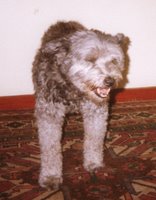
2006, 1994, 1982, 1970, 1958, 1946, 1934, 1922 … all of these are Dog years. This has had an enormous impact on my life. I was born in 1970, my mother in 1946, and her mother in 1922. My whole life, I have been surrounded and supported by the tightly woven highly-strung realities from which Dogs construct their worlds. It’s impossible for me to imagine any other way of being, than to be treading water, balancing on the barrel of this spinning planet, juggling the complex network of relationships and associations, with the parameters, possibilities and variables constantly shifting so that I have to adjust, and re-adjust to the changing demands upon me. I am the only constant, but I myself am not an entirely stable force, so I play an ongoing starring role in the dance of my life. This means I must necessarily step outside myself from time to time – frequently, as it happens, and take a look from various vantage points around the constellation of my universe. I cannot assume, no matter how well I profess to know myself, that I will remain the same, anymore than I can assume that any one variable within the myriad mix of elements within my crazy quilt kaleidoscope is certain for longer than a moment.
And really – what better way to be? It means that Life is never boring!
All the Dogs I know are happiest when we’re working. The most-blessed Dogs are those who love most of what we do. These are the days when our long-term goals are appearing on the horizon, due to our ongoing efforts and concentration of our energies. These are the days when what we see in our mind’s eye begins to take form in our worlds. These are the days when we dodge every obstacle that pops onto our path or engage with those obstacles as challenges that simply serve to make our lives more interesting. Dogs always prefer optimism.
It’s no accident that one of the story books my mother most loved to read me when I was a toddler is about the little red caboose that conquers its challenges with the steady mantra “I think I can, I think I can!” Who wants to be up front, big-noting oneself and grabbing all the attention? Dogs know how to bring up the rear with aplomb, barking and snapping as bark and snap we must, and basking afterwards with a glowing sense of self-satisfaction in a job well done.
Most Dogs are self-motivated creatures, well-able to see what is needed in their worlds, and who begin to shepherd all the necessary elements into a cohesive flock, so that creation can begin, barking loudly, wagging their tails, panting for breath and scampering madly for the sheer joy of being part of that wonderful process.
The cursed Dog is she who doggedly continues to do what must be done simply for the fact that it must be done in order that the whole does not topple over and crush her, even while she begs secretly to be crushed so that she need not continue to do these things that are quelling her spirit and martyring her possibility of discovering joy in Life. Dark periods in a Dog’s life are filled with a corrosive and dangerous despair usually brought on by overwhelm or a heavy constellation of bad circumstances. It takes a great deal to bring down a Dog.
Note to reader: If a Dog in your world is suffering with this condition, you can do her an everlasting kindness to interrupt the flow by intercepting the loop of her self-destructive thoughts and actions with some kind of diversion that will jolt the unhappy Dog back into a new frenzy of positive action. Let her know how much you love and value her.
(c) Melina Magdalena (2006)
“…that’s a large part of what economics is – people arbitrarily, or as a matter of taste, assigning numerical values to non-numerical things. And then pretending that they haven’t just made the numbers up, which they have. Economics is like astrology in that sense, except that economics serves to justify the current power structure, and so it has a lot of fervent believers among the powerful.”
Red Mars, Kim Stanley Robinson , 1992, Voyager paperback, p.351-352
Dedicated to Benedict Cupid, my truly faithful and friendly canine companion, 1993-2005.With warm and loving thoughts also to the important Dog-Women in my life: my maternal grandmother, mother and niece.

2006, 1994, 1982, 1970, 1958, 1946, 1934, 1922 … all of these are Dog years. This has had an enormous impact on my life. I was born in 1970, my mother in 1946, and her mother in 1922. My whole life, I have been surrounded and supported by the tightly woven highly-strung realities from which Dogs construct their worlds. It’s impossible for me to imagine any other way of being, than to be treading water, balancing on the barrel of this spinning planet, juggling the complex network of relationships and associations, with the parameters, possibilities and variables constantly shifting so that I have to adjust, and re-adjust to the changing demands upon me. I am the only constant, but I myself am not an entirely stable force, so I play an ongoing starring role in the dance of my life. This means I must necessarily step outside myself from time to time – frequently, as it happens, and take a look from various vantage points around the constellation of my universe. I cannot assume, no matter how well I profess to know myself, that I will remain the same, anymore than I can assume that any one variable within the myriad mix of elements within my crazy quilt kaleidoscope is certain for longer than a moment.
And really – what better way to be? It means that Life is never boring!
All the Dogs I know are happiest when we’re working. The most-blessed Dogs are those who love most of what we do. These are the days when our long-term goals are appearing on the horizon, due to our ongoing efforts and concentration of our energies. These are the days when what we see in our mind’s eye begins to take form in our worlds. These are the days when we dodge every obstacle that pops onto our path or engage with those obstacles as challenges that simply serve to make our lives more interesting. Dogs always prefer optimism.
It’s no accident that one of the story books my mother most loved to read me when I was a toddler is about the little red caboose that conquers its challenges with the steady mantra “I think I can, I think I can!” Who wants to be up front, big-noting oneself and grabbing all the attention? Dogs know how to bring up the rear with aplomb, barking and snapping as bark and snap we must, and basking afterwards with a glowing sense of self-satisfaction in a job well done.
Most Dogs are self-motivated creatures, well-able to see what is needed in their worlds, and who begin to shepherd all the necessary elements into a cohesive flock, so that creation can begin, barking loudly, wagging their tails, panting for breath and scampering madly for the sheer joy of being part of that wonderful process.
The cursed Dog is she who doggedly continues to do what must be done simply for the fact that it must be done in order that the whole does not topple over and crush her, even while she begs secretly to be crushed so that she need not continue to do these things that are quelling her spirit and martyring her possibility of discovering joy in Life. Dark periods in a Dog’s life are filled with a corrosive and dangerous despair usually brought on by overwhelm or a heavy constellation of bad circumstances. It takes a great deal to bring down a Dog.
Note to reader: If a Dog in your world is suffering with this condition, you can do her an everlasting kindness to interrupt the flow by intercepting the loop of her self-destructive thoughts and actions with some kind of diversion that will jolt the unhappy Dog back into a new frenzy of positive action. Let her know how much you love and value her.
Saturday, December 09, 2006
no laughing matter
No laughing matter
(c) Melina Magdalena, 2006
Pauline Hanson ≠ Australian
Once again Pauline Hanson has raised her ugly head and opened her foul mouth to spew hatred and incite dissent on behalf of the common Australian. The ease and facility with which she links simple words into spectacularly hurtful slogans is frightening. Would that it could be put down to some linguistic malfunction on her part, but she is a native English speaker. Her words are reported with crystal clear accuracy, and they drip malevolently with the venom of the implied assent of the voiceless majority who fail to counter them.
By splashing Pauline Hanson’s hate messages around so carelessly, the media award them legitimacy they would otherwise lack. By broadcasting Pauline Hanson’s hate messages without any effort to present a balanced view, her hatred is given far more weight than it otherwise would be. Claims by other politicians that Pauline Hanson is not taken seriously constitute their collusion with her way of seeing the world. The media embrace Pauline Hanson as a celebrity and an underdog. She uses her status to deliberately undermine cultural diversity in Australia.
Pauline Hanson’s foul words constitute racial vilification. She should be prosecuted to the full extent of the law for spreading her hate messages around the globe. To continue to regard her work as harmless is to enable her white supremacist stance to insinuate itself into everyday Australian life, which is what advocates of multiculturalism have been working against for decades.
Pauline Hanson is by no means original in attacking the most vulnerable sectors of Australian society and singling them out with her vicious attacks. The connotations of dirt and disease have been collocated with Jews, Italians, Greeks, Arabs, Aboriginals, Chinese, Irish, Vietnamese and Islanders to name a few. As these groups have gained legitimacy and voice within Australian society, they have all demanded loudly that the racist attacks and verbal slurs against them cease. Why? Words hurt and cause deep damage to the psyche of the group so attacked that can take generations to mend. And until the insult has been acknowledged in a way that allows the pain to be recognised and named, no healing can even begin. Where do the African communities of Australia begin to acknowledge the assaults upon their members?
As human beings, regardless of our race or ethnicity, we come into this world with nothing and we leave this world with nothing. Whatever we achieve and create in between the time of our birth and the time of our death is incidental, except to those who continue to live in the world that through our life’s work, we have helped to create. I do not want to leave a world in which the legacy of Pauline Hanson’s hate messages overrides the work I continue to do, along with many other Australians, to create a world in which people of diverse races, religions and cultures co-exist harmoniously.
(c) Melina Magdalena, 2006
Pauline Hanson ≠ Australian
Once again Pauline Hanson has raised her ugly head and opened her foul mouth to spew hatred and incite dissent on behalf of the common Australian. The ease and facility with which she links simple words into spectacularly hurtful slogans is frightening. Would that it could be put down to some linguistic malfunction on her part, but she is a native English speaker. Her words are reported with crystal clear accuracy, and they drip malevolently with the venom of the implied assent of the voiceless majority who fail to counter them.
By splashing Pauline Hanson’s hate messages around so carelessly, the media award them legitimacy they would otherwise lack. By broadcasting Pauline Hanson’s hate messages without any effort to present a balanced view, her hatred is given far more weight than it otherwise would be. Claims by other politicians that Pauline Hanson is not taken seriously constitute their collusion with her way of seeing the world. The media embrace Pauline Hanson as a celebrity and an underdog. She uses her status to deliberately undermine cultural diversity in Australia.
Pauline Hanson’s foul words constitute racial vilification. She should be prosecuted to the full extent of the law for spreading her hate messages around the globe. To continue to regard her work as harmless is to enable her white supremacist stance to insinuate itself into everyday Australian life, which is what advocates of multiculturalism have been working against for decades.
Pauline Hanson is by no means original in attacking the most vulnerable sectors of Australian society and singling them out with her vicious attacks. The connotations of dirt and disease have been collocated with Jews, Italians, Greeks, Arabs, Aboriginals, Chinese, Irish, Vietnamese and Islanders to name a few. As these groups have gained legitimacy and voice within Australian society, they have all demanded loudly that the racist attacks and verbal slurs against them cease. Why? Words hurt and cause deep damage to the psyche of the group so attacked that can take generations to mend. And until the insult has been acknowledged in a way that allows the pain to be recognised and named, no healing can even begin. Where do the African communities of Australia begin to acknowledge the assaults upon their members?
As human beings, regardless of our race or ethnicity, we come into this world with nothing and we leave this world with nothing. Whatever we achieve and create in between the time of our birth and the time of our death is incidental, except to those who continue to live in the world that through our life’s work, we have helped to create. I do not want to leave a world in which the legacy of Pauline Hanson’s hate messages overrides the work I continue to do, along with many other Australians, to create a world in which people of diverse races, religions and cultures co-exist harmoniously.
Subscribe to:
Posts (Atom)